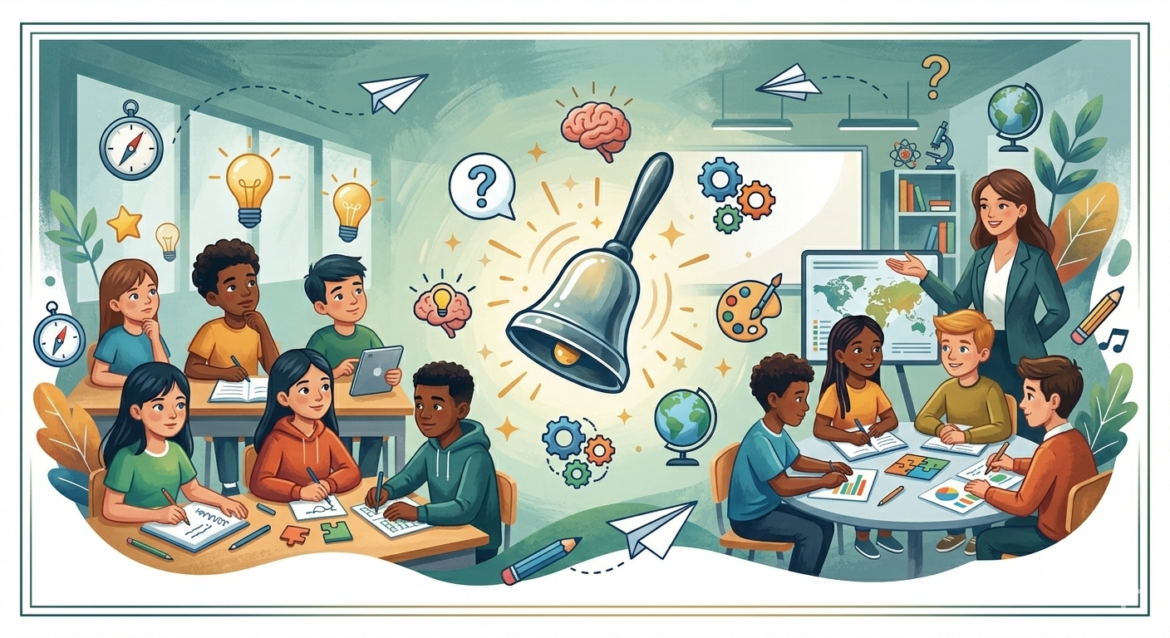
You know the scene. The bell rings. Half your students are still mentally scrolling TikTok, replaying a conversation from the hallway, or staring blankly at the ceiling. You’ve got maybe 90 seconds before their attention splinters entirely.
Welcome to teaching in the attention economy.
The Attention Economy Has Entered the Building
Economists Herbert Simon and Michael Goldhaber coined the term “attention economy” decades ago, but teachers are living it every single day. The idea is simple: attention is a finite, valuable resource, and every app, notification, and social platform is engineered to capture as much of it as possible.
The result? What researcher Gloria Mark at UC Irvine calls “attention fragmentation.” Her studies show that it now takes an average of 23 minutes and 15 seconds to fully regain focus after an interruption. For teenagers who have never known a world without smartphones, the baseline for sustained focus may be even shorter.
The classroom is fighting an arms race it didn’t start. But here’s the good news: cognitive science gives teachers powerful tools to win the first five minutes.
Why Bellringers Work: The Neuroscience
A well-designed bellringer isn’t just a time-filler. It’s a neurological on-ramp.
1. Priming the Brain Cognitive priming (Tulving & Schacter, 1990) shows that exposure to a stimulus increases sensitivity to related stimuli. A short, curiosity-provoking prompt literally prepares the brain to receive new content.
2. The Spacing Effect and Retrieval Practice The Learning Scientists (learningscientists.org) consistently highlight retrieval practice as one of the most evidence-backed strategies in education. A daily bellringer that asks students to recall prior content strengthens long-term memory consolidation more than re-reading notes ever could.
3. Dopamine and Novelty Neuroscientist Wolfram Schultz’s work on dopamine reward circuits shows that novel, surprising, or game-like stimuli trigger dopamine release, which is associated with motivation and focus. If your bellringer is slightly unexpected or interactive, you’re working with the brain’s chemistry, not against it.
4. Reducing Cognitive Load at the Transition John Sweller’s Cognitive Load Theory tells us transitions (hallway to classroom) are cognitively expensive. A structured, predictable low-stakes task at entry reduces extraneous cognitive load and redirects working memory toward learning.
The Warehouse: Five Micro-Learning Bellringers
Each bellringer below takes five minutes or less to set up, is designed to capture attention immediately, and connects to brain science.
1. “One Word Wonder”
Tool: Curipod | Setup time: 2 minutes
Create a Curipod slide with a single image and the prompt: “What one word comes to mind when you see this?” Students respond on their devices and watch a live word cloud populate on the screen. The visual movement and peer responses are magnetic.
Why it works: Social comparison and novelty trigger dopamine. Real-time anonymized responses reduce anxiety and increase participation across all learners.
Tip: Use images that loosely connect to your lesson’s essential question without giving it away.
2. “Spot the Error” Slide
Tool: Canva Magic Design | Setup time: 3 minutes
Use Canva’s AI-powered Magic Design to generate a visually rich infographic on yesterday’s topic, then manually introduce one or two factual errors. Project it as students walk in. The first one to spot and explain the error wins a small incentive.
Why it works: Activates retrieval practice and error detection, which research links to deeper encoding (Butler & Roediger, 2008). Competitive framing engages the reward system.
3. “Two Truths and a Misconception” Poll
Tool: Curipod or Mentimeter | Setup time: 3 minutes
Post three statements about the upcoming or previous unit. Two are true; one is a common misconception. Students vote in real time.
Why it works: Directly targets and disrupts misconceptions before they compound. Research by Manu Kapur on “productive failure” shows that confronting incorrect ideas before instruction improves learning outcomes.
4. The 60-Second Silent Sketch
Tool: Paper, whiteboard, or Google Slides | Setup time: 1 minute
Display a vocabulary word, concept, or quote on the board. Students have 60 seconds to sketch what it means, no words allowed. Share two or three sketches anonymously via phone camera.
Why it works: Dual coding theory (Paivio, 1971) tells us that combining verbal and visual representations strengthens memory. The sketch also externalizes thinking, helping students self-assess what they actually know.
5. “This or That” Visual Debate
Tool: Canva or PowerPoint | Setup time: 2 minutes
Create a simple slide with two contrasting images or ideas side by side (or use one of these Canva templates). Students physically move to one side of the room (or respond digitally) to declare their choice, then defend it in 10 words or less to a neighbor.
Why it works: Physical movement boosts alertness via cerebellar-cortical activation. The brief verbal justification activates elaborative encoding, which deepens understanding (Craik & Lockhart, 1972).
Getting Started: Your Three-Step Micro-Learning Launch Plan
- Pick one bellringer from the warehouse and try it tomorrow. Commit to the same one for a week so students develop a predictable routine (which itself reduces cognitive load).
- Build a five-minute buffer into your lesson plan at the start. Treat the bellringer as sacred instructional time, not optional warm-up.
- Rotate every two to three weeks. Novelty is a feature, not a bug. When the same format loses its spark, swap to a new one.
The Bottom Line
You can’t out-engineer TikTok’s algorithm. But you don’t have to. The research is clear: a structured, engaging, low-stakes entry task resets the cognitive clock, draws attention back into the room, and activates the neural pathways that make learning stick.
Five minutes at the start of class can transform the 45 that follow.
Want more strategies like this? Explore TCEA’s professional development library and connect with fellow educators in our member community.