Accidental learning, the kind of informal learning that takes place in online games, is now the rule. The risks of gameplay are low and the opportunities for collaboration high. Why not use online games like Fortnite to teach collaboration in schools? Let’s explore a topic that so often results in a battle royale: gaming in schools.

What is Fortnite?
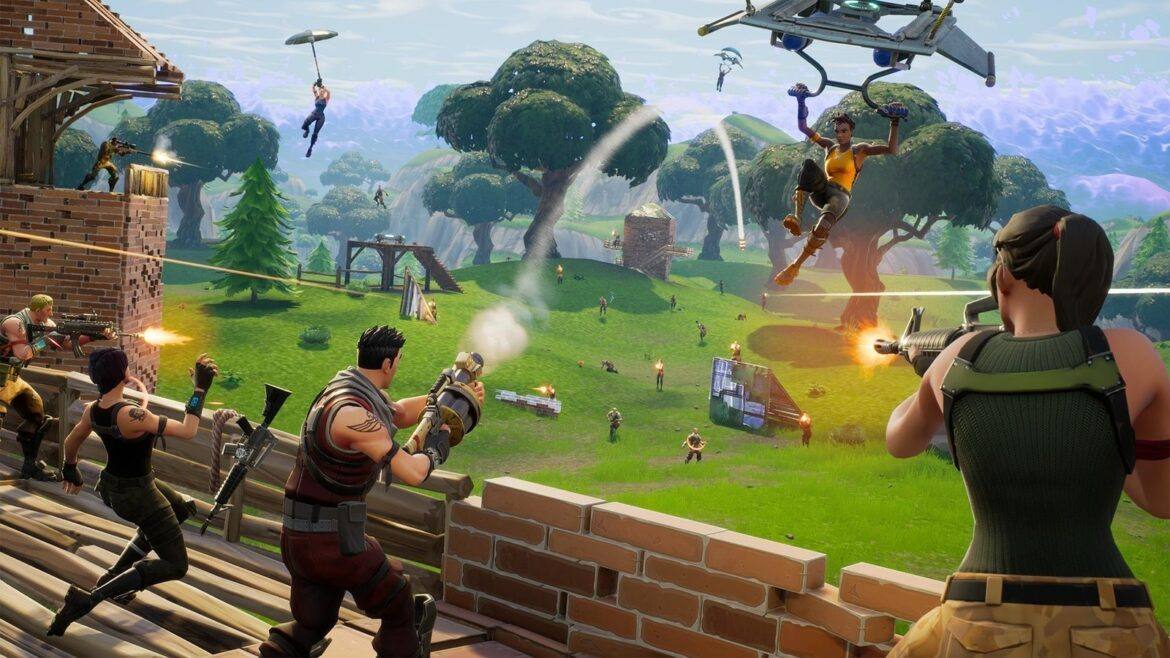
If you have missed the buzz about this online shooter game, Variety magazine sums it up in this way:
The wildly popular game “Fortnite Battle Royale,” an online shooter in which 100 players fight to the death on a cartoonish island arena, is entering the world of higher education. Ohio’s Ashland University announced this week that it’ll be the first college in the U.S. to offer scholarships specifically for the game.
Academic institutions offering scholarships for virtual skill development (learn more about eSports in Education). Is that the best approach to encouraging learning? Stephen Reid, an advocate of Minecraft: Education Edition for use in schools, says (Source):
- “Fortnite is not the kind of game we should be trying to use in education! I do not advocate Fortnite as #GamesBasedLearning.”
- “I worry that a lot of parents are letting their children play it because they see cartoon images.”
Reid challenges us all to ask an important question: “Do we want students learning collaboration as they hunt and kill others?” Dr. Harrison McCoy is in agreement with Reid and expressed dismay about promoting the use of Fortnite in school. Read the twitter conversation.
Special Feature: Dr. Harrison McCoy offered more extended reflections. Those will be included as a comment on this blog entry. Thank you, Dr. McCoy!
Meanwhile, others suggest there are real benefits to using games for learning.
Learning from Failure?
In 2006, I blogged about how John Seelye Brown described accidental learning in this way:
It’s learning to be – a natural byproduct of adjusting to a new culture – as opposed to learning about. Where traditional learning is based on the execution of carefully graded challenges, accidental learning relies on failure. Virtual environments are safe platforms for trial and error. The chance of failure is high, but the cost is low and the lessons learned are immediate.
Brown points to the collaboration benefits as well.
When role-playing gamers team up to undertake a quest, they often need to attempt particularly difficult challenges repeatedly until they find a blend of skills, talents, and actions that allows them to succeed. This process brings about a profound shift in how they perceive and react to the world around them. They become more flexible in their thinking and more sensitive to social cues.
Students are often more engaged in online games than at school. Our collective fixation on high stakes assessments has distracted us from engaging learning. Research suggests we should focus on what works.
What Does the Research Say?
The research firm Demos discussed this phenomenon in 2007. The report, entitled “Their Space: Education for a Digital Generation,” remains relevant. The authors suggest that moral panic is normal. We experience it when coming in contact with new technology. Instead of hysteria, however, we should encourage learners to reflect on their burgeoning media literacy. That effort could happen at school. The authors also suggest blending collaborative projects into instruction.
Demos isn’t alone. In a 2018 publication, a leading university drew similar conclusions. Stanford experts suggested that games support robust learning practices. Those include teamwork, strategic thinking, spatial understanding, and imagination (Source: Stanford). A 2018 study asserts the following:
Researchers have found no evidence to support the theory that video games make players more violent.
Science Daily (2015) reported violent video games are not linked to aggression. In 2014, Ohio University found other results. Researchers found gamers, like non-gamers, had the same neural response to provocative images (Source). It is too easy to blame our creations, our tools and instruments, for our own failings. Gun violence has affected more than 187,000 students since Columbine. What steps should we take in schools?
Gaming in School?
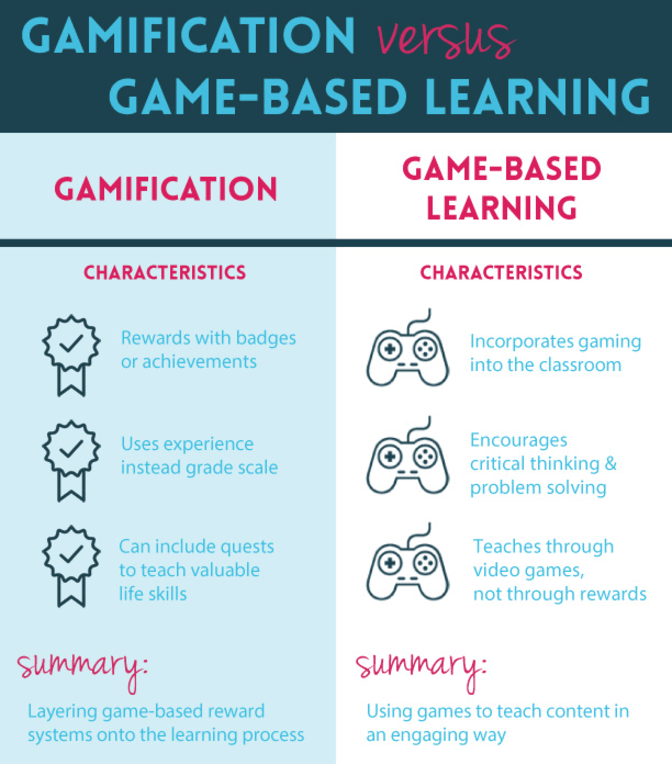
Decide first how to best engage your students. Should you rely on gamification of learning? Or game-based learning (GBL)? The former relies on using game design techniques. Gamifying makes the learning process more enjoyable and motivating (e.g. Classcraft).
The latter approach (GBL) relies on students playing games. Some examples include Minecraft: Education Edition and Cignition in class. Rather than adding badges and rewards, GBL uses video games to teach a subject or skill itself. Students learn to think in a critical manner, solving authentic problems for themselves.
Strategies you can adopt include:
- Align game types with learning outcomes
- Turn learning and knowledge into the clue
- Apply proven effective instructional strategies (e.g. Marzano’s Nine Strategies) to game design
- Guide the gamer to achieve goals
- Make the game immersive
- Provide enough challenges
“I’d like to see curriculum that offers a set of problems with a very good mechanic to solve them. [it should be] connected to social activities and participation spaces in and out of school,” says John Paul Gee. This allows students to “be proactive and take it further, learn collaboratively, and even learn to design.”
Ready to Adopt GBL?
Before jumping to adopt game-based learning based on Fortnite, first inventory your biases. Mine are easy. I’ve been a gamer since age thirteen. My son plays Fortnite, narrowcasting his gameplay via Twitch. I see little evidence of game violence manifesting in our lives. Set boundaries, craft a class contract, and assess participation.
Second, ask yourself, “Is the design of a game easy to adapt to learning objectives?” In the case of Fortnite, game design may not be overcome due to the amount of peer slaying that is central to play. Rely on game engines that can be adapted to learning objectives.
Third, decide “How have you involved stakeholders (parents, administrators) in the curriculum development process?” Without their involvement and their support, you are setting yourself up for failure. Brave educators have adopted game-based learning before, but society often expresses itself in schools. For some communities, game-based learning has arrived. For others, not so much. Make sure your enthusiasm doesn’t result in a battle royale in your school.
Have an Opinion?
I would love to hear other opinions on this issue. Share your professional remarks in the comments or link to your blogged remarks.




 “What could I create that would make this more helpful to viewers?” I asked in my early attempts at crafting an

 Mix up learning for your students. Create engaging and relevant learning experiences for students with

 In a
In a