
Meeting with a parent can happen for all kinds of reasons. Maybe a student is struggling academically. Maybe there has been a behavior concern. Maybe a parent has questions, or you simply need to check in.
Some conversations feel easy. Others may have you thinking through every possible way the meeting could go before it even starts. What do I say? How do I bring up a concern without putting a parent on the defensive? What if the conversation gets uncomfortable?
Parent meetings do not have to feel intimidating. With a little preparation and a few communication strategies, you can make these conversations more productive, positive, and focused on what matters most, which is helping the student succeed.
What Is Your Biggest Parent Meeting Challenge?
Take a quick mental vote. Which part of meeting with parents is hardest for you?
- Sharing concerns about academics
- Discussing behavior
- Talking with an upset parent
- Keeping the conversation on track
- Finding the right words
- Managing a short meeting
Keep your answer in mind as you read. There is a good chance one of the strategies below can make that part of the conversation a little easier.
Start With a Plan
It is easy to collect every test, assignment, reading level, behavior note, and data point you have about a student. The problem? You may only have 10 or 15 minutes to talk.
Instead of trying to cover everything, identify the most important information you want the family to leave knowing.
Before each conference, jot down:
- One strength you want to celebrate
- One or two areas you want to discuss
- A specific example or piece of student work
- One question you want to ask the parent or caregiver
- A possible next step
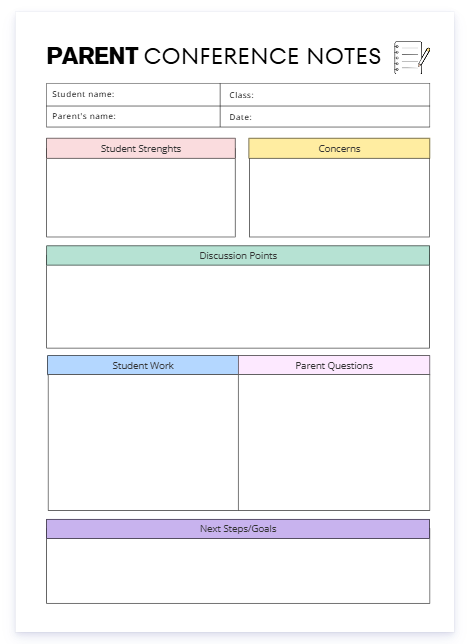
Think of this as your conference roadmap. It can help you stay focused without making the conversation feel scripted. Check out the Parent Conference Notes Planner template that can be customized for your parent meeting.
Begin With Something Specific and Positive
Starting with a genuine strength can set the tone for the conversation. Skip vague comments such as, “She’s doing great.” Offer something more meaningful. For example, say, “Maria has become much more confident about sharing her thinking during math.” Specific comments show families that you know their child as a person, not simply as a name in your gradebook.
However, do not use a positive comment simply to soften the blow before immediately delivering a long list of problems. Parents can usually tell when a compliment is just the first layer of a feedback sandwich. Make the positive observation real.
Bring Evidence to the Conversation
When discussing an academic or behavioral concern, examples can make the conversation clearer. Instead of saying, “He struggles with writing.” Try saying, “I’ve noticed that getting started is the hardest part for him. On his last three writing assignments, he had strong ideas when we talked, but he only wrote one or two sentences independently.” That gives the family something concrete to understand.
Student work, assessment results, observation notes, and other classroom examples can help keep the conversation focused on what you are seeing rather than on labels or assumptions.
Ask Questions and Listen
A conference should not feel like a teacher presentation with a parent sitting in the audience. Give the family time to talk.
You might ask:
- What does homework look like at home?
- Has your child mentioned this class or subject recently?
- What helps when your child becomes frustrated?
- Is there anything you are noticing at home that would be helpful for me to know?
- What is one thing you would like your child to feel more confident about this year?
Then listen. Really listen. You may learn something that changes how you see the situation. Active listening can include paraphrasing what you heard, asking clarifying questions, and avoiding the temptation to jump immediately into advice or solutions. Sometimes a parent needs to know that you understand the concern before they are ready to talk about what happens next.
Try It: What Would You Say?
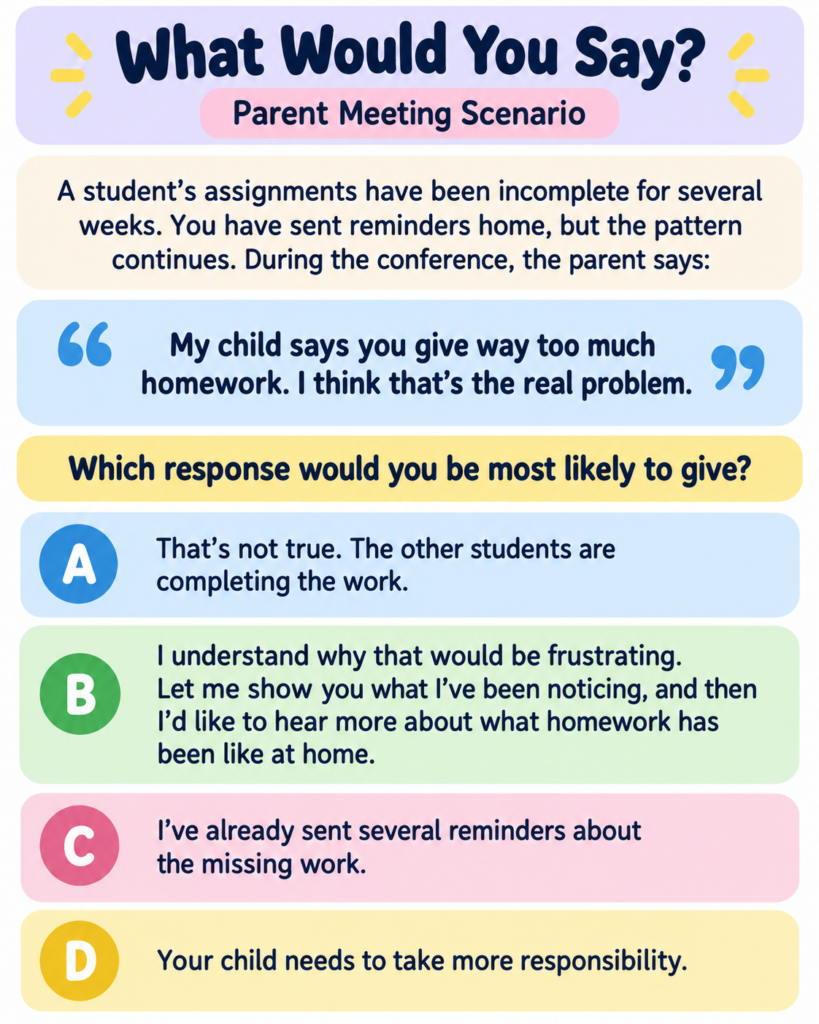
B keeps the conversation open. It acknowledges the parent’s concern without agreeing or disagreeing before you have heard more. It also gives you an opportunity to share the information you have while inviting the parent to provide additional context. The goal is not to “win” the conversation. The goal is to better understand the problem and decide what both school and home can do next.
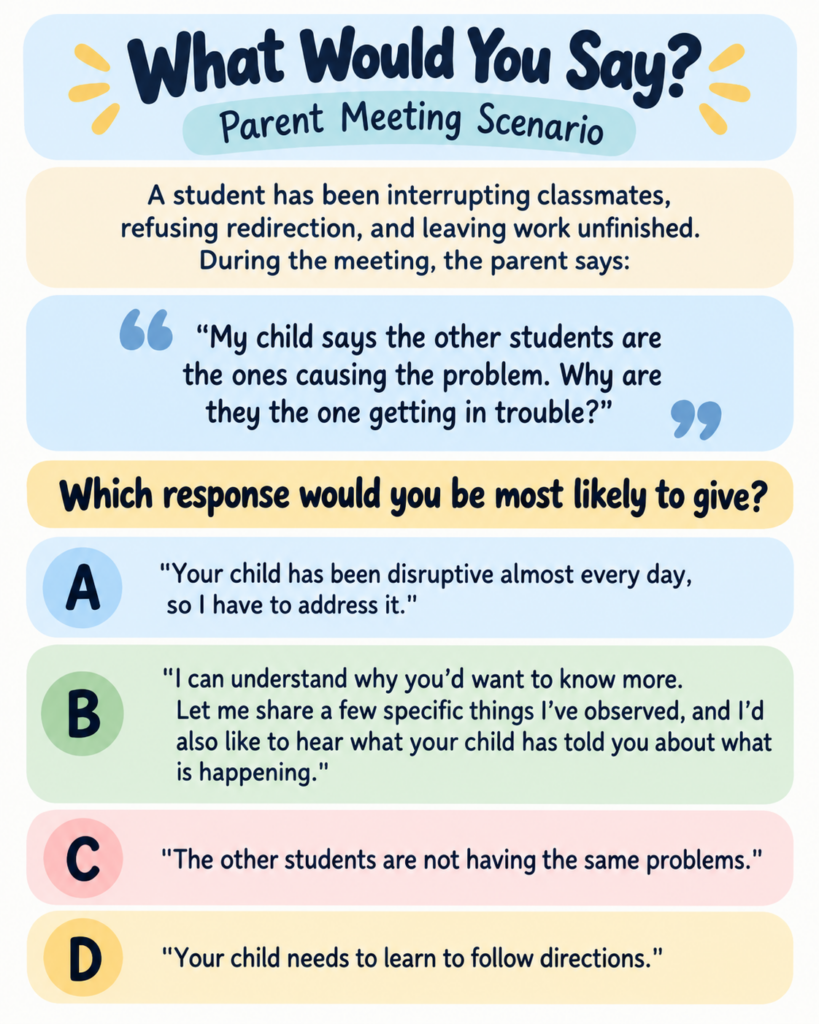
B helps keep the conversation focused and open. It acknowledges the parent’s concern, gives you a chance to share specific observations, and invites the family to provide more information. From there, you can describe what you have seen without labeling the student. Specific examples give everyone something concrete to discuss. They can also help you move the conversation toward the next question: What support might help the student be more successful?
Focus on What You Have Observed
Difficult conversations can become even more difficult when we move from describing a behavior to describing a child.
Compare these two statements:
- “Liam is disrespectful.”
- “During independent work this week, Liam called out several times while classmates were speaking. When I redirected him, he continued talking.”
The second version focuses on observable behavior. That matters. Describing what happened gives you and the family something specific to discuss. Labels can quickly put someone on the defensive and may not accurately describe what is happening.
Keep Bringing the Conversation Back to the Student
Sometimes conferences wander. One minute you are discussing missing assignments, and five minutes later you are talking about last year’s teacher, siblings, district policies, and something that happened in second grade.
When that happens, gently bring the conversation back to the shared goal. You might say, “I want to make sure we leave with a plan that will help Jordan. Could we talk about what might make completing assignments easier this week?”
That small reset can be useful when time is short.
Make the Next Step Manageable
Avoid ending a conference with a giant list of things everyone should improve. Choose one or two realistic next steps. For example:
- Teacher: Provide a visual checklist for long assignments.
- Student: Show the checklist to the teacher before leaving class.
- Family: Check the learning management system together on Tuesday and Thursday.
A small plan that everyone understands is often more useful than 10 suggestions nobody remembers by the time they reach the parking lot.
When a Conversation Gets Difficult
Even with preparation, some conferences will be uncomfortable. If a parent becomes frustrated, try to slow the conversation down rather than matching the emotion in the room. Let the parents know that you are concerned too and understand what they’re saying.
If the conversation moves beyond what you can appropriately address, follow your campus procedures and involve an administrator, counselor, or other staff member when needed. You do not have to solve every issue during one conference.
Follow Up
A quick follow-up can make a big difference. If you agreed to try a new strategy, check back with the family after a week or two. The message does not have to be long. A small message tells families that the conference was not simply an item checked off the calendar. You meant what you said, and you are continuing to work together.
Quick Check Before Your Next Conference
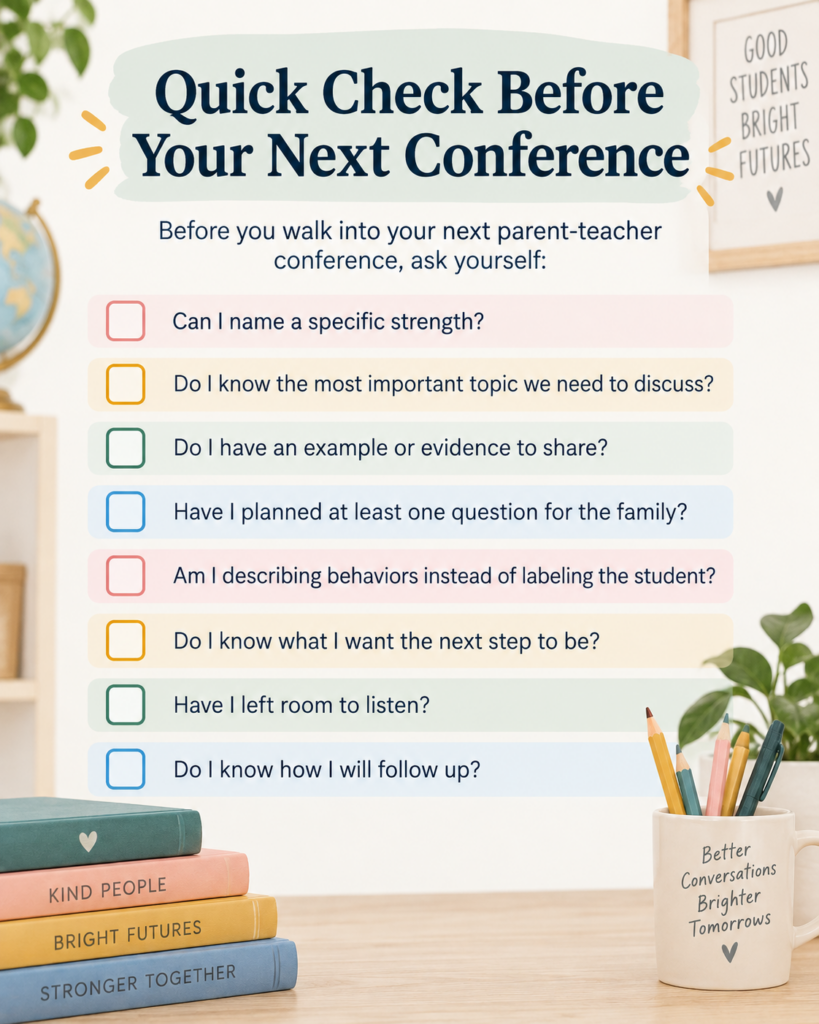
Before you walk into your next parent-teacher conference, ask yourself:
- Can I name a specific strength?
- Do I know the most important topic we need to discuss?
- Do I have an example or evidence to share?
- Have I planned at least one question for the family?
- Am I describing behaviors instead of labeling the student?
- Do I know what I want the next step to be?
- Have I left room to listen?
- Do I know how I will follow up?
You do not need a perfectly scripted conference. In fact, the best conversations probably will not follow a script at all. Prepare what matters, listen carefully, stay focused on the student, and leave with one clear next step.
And if you have ever finished a conference, closed the door, and immediately thought that you could have worded something better, then welcome to teaching. The good news is that every conversation gives us a chance to get a little better at the next one.
