One of the problems that plagued me as a young math student? Getting the right answer without understanding how I got there. It’s like making an intuitive leap instead of depending on a step-by-step strategy. As you might guess, math isn’t my strongest subject. Rather than see it as a personal failing, I’m trying to find a step by step process that makes sense to me. Gen AI, as you know, can produce polished steps faster than most of us can find the answer key. For students, this can make learning something new even trickier.
Become a CyberSmart Educator with a practical, self-paced course designed to help you protect sensitive data, secure accounts and devices, recognize social engineering attacks, respond appropriately to cybersecurity incidents, and build stronger digital safety habits. Or, learn AI Essentials for Educators. Each course is $49 at full price or $34 at the discounted rate. Register online through TCEA Courses.
A Problem To Solve
Picture a seventh grader working through a discount problem. The jacket costs sixty dollars, the store is taking thirty percent off. The student writes down forty-two dollars. The answer is correct. Then you ask, “Why did you multiply by 0.7 instead of 0.3?” and the whole thing falls apart. The student may have followed a pattern, copied a process, or got help from somewhere, but never really owned the idea. Identifying patterns is what I do in writing as a shortcut to avoid thinking. Do that when you are writing or trying to solve a math problem, you really miss out on the critical thinking part of problem-solving.
And, unfortunately, that’s the most important part, isn’t it? Not whether the paper looks good, or whether the answer is clean, but rather, when the explanation makes sense to the learner. So how do you deal with that? I’d like to suggest the ACE Framework.
A Simple Routine
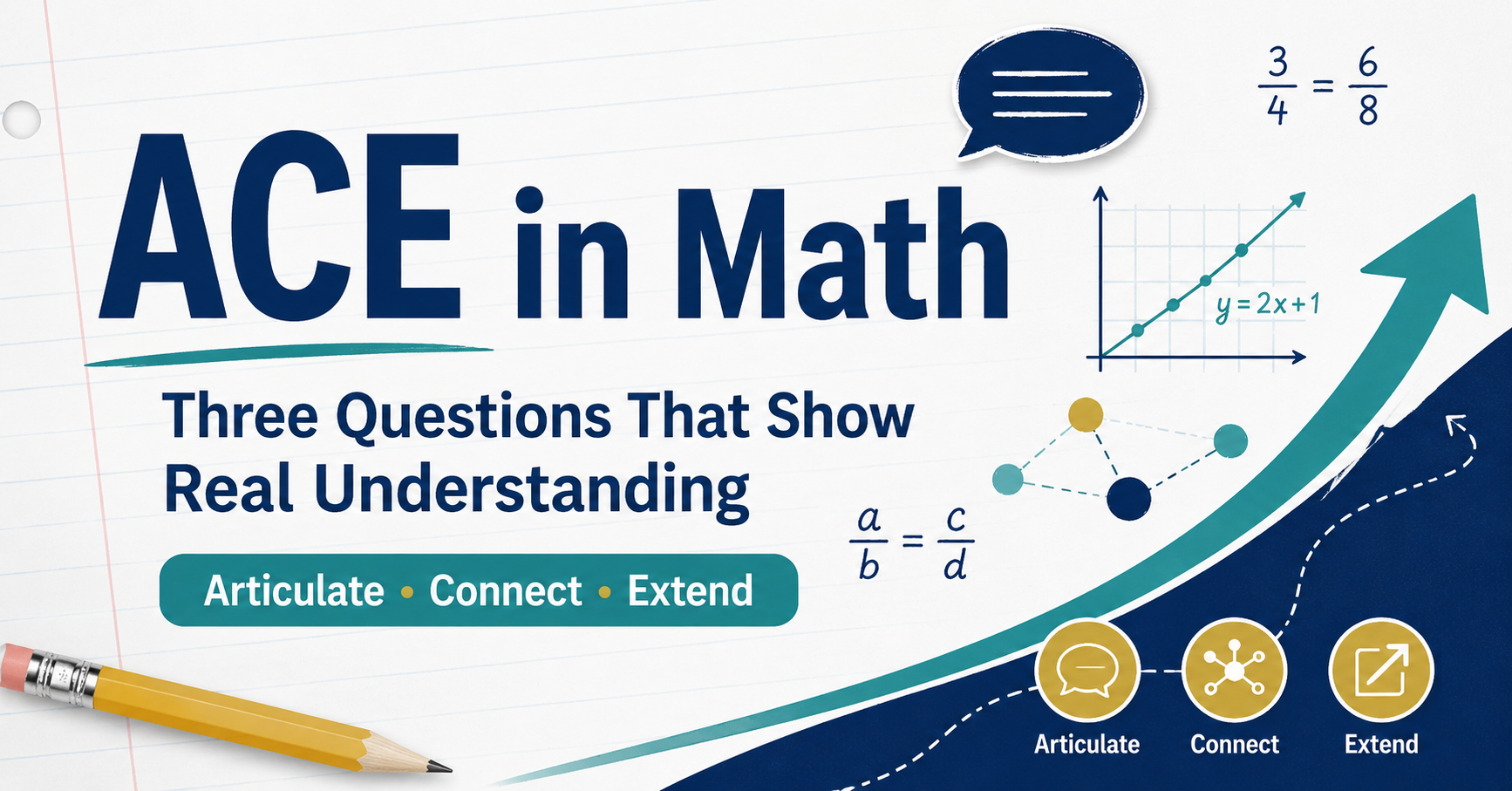
In the first post in this series, ACE It: Three Steps from Surface to Transfer Learning, I shared ACE as a simple routine for checking understanding. It stands for Articulate, Connect, and Extend. In math, ACE gives you three questions that can tell you a lot more than a completed worksheet.
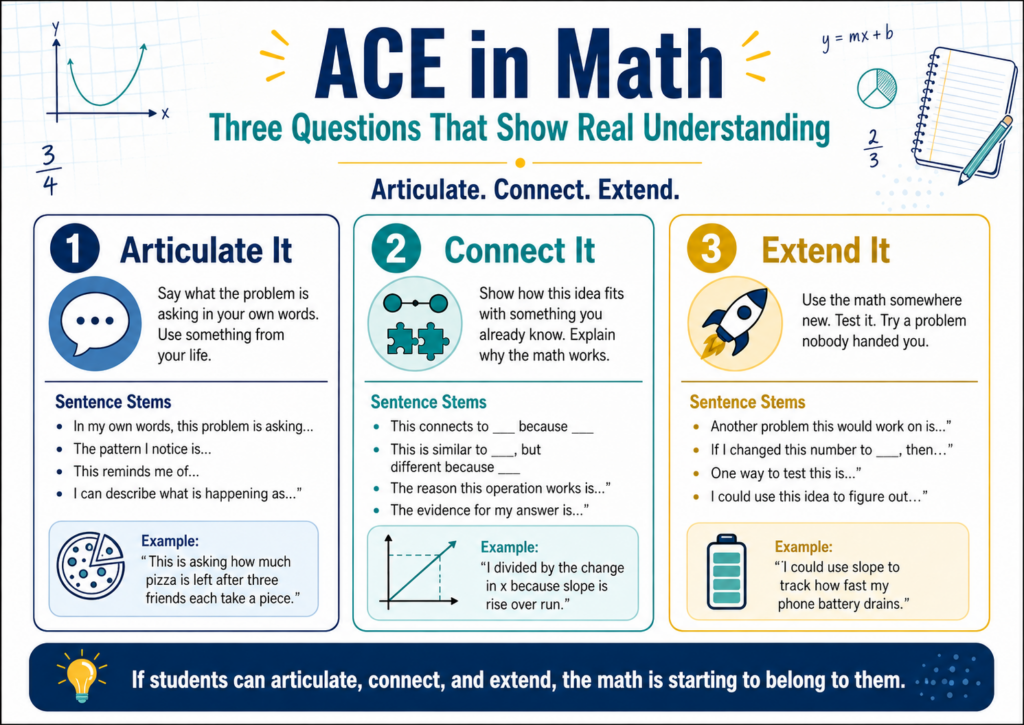
Articulate It
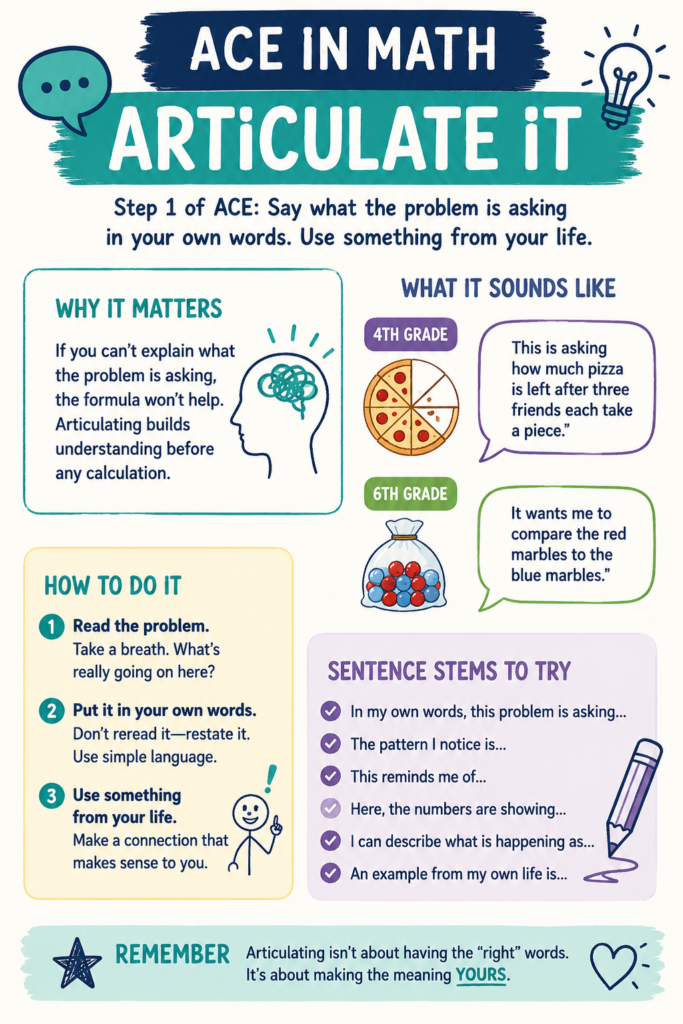
Say what the problem is asking in your own words. Use something from your life.
Before students start calculating, ask them to say what the problem is really asking. That sounds simple, but it is often where the trouble starts.
A fourth grader looking at a fraction problem might say, “This is asking how much pizza is left after three friends each take a piece.” A sixth grader working with ratios might say, “It wants me to compare the red marbles to the blue marbles.” The wording does not have to be perfect. In fact, I worry a little when it is too perfect. What you want is a student using ordinary language to show that the problem has meaning.
Try sentence stems like these:
- “In my own words, this problem is asking…”
- “The pattern I notice is…”
- “This reminds me of…”
- “Here, the numbers are showing…”
- “I can describe what is happening as…”
- “An example from my own life is…”
If students cannot restate the problem, the formula will not rescue them. They may still get through the worksheet, but the foundation is shaky. Articulate gives you a fast way to find that out before everyone is three steps into the wrong process.
Connect It
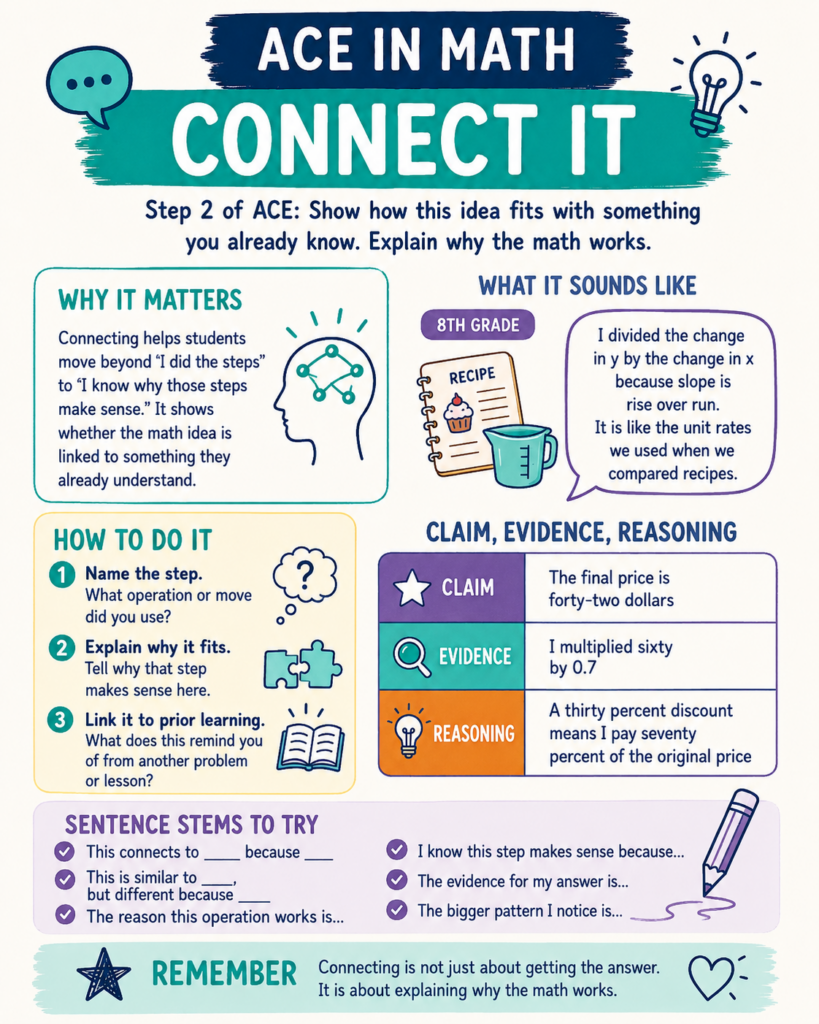
Show how this idea fits with something you already know. Explain why the math works.
Connect is where students move from “I did the steps” to “I know why those steps make sense.” For example, an eighth grader solving a slope problem might say, “I divided the change in y by the change in x because slope is rise over run. It is like the unit rates we used when we compared recipes.”
That explanation tells you something important. The student is not just naming a rule. She is linking a new problem to an older idea and explaining why the operation fits.
This is also where claim, evidence, and reasoning can show up naturally in math.
| Part | What It Sounds Like in Math |
|---|---|
| Claim | “The final price is forty-two dollars” |
| Evidence | “I multiplied sixty by 0.7” |
| Reasoning | “A thirty percent discount means I pay seventy percent of the original price” |
That reasoning line is the difference between doing math and reporting math. It is also the line that disappears when students rely too much on copied steps, online answer sites, or Gen AI output they do not understand.
Useful Connect stems include:
- “This connects to _ because _”
- “This is similar to , but different because ”
- “The reason this operation works is…”
- “I know this step makes sense because…”
- “The evidence for my answer is…”
- “The bigger pattern I notice is…”
When students connect, math starts to look less like a stack of disconnected chapters. Percent, ratio, slope, rate, and proportion begin to talk to one another. This is when deep learning begins to happen, as students make connections between ideas and information that previously was silo’d.
Extend It
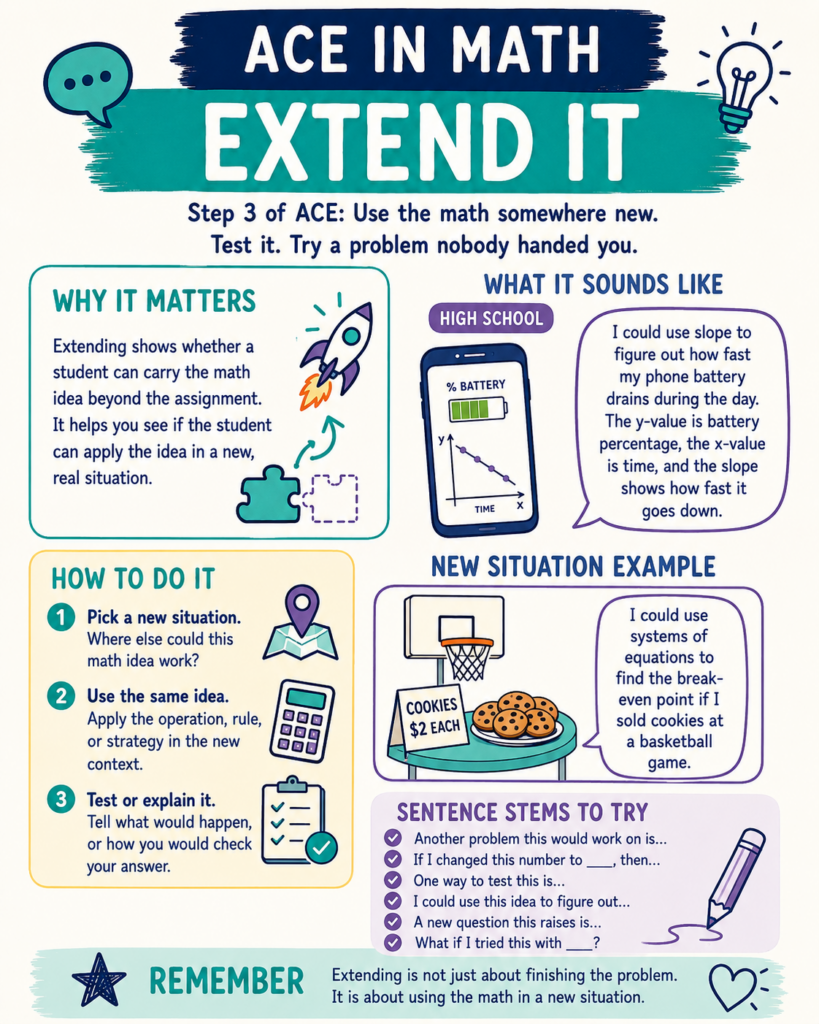
Use the math somewhere new. Test it. Try a problem nobody handed you.
Extend is where you find out whether the student can carry the idea beyond the assignment.
An algebra student might say, “I could use slope to figure out how fast my phone battery drains during the day. The y-value would be the battery percentage, the x-value would be time, and the slope would show how fast it is going down.” That may not be a polished mathematical explanation yet, but it is a real one. The student is taking the idea somewhere personal and testable.
A student studying systems of equations might say, “I could use this to figure out when I would break even selling cookies at a basketball game.” Now the math has a reason to exist. Cost, price, profit, and the point where two lines meet are no longer just items on a worksheet.
Try stems like these:
- “Another problem this would work on is…”
- “If I changed this number to _, then…”
- “One way to test this is…”
- “I could use this idea to figure out…”
- “A new question this raises is…”
- “What if I tried this with _?”
Extend is also where Gen AI assistance becomes easier to spot. A chatbot can explain slope. It can generate practice problems. What it cannot easily do is replace a student’s lived context, especially when you ask the student to explain it aloud and adjust the idea in real time.
What ACE Looks Like During Math Help
When a student gets stuck, I try not to begin by correcting the worksheet. I start with the question, “Tell me what this problem wants you to find.” That one question saves time because it tells you whether the student is struggling with computation, vocabulary, context, or the whole setup.
Here is a simple way to use ACE during conferring, tutoring, or homework help:
| ACE Step | Ask This | Listen For |
|---|---|---|
| Articulate | “What is this problem asking?” | The student can explain the situation in plain language |
| Connect | “Why did you use that operation?” | The student can give a reason, not just name a rule |
| Extend | “Can you make up a problem like this?” | The student can use the idea in a new situation |
For parents, this is useful because you do not have to reteach the entire math lesson at the kitchen table. You can ask three questions before checking the answer:
- “Tell me what this problem is asking in your own words”
- “Why did you do that step?”
- “Can you make up a problem like this about something we do at home?”
Those questions do not turn a parent into a math teacher, which is probably best for everyone involved. They do, however, make the student’s thinking visible. If the student can answer them, the math is probably sticking. If not, you know where to begin.
Did You Know? TCEA offers Effective Math courses in K-2, 3-5, 6-8, and 9-12 versions. Each course is self-paced and offers 12 CPE credit hours. These pair well with ACE when you want students to move beyond getting the answer and toward explaining the math.
The Quick Test
Pick one math problem your students worked on this week. Ask them to ACE it.
Can they explain what the problem is asking? Can they tell you why the operation fits? Can they create a new problem that uses the same idea?
If they can do all three, the math is probably theirs. If they stall on one, that is not a failure. It is a map. Now you know whether to help them name the problem, explain the reasoning, or transfer the idea somewhere new.
Here’s a quick reference guide to all the sentence stems mentioned in this blog entry, by the way:
Try ACE on one math problem this week and share what you noticed in the comments.
👤 Human-directed (Miguel Guhlin) · 🤖 Gen AI-assisted (Claude, ChatGPT)