
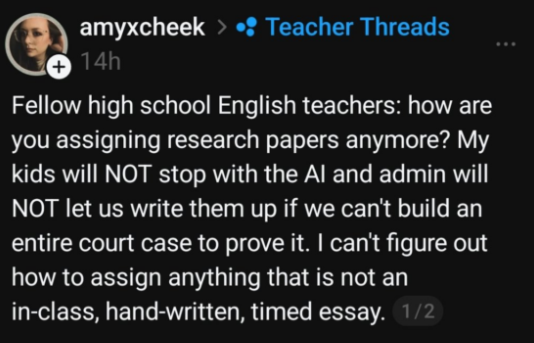
“Worthless.” That’s how one English teacher described her experience in teaching essay writing to students who had embraced Gen AI. “Even with wonderful, supportive administration, I can’t teach kids who won’t make the effort.” The problem is that students are side-stepping the cognitive work of reading, grappling with ideas through outlining, organizing, and writing. Gen AI short-circuits that process.
Solutions to Student AI Use
This is a tough challenge for many educators, from third grade to university level. As a result, everyone has a response, some of which have been tried in the classroom.
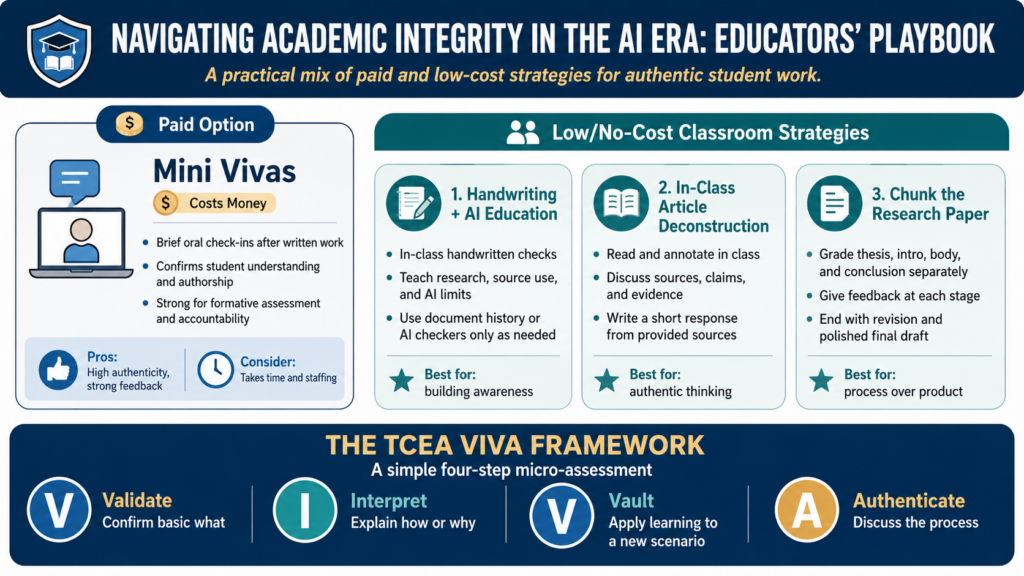
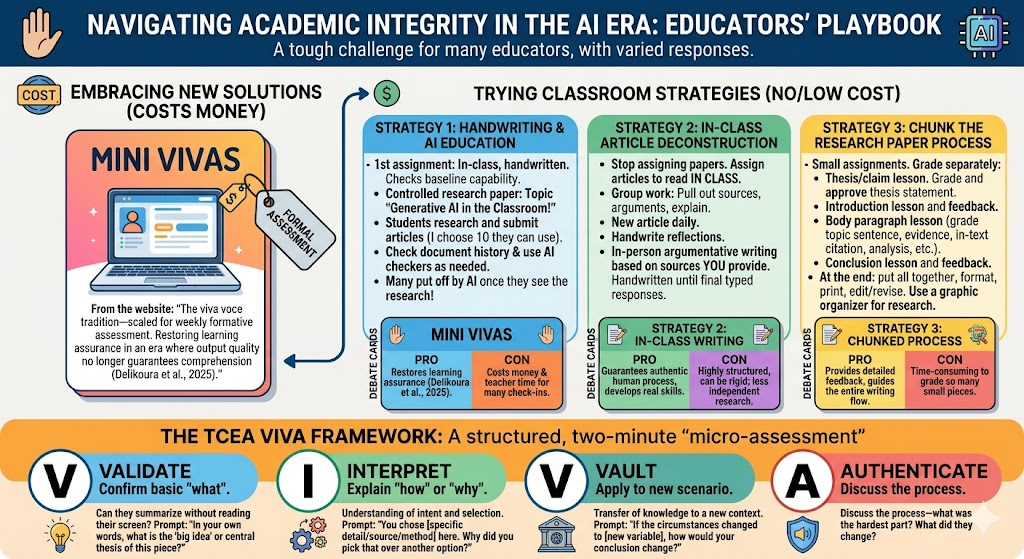
Some suggest embracing new solutions that cost money and combine tried and true approaches (e.g. viva voce), like this one:
MiniVivas: This is a well-thought out approach to bringing VIVAs to students. From the website: “The viva voce tradition—scaled for weekly formative assessment. Restoring learning assurance in an era where output quality no longer guarantees comprehension (Delikoura et al., 2025).” This solution relies on SayVeritas website, which is not free (see pricing).
Others have suggested the following:
- “First assignment is in class, handwritten- that gives me a sense of their capabilities. Before the independent research essay, we write a controlled research paper – topic is generative AI in the classroom! They learn to research and submit articles- I choose 10 of them that they can use in their paper. I check their document history and use AI checkers as needed. Many of them are put off by AI once they see the research!” (source)
- “Stop assigning research papers for them to write, and instead assign them research articles to read in class, and work together in groups to pull out the sources, the arguments, and explain it.
New article each day. Then, have them handwrite their reflections. Then, do in-person argumentative writing based on sources YOU provide and all handwritten until the very end when they can type up final responses.” (source) - “Chunk it, small assignments. Thesis statement or claim lesson: grade and approve thesis statement. Introduction lesson: student writes introduction, you provide feedback. How to write a body paragraph lesson (grade topic sentence, evidence, in-text citation, analysis, etc). Each body paragraph is graded separately. Then same for conclusion. At the end they put it all together, format, print, edit/revise. I also have them do a graphic organizer for their research.” (source)
How would you approach the problem? While you’re reflecting on that, I had to underscore one I stumbled across. Let’s review the problem scenario again that classroom teachers are struggling with.
A Problem Scenario
Consider this scenario:
A student slides a half-page of bullet points across the desk. “I read the article,” they say. You look it over. It could have come from anywhere. It probably came from ChatGPT or some free Chinese Gen AI tool that is free and powerful (e.g. Z.ai is one I found quite powerful). On quizzing the student, you realize they don’t understand sentences and concepts they didn’t craft.
If you think it’s not possible (who would think that today?), here’s a table outlining student-oriented prompts for using Z.ai to resolve common assignments. I’ve cut a few of the rows to keep it short.
| Assignment Category | What I Can Do (My Capability) | Student-Oriented Prompt (Copy & Paste) | Example Assignment |
|---|---|---|---|
| Essay & Research Writing | Brainstorm Ideas | Help me brainstorm three different thesis statements for an essay about the theme of ambition in Shakespeare’s “Macbeth.” | English Literature Essay |
| Create an Outline | Create a detailed 5-paragraph outline for an essay arguing that renewable energy is more economically viable than fossil fuels in the long term. | Environmental Science Paper | |
| Math & Science | Explain Concepts | Explain the process of photosynthesis like I’m a 14-year-old. Use an analogy to help me understand it. | Biology Homework |
| Step-by-Step Solutions | Show me the step-by-step solution to this algebra problem: 3(x + 2) = 5x – 7. Explain each step clearly. | Algebra Homework | |
| Research & Study Prep | Summarize Information | Summarize the main arguments of this article [paste text here] in three bullet points. | Current Events Presentation |
| Create Study Aids | Create a set of 10 flashcards (in a Q&A format) for my upcoming history test on the American Civil War. | History Test Prep | |
| Creative & Language | Generate Prompts | Give me five short story prompts in the fantasy genre that involve a magical map. | Creative Writing Assignment |
| Translate & Practice | How do you say “I would like to order a coffee with milk” in French? Can you break down the pronunciation for me? | French Homework |
With all this available support for free, cognitive offloading is easy (if not recommended). How can we close the loophole? Stefan Bauschard, one of my favorite education authors, shares an approach worthy of mention that can close the loophole.
A Solution
Debate cards close that loophole. This type of assignment may do a better job of proving whether a student actually read something. Any writing teacher or person that depends on writing as a way to make thinking visible must find a different approach. Why not try debate cards as a way to close the loophole Gen AI makes possible?
Stefan Bauschard, writing in Education Disrupted, makes the case that cards do something most assignments cannot. Here are four reasons to try them.
1. Cards Force Students to Actually Read
“How do I build a card?” a student might ask. To build a card, a student has to find the specific passage that supports a specific claim. They have to read closely enough to pick the two sentences that carry the argument. That judgment cannot be faked, and it cannot be delegated to a Gen AI tool without the whole exercise falling apart in a live round.
Here is what a finished card looks like on a climate change topic, aligned to NGSS MS-ESS3-5 (asking students to use evidence to support arguments about solutions to resource and environmental issues) and Texas TEKS Science 6.3(C) (use evidence to construct an explanation):
Cutting carbon emissions now prevents the worst climate outcomes later
Diffenbaugh, 24 — Noah Diffenbaugh, Professor of Earth System Science, Stanford University, Science, March 2024.
Scientists have documented that global temperatures have already risen 1.2 degrees Celsius above pre-industrial levels. Unchecked emissions could push warming past 2 degrees Celsius by 2050, triggering more frequent droughts, floods, and wildfires. Research shows that cutting emissions by 45 percent before 2030 keeps the worst outcomes within reach of prevention. Every year of delay narrows that window further.
Notice the tag is a claim, not a topic sentence. The bolded sentences are what a student reads aloud. The rest provides context if challenged. I sure wish someone had introduced me to these in middle school.
2. Cards Teach Students to Frame an Argument
“Can’t I just use this quote?” a student asks, pointing to a paragraph highlighted end to end.
The answer is no. The tag is the hard part.
A tag is a single sentence, written in the student’s own words, that states what the evidence proves. Not “this article talks about smartphones in schools.” More like: “Smartphone bans improve focus and reduce bullying without requiring new spending.” Two students reading the same article should be able to write different tags depending on the argument they are building. That is the point. The tag is where the student’s own thinking lives.
This aligns directly to Common Core ELA Standard CCSS.ELA-LITERACY.W.7.1 (write arguments to support claims with clear reasons and relevant evidence) and Texas TEKS ELA 7.5(H) (synthesize information from multiple sources to create new understanding).
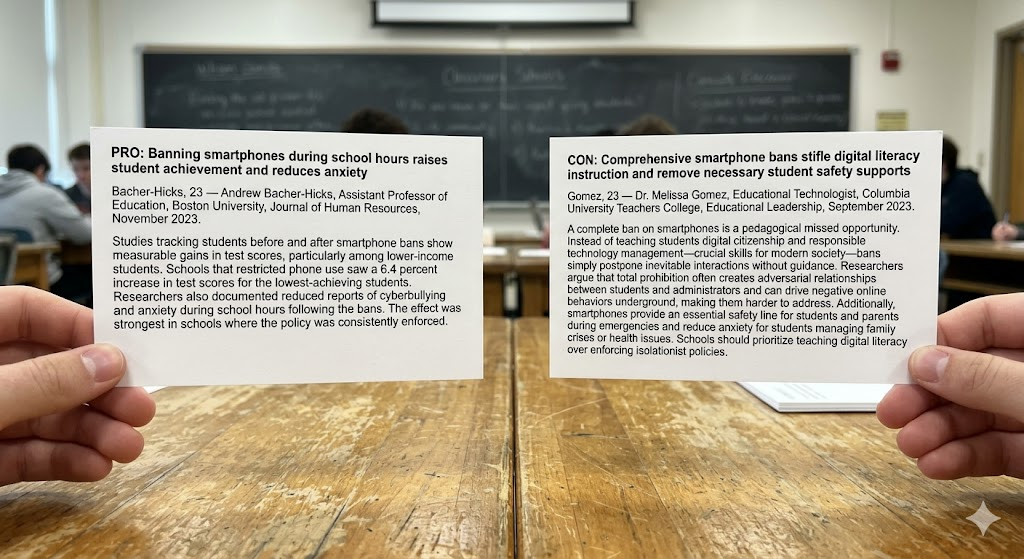
Here is a card on smartphone bans a seventh grader might build:
Banning smartphones during school hours raises student achievement and reduces anxiety
Bacher-Hicks, 23 — Andrew Bacher-Hicks, Assistant Professor of Education, Boston University, Journal of Human Resources, November 2023.
Studies tracking students before and after smartphone bans show measurable gains in test scores, particularly among lower-income students. Schools that restricted phone use saw a 6.4 percent increase in test scores for the lowest-achieving students. Researchers also documented reduced reports of cyberbullying and anxiety during school hours following the bans. The effect was strongest in schools where the policy was consistently enforced.
3. Cards Make Students Engage With the Other Side
“But my evidence is right,” a student says, arms crossed, after an opponent reads a card that directly contradicts theirs.
That moment is the lesson.
In a debate round, your opponent has cards too. You have to respond to their best arguments, not assert your opinion louder. Bauschard notes that this is the opposite of how most people encounter disagreement online. Students learn to ask: Does that tag overstate what the evidence says? Is the source outdated? What did that card leave out?
This is exactly what Common Core ELA Standard CCSS.ELA-LITERACY.SL.8.4 calls for (present claims and findings, using appropriate eye contact, adequate volume, and clear pronunciation) and Texas TEKS ELA 8.5(G) (evaluate the relevance and reliability of sources).
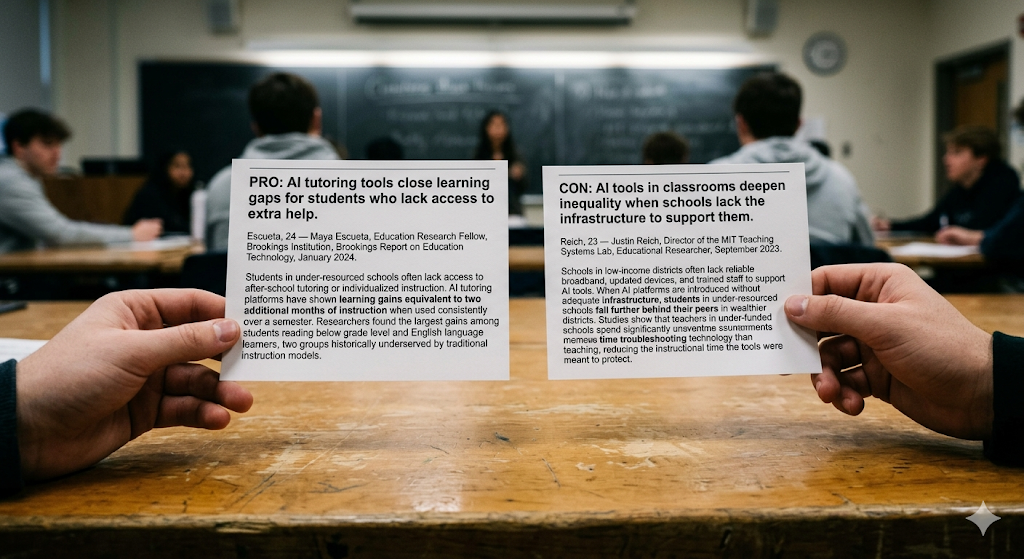
Here are two cards on AI in K-12 schools that could face off in a round. A student defending the pro side might read this:
AI tutoring tools close learning gaps for students who lack access to extra help
Escueta, 24 — Maya Escueta, Education Research Fellow, Brookings Institution, Brookings Report on Education Technology, January 2024.
Students in under-resourced schools often lack access to after-school tutoring or individualized instruction. AI tutoring platforms have shown learning gains equivalent to two additional months of instruction when used consistently over a semester. Researchers found the largest gains among students reading below grade level and English language learners, two groups historically underserved by traditional instruction models.
A student on the opposing side might counter with this:
AI tools in classrooms deepen inequality when schools lack the infrastructure to support them
Reich, 23 — Justin Reich, Director of the MIT Teaching Systems Lab, Educational Researcher, September 2023.
Schools in low-income districts often lack reliable broadband, updated devices, and trained staff to support AI tools. When AI platforms are introduced without adequate infrastructure, students in under-resourced schools fall further behind their peers in wealthier districts. Studies show that teachers in under-funded schools spend significantly more time troubleshooting technology than teaching, reducing the instructional time the tools were meant to protect.
Placed side by side, these two cards have the potential to show students that smart people with good evidence can reach opposite conclusions from the same problem. That’s a life lesson, a harder lesson than any worksheet or casual writing assignment can deliver.
4. Cards Transfer Across Every Subject
“Do we have to do this in science too?” a student asks, only half joking.
Yes. That is the point.
A history class can card primary sources. A science class can card research abstracts. An English class can card news reporting. The format works anywhere students argue with evidence rather than opinion. Here is a card on the Iran War of 2026, built for an eighth grade social studies class and aligned to Texas TEKS Social Studies 8.29(A) (evaluate the impact of events on individuals and communities) and Common Core RH.6-8.8 (distinguish among fact, opinion, and reasoned judgment in a text):
AI-generated images in the Iran conflict made it harder for civilians to know what was real
Alimardani, 26 — Mahsa Alimardani, Staff Writer, The Atlantic, March 13, 2026.
During the early weeks of the Iran conflict, AI-generated images spread across social media platforms purporting to show military equipment staged inside civilian schools. Fact-checkers confirmed the images were fabricated, but corrections arrived after the original posts had already reached millions of viewers. Researchers studying the conflict concluded that the volume of AI-generated content made it functionally impossible for most civilians to distinguish real photographs from fabrications in real time. The result was a public that could no longer trust visual evidence from an active war zone.
This card works in a social studies discussion about media literacy, propaganda, or the ethics of AI in warfare. It also connects to a current event students are likely already talking about.
Where to Start
| Starting Point | What to Do |
|---|---|
| Students new to debate | Provide a finished card, remove the tag, ask students to write their own |
| Students ready to build cards | Give two articles on one topic and ask for three cards each |
| Students who need a challenge | Ask them to find the weak card in a set of ten and explain why |
Be sure to read Stefan Bauschard’s “Debate Cards: Teaching Students to Think With Evidence” in Education Disrupted (March 13, 2026).
👤 Human-directed (Miguel Guhlin) · 🤖 Gen AI-assisted (Claude, ChatGPT)

1 comment
Great article, Miquel! As always, I love how you target an issue in education and then offer solutions. Thanks for the engaging visuals!