Dear TCEA Responds:
This year I really want to focus more on the Jigsaw Method with my third graders. My main question is how does Jigsaw work when students are later tested individually? How does the Jigsaw Method help while testing?
Thanks,
Marcia
Dear Marcia:
Thanks for writing. You are asking the right question. Group work can look busy, cheerful, and productive, but the real test comes later when each student has to sit with a pencil, a screen, or a high-stakes assessment on the desk and students have to answer on their own.
“Interestingly, the only strategy that seemed to work in all four quadrants (acquiring surface, consolidating surface, acquiring deep, consolidating deep) was the jigsaw activity (d=0.92)…. In a jigsaw activity students are reading new information, discussing it with others who have read the same thing to extend their understanding, and then moving to new groups where they teach peers about what they read and learn new information from group members.”
— “How Do You Know When A Teaching Strategy Is Most Effective? John Hattie Has An Idea,” MindShift
As a former third grade teacher, I get the concern. Third graders can explain something beautifully to a partner one minute, then a few moments later, they might not know how to articulate it. That’s because they may be depending on written notes or short-term memory. That does not mean Jigsaw has failed. It means the lesson needs a bridge from “my group talked about it” to “I can use it by myself.”
Bridging that gap is where a framework like ACE can help. I certainly wish I had known about something like ACE when working with my third graders.
What is ACE?
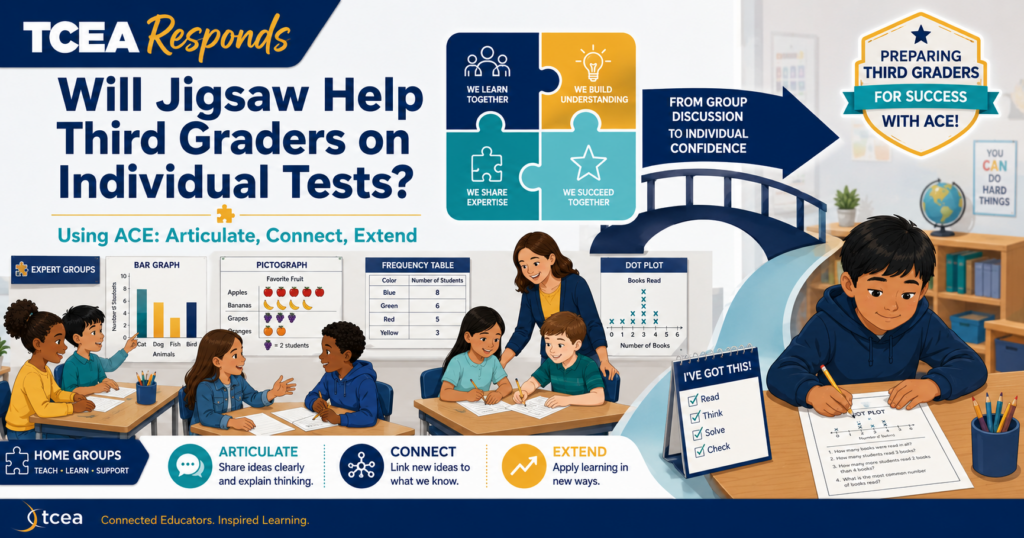
ACE stands for Articulate It, Connect It, and Extend It. This simple way of making sure students explain learning in their own words is powerful. It scaffolds their explanation as they work to connect it to what they learned in classroom discussion with others, and then moves to ensuring they try it in a new situation. The idea is to do this before they encounter these ideas on a high-stakes assessment.
Articulate It: Students Say Their Piece Clearly
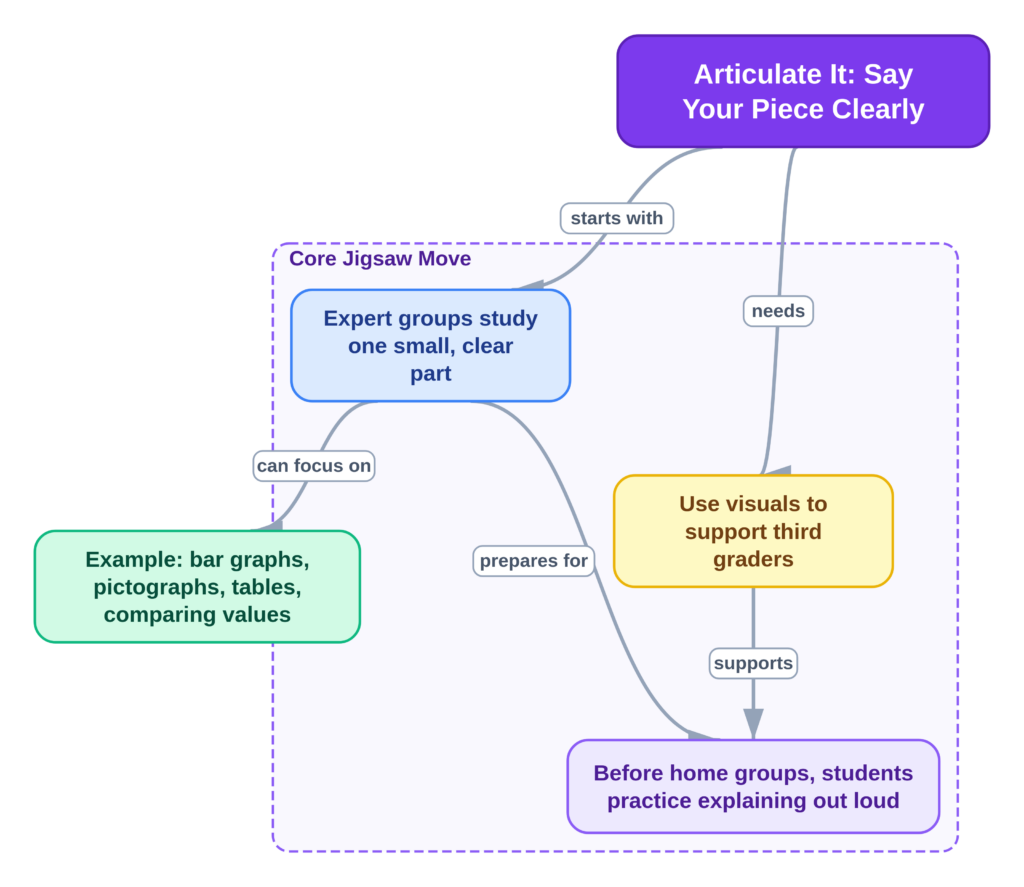
In a three-step Jigsaw, students first move into expert groups. Each group studies one part of the learning. In third grade, that part needs to be small, clear, and supported with visuals.
For example, if you are working on data and graphs, one expert group might study bar graphs. Another might study pictographs. Another might study tables. A fourth might study questions that ask students to compare values.
Reading or hearing the information is not enough. Before students return to their home groups, ask each expert group to practice saying their part out loud.
Try stems like these:
- “The graph shows…”
- “One thing I notice is…”
- “This number means…”
- “I would explain this to my group by saying…”
This is where testing begins before the test. If students cannot explain their assigned piece in their own words, they are not ready to teach it to anyone else.
Connect It: Students Teach and Listen
The second step is when students return to their home groups. Each student teaches their part, and the group builds the whole picture together.
This is the part that helps with individual testing. Students hear the idea more than once, in language closer to their own. They ask questions. They correct misunderstandings. The goal is to get them to notice how one piece connects to another.
In a third grade classroom, you may want a simple recording sheet.
| Student task | Teacher check |
|---|---|
| Teach your expert part | Can the student explain without reading every word? |
| Listen to each group member | Can the student write one useful note from each person? |
| Ask one question | Does the question clear up confusion? |
| Complete one practice item together | Can the group explain why the answer works? |
That last line matters. Do not stop with students sharing information. Add one classroom-style question after the sharing. Ask the group to solve it and explain the answer. That explanation enables students to make a connection between cooperative learning and individual assessments each will face.
Extend It: Students Try It Alone
The third step is what makes the Jigsaw stronger. Students return to expert groups or work individually to apply what they learned from the home group conversation. This is where you can say, “Now try one by yourself.”
For third graders, keep the task short. Give students one individual item that looks like the kind of question they will see later. Then ask for a quick ACE response:
- Articulate: “What is the question asking?”
- Connect: “What did someone in your group say that helped you?”
- Extend: “How would you solve a new question like this?”
The purpose of this is two-fold: First, it checks whether the student learned more than their original expert piece. Second, it helps you find gaps before the test.
If a student can only answer questions about the part they taught, the Jigsaw is not finished yet. The goal is for each student to learn the whole puzzle, not only carry one puzzle piece, incomplete understanding of the whole, around like a badge. They have to see the whole puzzle and how the pieces fit together.
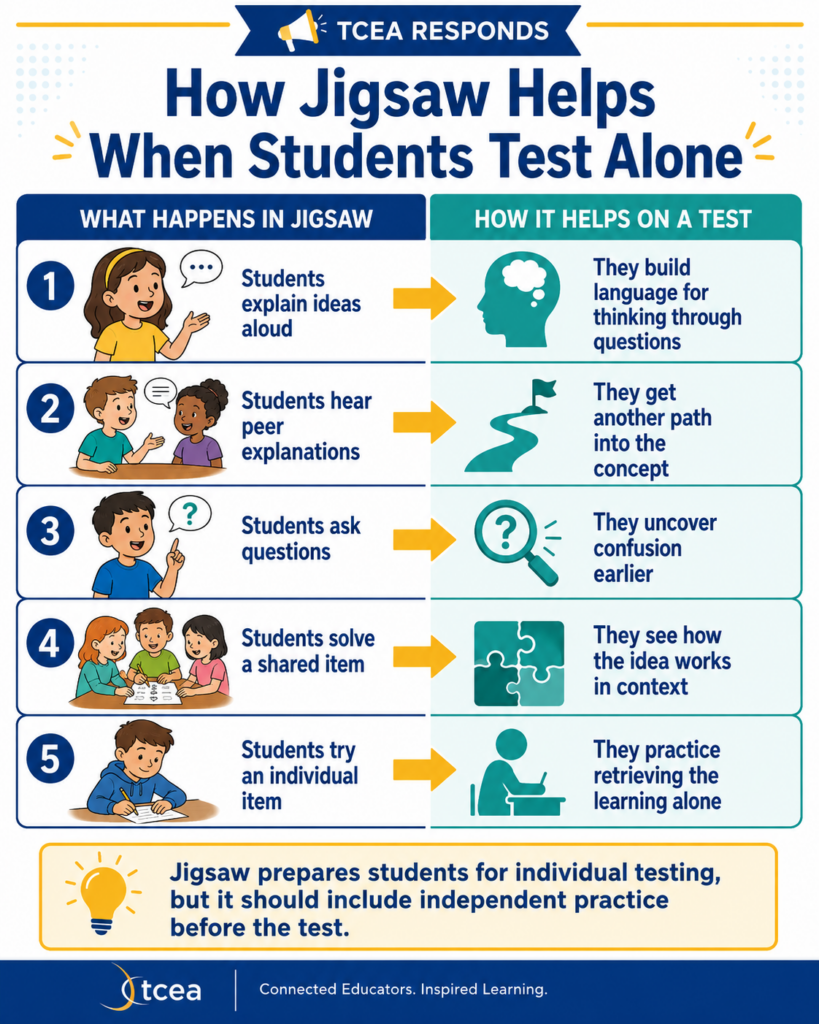
How Jigsaw Helps When Students Test Alone
Since the Jigsaw Approach is not a test-taking trick, think of it as a way for students to rehearse the thinking required for a test or assessment. Students are rehearsing the thinking that testing requires, leveraging a simple framework like ACE in their interactions with other students.
| What happens in Jigsaw | How it helps on a test |
|---|---|
| Students explain ideas aloud | They build language for thinking through questions |
| Students hear peer explanations | They get another path into the concept |
| Students ask questions | They uncover confusion earlier |
| Students solve a shared item | They see how the idea works in context |
| Students try an individual item | They practice retrieving the learning alone |
That final part is one of the most valuable. If students will be tested individually, they need individual practice before the test. Jigsaw can prepare them, but it should not replace independent checks for understanding.
A Third Grade Example
Let’s say your class is working on TEKS 3.8A, summarizing a data set with multiple categories using a frequency table, dot plot, pictograph, or bar graph.
Here is a simple three-step Jigsaw structure:
- Expert groups study one data display: table, bar graph, pictograph, or dot plot
- Home groups teach each display and compare what is the same and different
- Students complete one individual question using a new data display
You might close with this exit ticket:
| ACE step | Student prompt |
|---|---|
| Articulate It | “This graph shows…” |
| Connect It | “This is like the graph my group studied because…” |
| Extend It | “A new question I can answer from this graph is…” |
That exit ticket shows you whether students can name an idea, connect it to what they practiced, and use it in a new situation.
ACE-Jigsaw Organizer
Give these a try in your class next time you decide to facilitate the Jigsaw Approach in your classroom:
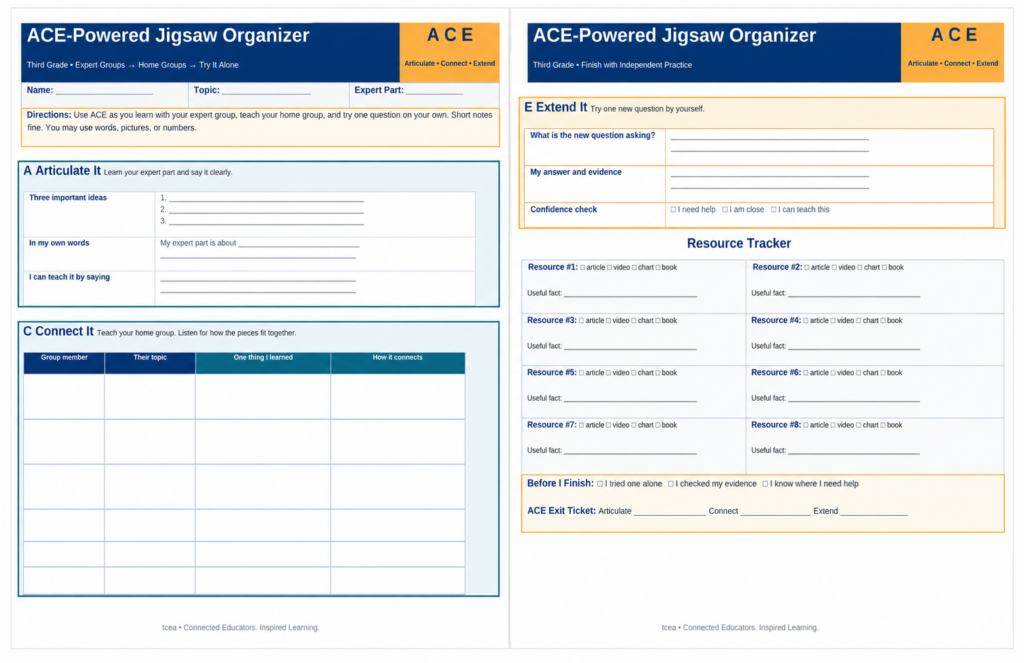
Two-page organizer (PDF version, Google Doc “make a copy” version)
Where Gen AI Helped
For this response, I used Gen AI as a planning partner. I explored the Jigsaw Method, then created a slide deck overview and a third grade lesson example. I also put together a Jigsaw implementation checklist.
Feel free to use one or all of these resources.
A Gen AI Prompt You Can Use
Copy and adapt this prompt in your favorite Gen AI tool:
I teach third grade. Create a three-step Jigsaw lesson for this standard: [paste standard]. The lesson should prepare students for individual testing. Include expert group tasks, home group discussion prompts, one group practice question, one individual exit ticket, and an ACE reflection with Articulate It, Connect It, and Extend It. Keep directions at a third grade reading level.
Did You Know? TCEA offers an online course on The Jigsaw Method for teachers and instructional leaders who want help planning and using this strategy.
Transforming Information into Knowledge with ACE and Jigsaw
Jigsaw can help third graders prepare for individual assessments. This happens when the group work leads back to each student’s own thinking. ACE gives you a simple way to check that students can explain the idea, connect it to what they learned from others, and try it on a new question.
I like how Dr. Judi Harris put it many years ago. To paraphrase her:
We transform information that lives outside of us into knowledge that becomes part of who we are. That is the real goal.