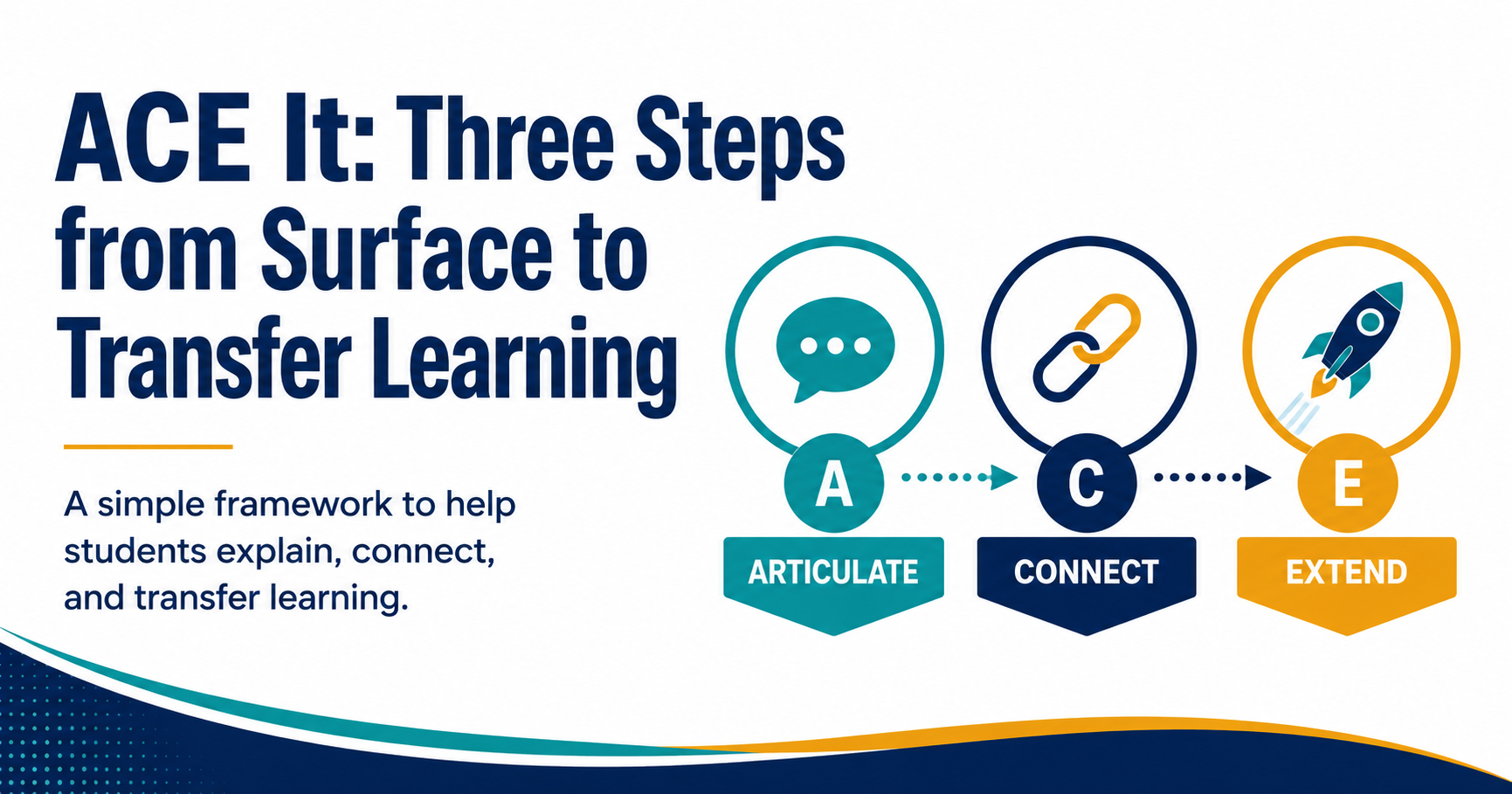
If your students are able to get Gen AI to complete their work, what can you do to encourage productive struggle? That’s a question a lot of us are struggling with in education. With Gen AI tools saturating every facet of students’ lives, it seems impossible. But, a new framework may be something you can use in class and encourage parents to rely on at home. This blog combines PRISM, VIVA, and builds on the research of the SOLO Taxonomy. The goal? A simpler framework that easier to remember for students, parents, and teachers.
Exploring the Gap
The gap between knowing a word and using it is where most learning stalls. Two frameworks help you spot that gap: SOLO Taxonomy and the Surface, Deep, and Transfer Learning phases from Hattie’s Visible Learning research. They are useful, but together they are also a lot to hand a parent at a fall conference. I wanted one anchor word students could remember and parents could use at homework time.
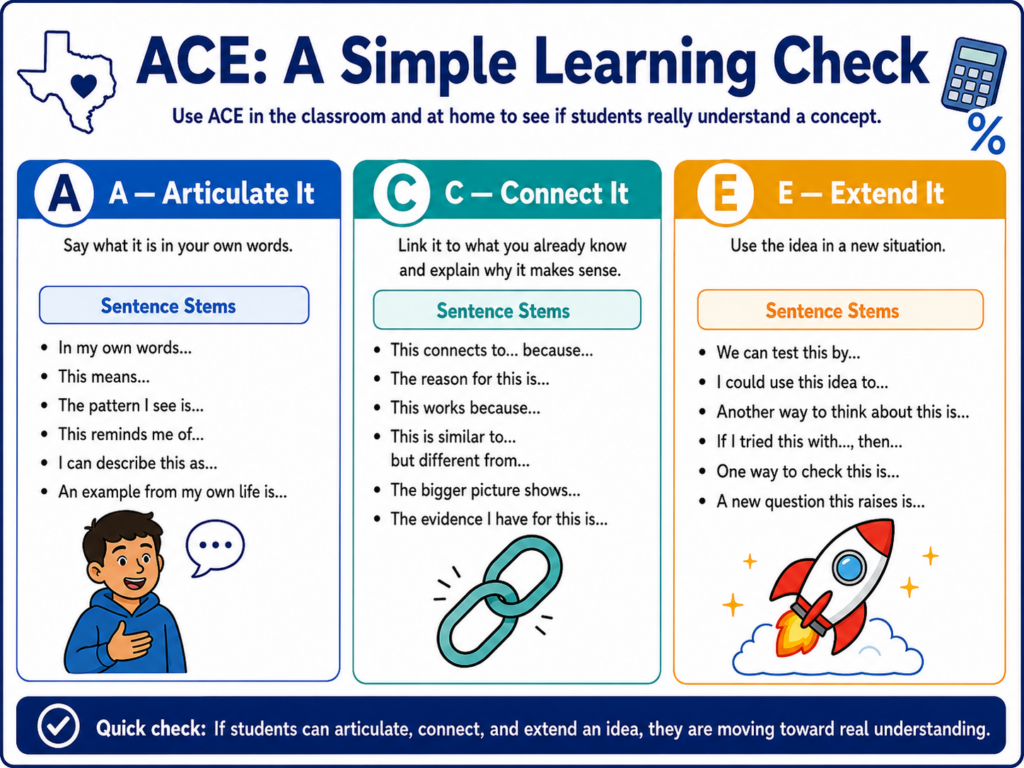
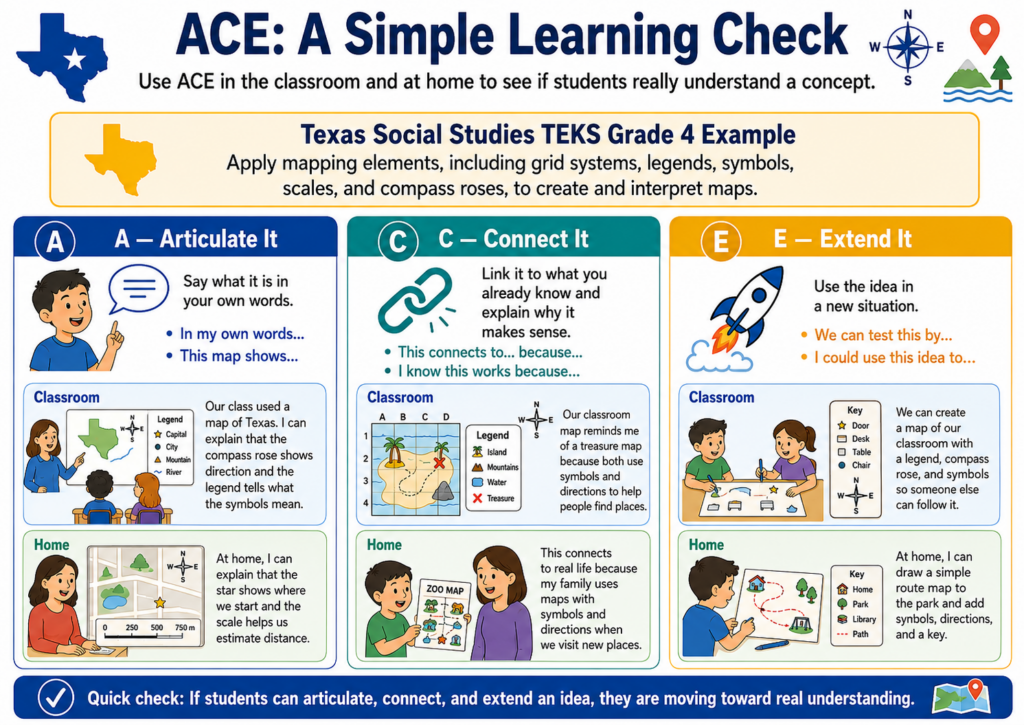
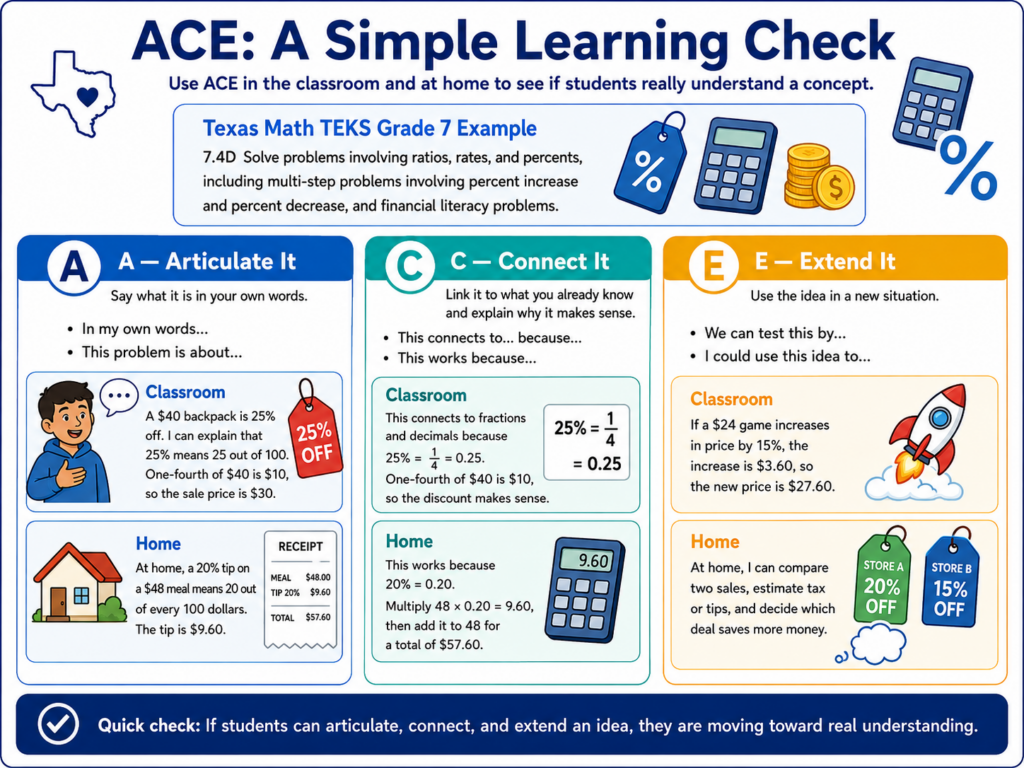
That word is ACE. Let’s work through each of the stages of ACE, which includes sentences stems to provide help.
A: Articulate It
Say what it is in your own words. Use something from your life.
This is the move from unistructural to multistructural on SOLO. In Visible Learning terms, it’s Surface Learning. The student names the idea and shows they have hold of at least one piece of it.
Sentence stems for Articulate:
- “The pattern I see is…”
- “This reminds me of…”
- “Here, I noticed that…”
- “In my own words, this means…”
- “I can describe this as…”
- “An example from my own life is…”
Example: A fourth grader explains photosynthesis by saying, “Plants eat sunlight, kind of like how I eat breakfast.” While this is a little simplistic, it makes that fourth graders understanding of photosynthesis visible. You can tell she has a solid foundation to build on when working to understand the idea behind the big word.
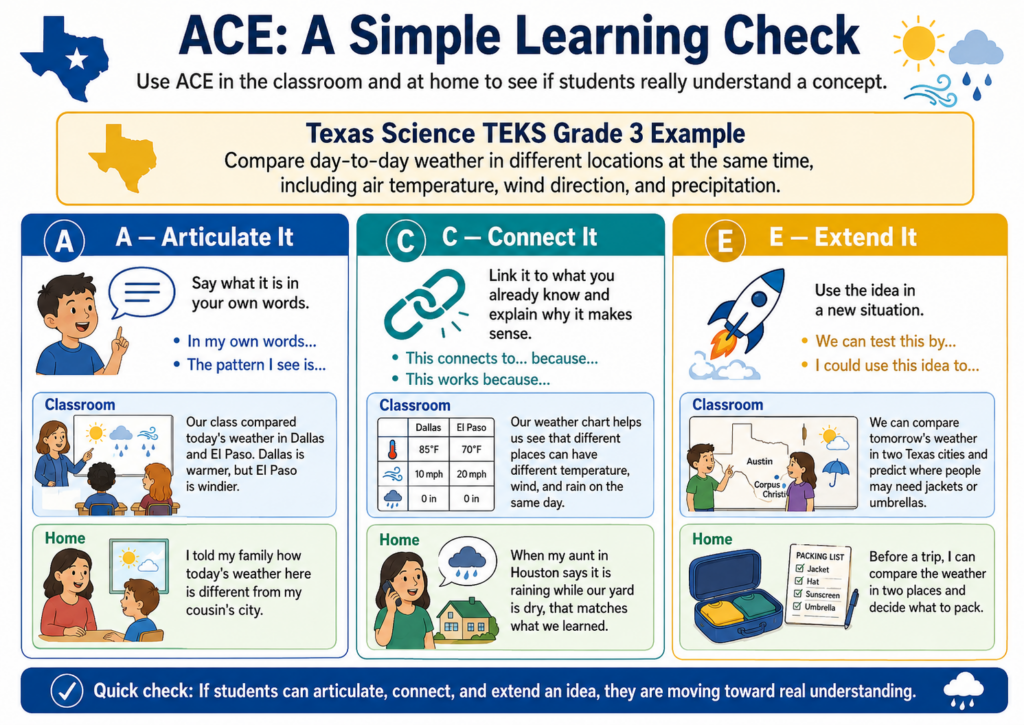
C: Connect It
Show how the idea fits with what you already know. Explain why it works.
This is relational stage on SOLO and the bridge from Surface to Deep Learning. That is, students are able to make connections between the ideas and information they have in their head, moving beyond silos of information. Instead of a child listing a lot of facts, they can link them.
Sentence stems for Connect:
- “This connects to _ because _“
- “The reason for this is…”
- “The bigger picture shows…”
- “This works because…”
- “This is similar to , but different from “
- “The evidence I have for this is…”
Example: That same fourth grader now says, “The basil in our kitchen window doesn’t get much sun, so it grows slowly. The leaves stay pale because there isn’t enough light to make food.” She has linked a word definition to an observation. If SOLO means the Structure of the Observed Learning Outcome, you see the students claim, evidence, and reasoning (CER).
E: Extend It
Use the idea somewhere new. Test it. Try it on a problem nobody handed you.
This is Extended Abstract on SOLO and Transfer Learning in Hattie’s research. The student takes the idea outside the lesson it came from. This is where we want students to end up with anything they learn, otherwise it’s inert knowledge without practical application. Strategies like Transfer Learning Strategies, Problem-Solving Teaching, Service Learning fit well here.
Sentence stems for Extend:
- “Another way to think about this is…”
- “We can test this by…”
- “One way to check this is…”
- “If I tried this with _, then…”
- “I could use this idea to solve…”
- “A new question this raises is…”
Example: “If I move the basil to the window with afternoon sun, the leaves should darken within two weeks. I’ll count new leaves and check the color to see if I’m right.”
How ACE Maps to the Frameworks
| ACE Step | What Students Do | Learning Phase and SOLO Level |
|---|---|---|
| Articulate | Say what it is in their own words | Surface Learning, Unistructural to Multistructural |
| Connect | Show how it fits and why it works | Deep Learning, Relational |
| Extend | Use it somewhere new | Transfer Learning, Extended Abstract |
Try using ACE with students and parents to counteract Gen AI fears. If your child can articulate a key idea, connect their own experience to it, and extend it to something new, you need not worry. But if their products (such as a written report, slideshow, infographic, video) comes across at a higher level than their ability to ACE it, then Gen AI did a lot of the work.
ACE can take about about 30 seconds to teach and model to students and parents. Encourage parents to come back later, and share how they used it when asking their children about their homework. Having students use ACE instead of asking, “Did you use Ai on this?” works better and builds a better relationship than veiled accusations of cheating and distrust.
Did You Know? TCEA’s Visible Learning with Ed Tech unlocks the power of evidence-based teaching and amplifies student learning. It offers a practical, eight-part deep-dive journey through the Surface, Deep, and Transfer Learning phases. Grounded in John Hattie’s Visible Learning synthesis, it concentrates on high-leverage practices that far exceed the 0.40 “hinge point” for a typical year’s growth.. Twelve CPE hours, self-paced, and it pairs naturally with each stage of ACE.
The Quick Test
Pick any concept your students worked on this week. Ask them to articulate it, connect it, then extend it. If they can work through all three well, they own the concept. If they stall, you know which stage to scaffold next.
Try ACE with one lesson this week and tell me what happened in the comments.
👤 Human-directed (Miguel Guhlin) · 🤖 Gen AI-assisted (Claude, ChatGPT)