It wasn’t until high school physics that I understood the concepts behind mass vs weight. I still remember being sure that heavier things fell faster. It made sense to me. A bigger rock should hit the ground first, right? Then someone put that idea up against evidence, and the “obvious” answer started to wobble. That is one of the uncomfortable gifts of science. It does not always let our first explanation survive.
Middle school is full of those moments. Students are old enough to argue, test, question, and defend an answer, but they are also carrying around plenty of almost-right ideas. Heavy things sink. A flat line on a graph means steady speed. Insulation adds cold. Mass disappears when something burns. These ideas are not silly. They are often reasonable guesses based on what students have seen. But they need testing.
Looking for More Critical Thinking Online Breakouts (CTOBs)?
Be sure to read Science Detectives: Critical Thinking Online Breakouts (CTOBs) for Your K-2, 3-5, and 6–8 Classroom, Celebrate America’s 250th Birthday, as well as the Critical Thinking Online Breakouts blog entries, Part One and Part Two. Science educators may also appreciate the Lab Safety Certification Activities.
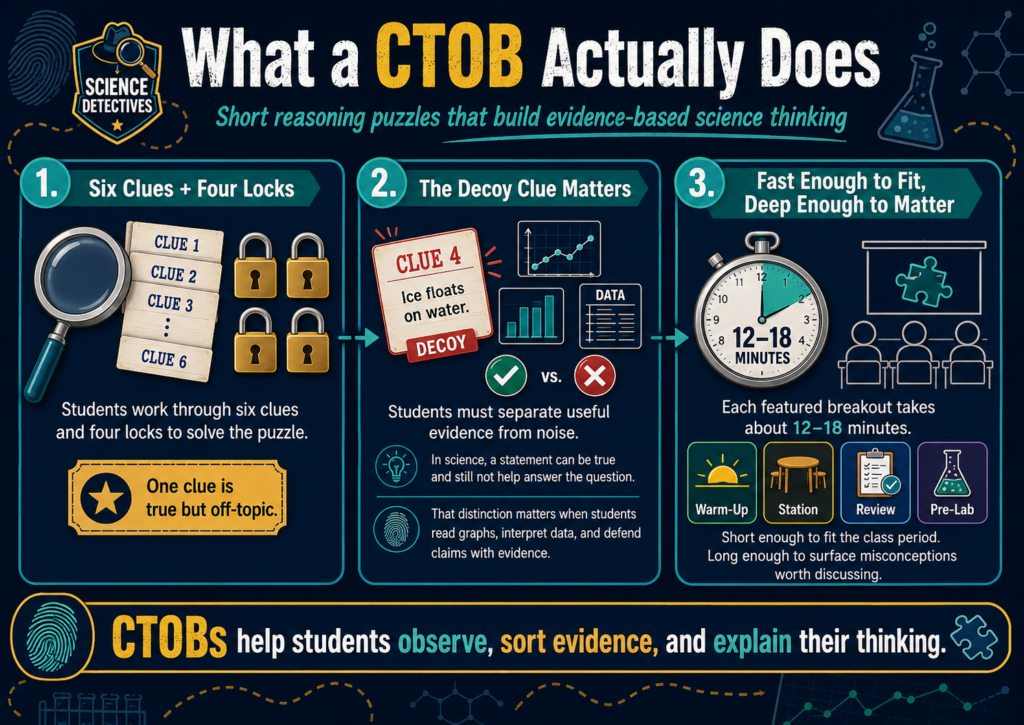
That is where Critical Thinking Online Breakouts, or CTOBs, fit nicely. They give students a short puzzle, a few clues, one true-but-off-topic decoy, and four locks to crack. To solve the breakout, students have to do more than remember a term. They have to decide what evidence matters.
Become a CyberSmart Educator with a practical, self-paced course designed to help you protect sensitive data, secure accounts and devices, recognize social engineering attacks, respond appropriately to cybersecurity incidents, and build stronger digital safety habits. Or, learn AI Essentials for Educators. Each course is $49 at full price or $34 at the discounted rate. Register online through TCEA Courses.
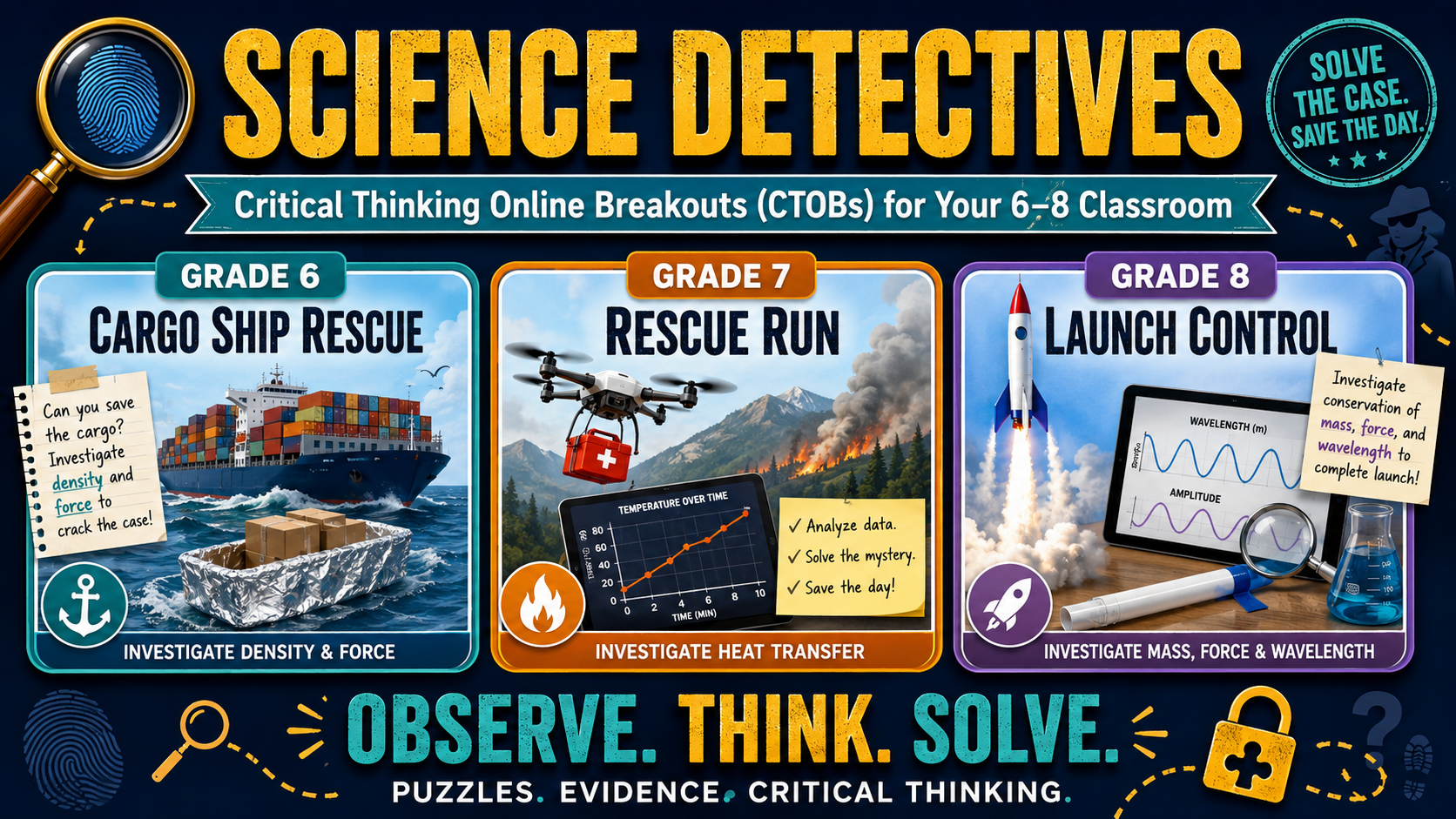
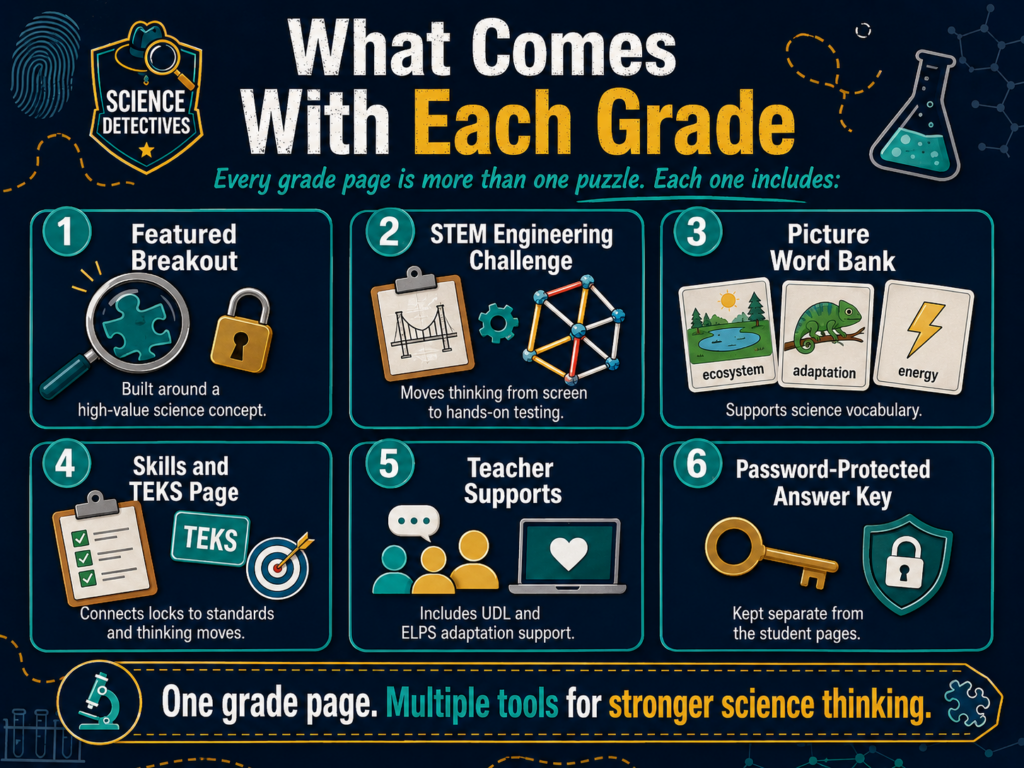
The science CTOBs for grades 6, 7, and 8 are free, browser-based activities. Each grade includes a featured breakout, a related STEM challenge, a picture word bank, Skills and TEKS support, teacher supports, and a password-protected answer key. They also run in seven languages, with no logins and no student data collected.
Ready for the middle school set? Let’s take a look.
Grade 6: Cargo Ship Rescue
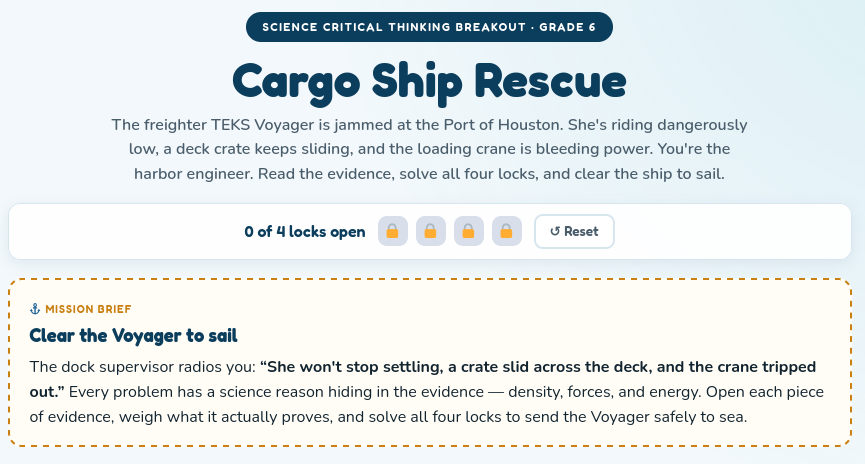
The featured grade 6 breakout is Cargo Ship Rescue. Students clear the freighter TEKS Voyager to sail by using density, net force, Newton’s Third Law, and energy conservation to solve four locks.
This is a strong middle school starting point because density is one of those ideas students often explain with the wrong word. They say “heavy” when they mean dense. They assume steel should sink because steel is heavy. But a steel ship floats because shape, volume, and overall density matter.
The breakout also challenges other common ideas: that a moving object must have an unbalanced force acting on it, that Newton’s Third-Law pairs cancel each other out, and that energy gets used up instead of transferred or transformed.
The paired STEM challenge is Build a Cargo Barge. Students use a square of aluminum foil to design a barge hull that holds as many pennies as possible before sinking. Then they redesign and try to beat their first result.
Try this: Run the breakout first. Then give each team foil, water, and pennies. Before testing, ask them to sketch a hull and predict how many pennies it will hold. After testing, ask, “What changed when you changed the hull shape?” That is where density becomes more than a definition.
The grade 6 concept set adds short breakouts on states of matter, mixtures, the periodic table, density, chemical change, forces and net force, waves, seasons and tides, Earth’s layers and rock cycle, and ecosystems and cells.
Grade 7: Rescue Run
The featured grade 7 breakout is Rescue Run. Students launch a search-and-rescue mission by reading a drone’s distance-time graph, telling speed from velocity, and reasoning about heat and thermal equilibrium.
This is a useful seventh grade puzzle because graphs can fool students. A rising line, a flat line, and a downhill line all feel intuitive until students have to explain what each one actually means. A flat line on a distance-time graph does not mean steady speed. It means the object has stopped. A downhill line does not mean slowing down. It means returning toward the starting point.
The breakout also tackles heat transfer. Students have to reason through the idea that insulation does not add cold. It slows heat transfer. Given enough time, warm and cool systems move toward thermal equilibrium.
The paired STEM challenge is Keep-It-Cold Cooler. Students design an insulated container to keep an ice cube frozen the longest or keep cold water coldest over a set time. Then they graph temperature changes and compare slopes.
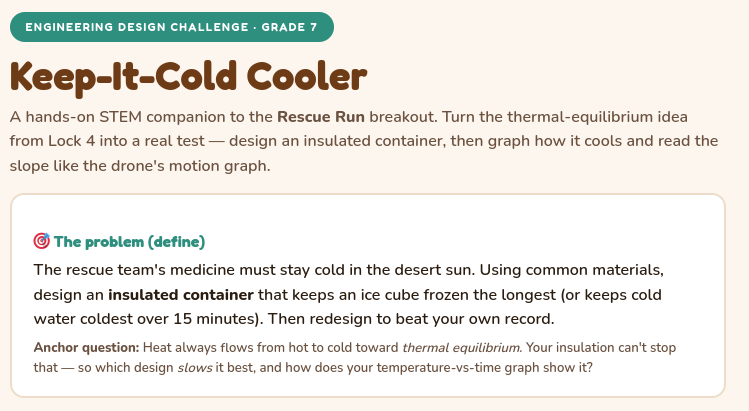
Try this: After the breakout, have teams build small coolers using cups, foil, cotton balls, paper towels, felt, or bubble wrap. Record the temperature every few minutes. Then ask students which graph shows the best design. The key is not just whose ice lasted longest, but who can explain the slope.
The grade 7 concept set includes elements and compounds, solutions and dissolving, motion graphs, heat transfer, the solar system, plate tectonics, water and watersheds, energy pyramids, human body systems, and classifying life.
Grade 8: Launch Control
The featured grade 8 breakout is Launch Control. Students clear a rocket for launch by proving conservation of mass, predicting acceleration with a = F ÷ m, and identifying wavelength.
This one feels right for eighth grade because it pulls together several ideas students need before high school science. Conservation of mass asks them to think at the particle level. Newton’s Second Law asks them to reason mathematically. Waves ask them to name what they are actually seeing.
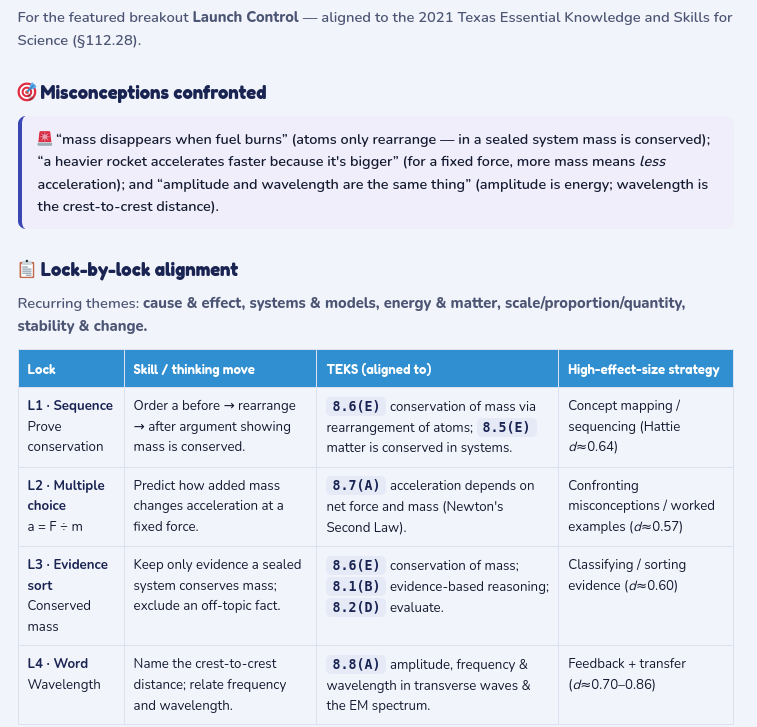
The breakout confronts three common misconceptions: that mass disappears when fuel burns, that a heavier rocket accelerates faster because it is bigger, and that amplitude and wavelength are the same thing.
The paired STEM challenge is Reaction in a Bag & Straw Rocket. In Part A, students use a sealed bag, baking soda, vinegar, and a balance to test whether mass is conserved during a reaction. In Part B, students build a straw rocket and test how payload mass affects flight distance when the launch push stays the same.
Try this: Start with the sealed-bag reaction. Have students measure mass before and after the fizzing reaction. Then ask, “If the bag stayed sealed, where could the mass have gone?” After that, move to straw rockets and payloads. The same students who just argued that atoms do not disappear now have to argue that more mass changes acceleration.
The grade 8 concept set adds short breakouts on classifying matter, acids and bases, conservation of mass, Newton’s laws, waves and the electromagnetic spectrum, stars and galaxies, weather systems, carbon and climate, ecosystem change, and cells and heredity.
Why This Works for Middle School Learners
Similar to the other CTOBs, the middle school learners have to
- Evaluate evidence, as well as ask, “Is this fact useful here?”
- Uncover misconceptions they may have about content
- Engage in design thinking to create a barge, a cooler, a straw rocket
This encourages them to reason first, test next, explain after.
Start Here
Pick your grade and open the featured breakout:
Run one this week. Then pair it with the STEM challenge. Let me know how it goes in the comments.
Licensing
While this content is available for free classroom use by individual teachers, if your campus or district would like to license this content for use, please don’t hesitate to reach out. The answer keys for each set of activities can be made available.
Connect via this online form

👤 Human-directed (Miguel Guhlin) · 🤖 Gen AI-assisted (Claude, ChatGPT)