
“Word learning requires multiple exposures to the word within meaningful contexts.” That’s a quote I ran across some time ago and jotted down in my notebook, alas, sans source. But it made me think that this might be true, not only of vocabulary, but also science thinking. It’s not that big a stretch. Let me illustrate with a super simple, perhaps oversimple, example.
Looking for More Critical Thinking Online Breakouts (CTOBs)?
Be sure to read Science Detectives: Critical Thinking Online Breakouts (CTOBs) for Your K-2, 3-5, and 6–8 Classroom, Celebrate America’s 250th Birthday, as well as the Critical Thinking Online Breakouts blog entries, Part One and Part Two. Science educators may also appreciate the Lab Safety Certification Activities.
A kindergartner doesn’t get “shadow” from one telling…it’s more of the experience, right? My daughter delighted in making shadows, blocking the light herself, watching her shape and others she made, appear. When the light clicks off, she wonders what happens but quickly gets it (this is also fun with puppies new to shadows, and don’t get me started on cats). Where the shadow goes is the subject of many a tale, and I’ve been known to tell a few myself to youngsters. The whole “who stole your shadow” is based on this moment of curiosity. For young learners, like kinder students, that “Why?” may be what science is supposed to feel like. It’s the observation, the noticing something and needing to know more that is the most delightful gift.
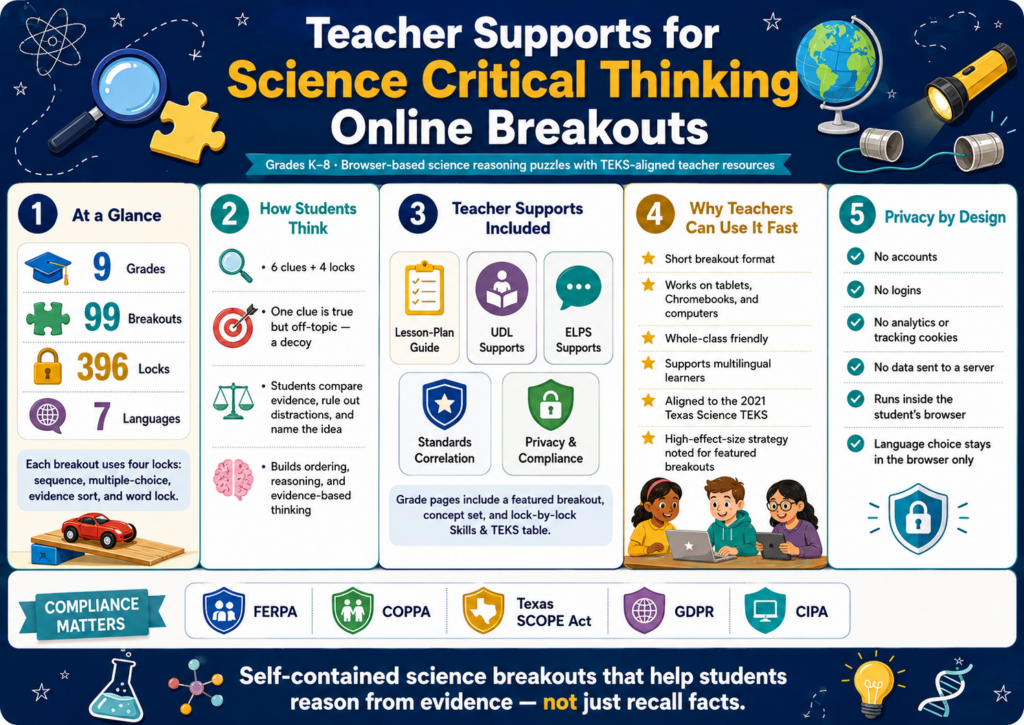
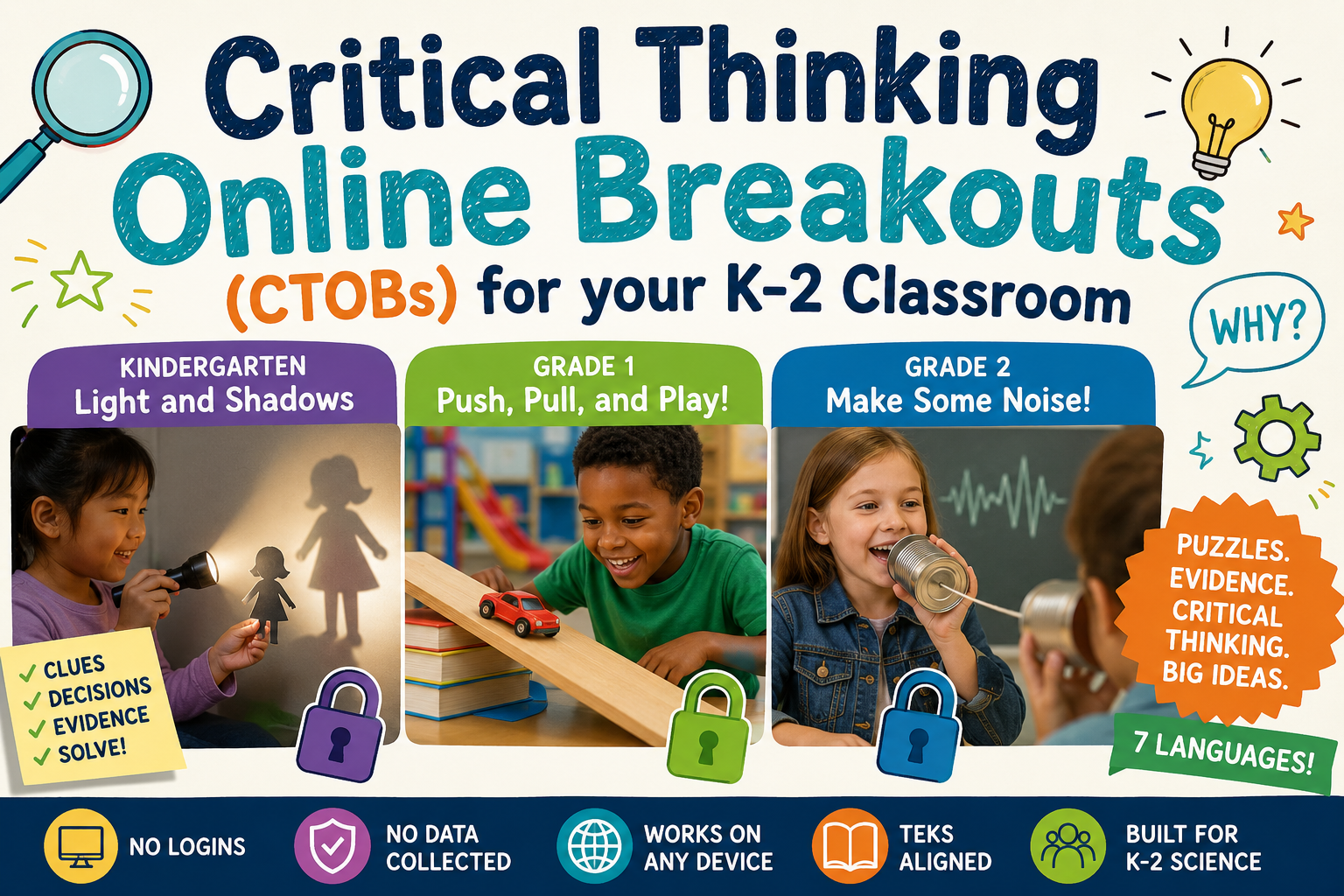
Some digital “science activities” for little ones ask them to read too much, log in to something, or click through a video and answer three questions. In the spirit of offering a different option, while keeping the digital, here’s something a little different. It’s a set of free, browser-based science breakouts built for grades K, 1, and 2.And, unlike many resources online today, there are no logins required. No FERPA data is collected or required.
These multilingual activities work for on a tablet, a Chromebook, a regular computer. How multilingual you may be wondering? Well, they come in seven different languages with suggestions for English Language Proficiency Standards (ELPS), a lesson plan, and Universal Design for Learning (UDL) adaptation. The goal is to ask kids to reason from evidence rather than “simply” recall facts.
Ready for a tour? Let’s take a look.
What a Breakout Actually Does
A breakout is a puzzle. Students get six clues and four locks. To open a lock, they have to look at the clues, figure out what fits, and rule out what doesn’t. One clue in every set is true but off-topic, a decoy. Kids have to decide what evidence matters and what to set aside. Knowing what facts to keep, which to set aside because they are irrelevant, involves critical thinking a five-year old can do.
Each breakout takes about six to twelve minutes. Short enough for a circle-time slot. Long enough for real reasoning.
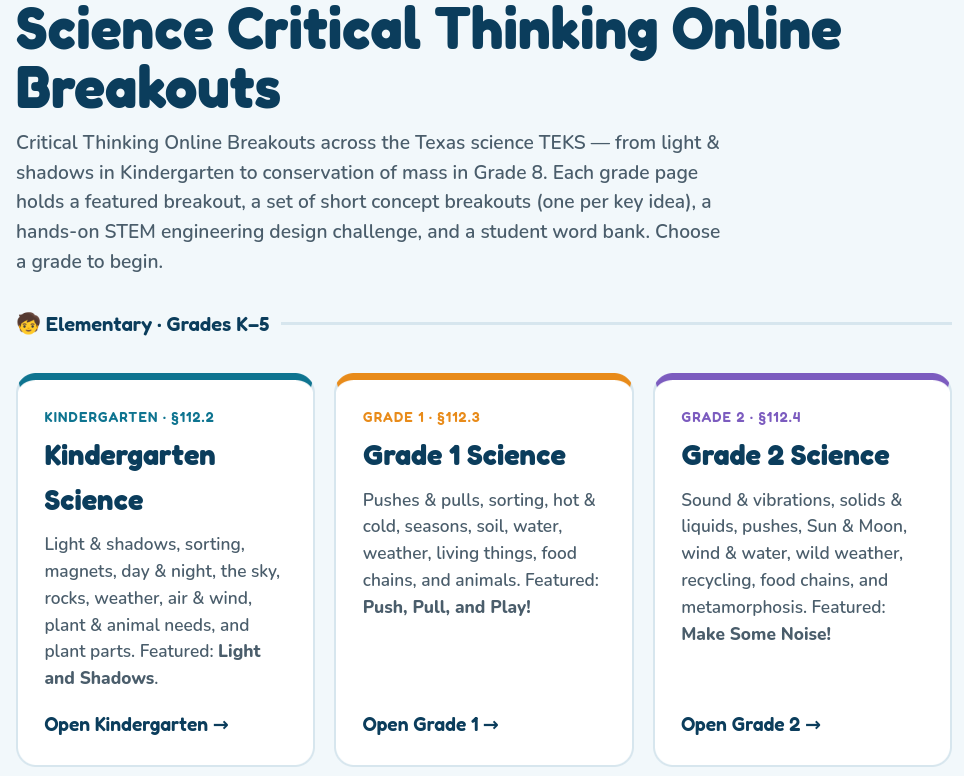
Kindergarten: Light and Shadows
The featured kindergarten breakout is Light and Shadows. Kids turn on a light, learn that we need light to see, and discover that blocking light makes a shadow. Six picture clues, four locks, and the whole thing works as a shadow-play STEM challenge.
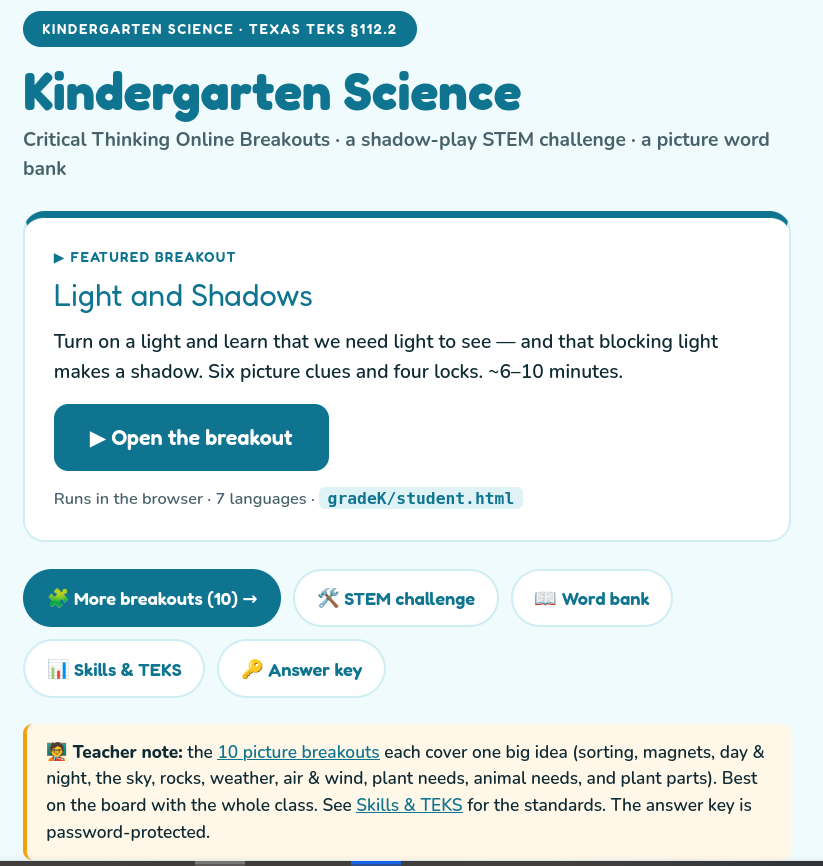
Because these are our youngest learners, the clues are pictures, not paragraphs. Beyond the featured puzzle, there are ten more single-concept breakouts covering sorting, magnets, day and night, the sky, rocks, weather, air and wind, plant needs, animal needs, and plant parts. Ten big ideas, each in its own short puzzle.
When you’re back in class, try this: Project Light and Shadows on the board. Run it as a whole class. Before you open each lock, ask, “Which picture helps us? Which one is a trick?” Let a student defend their answer out loud. That’s the science talk you’re after.
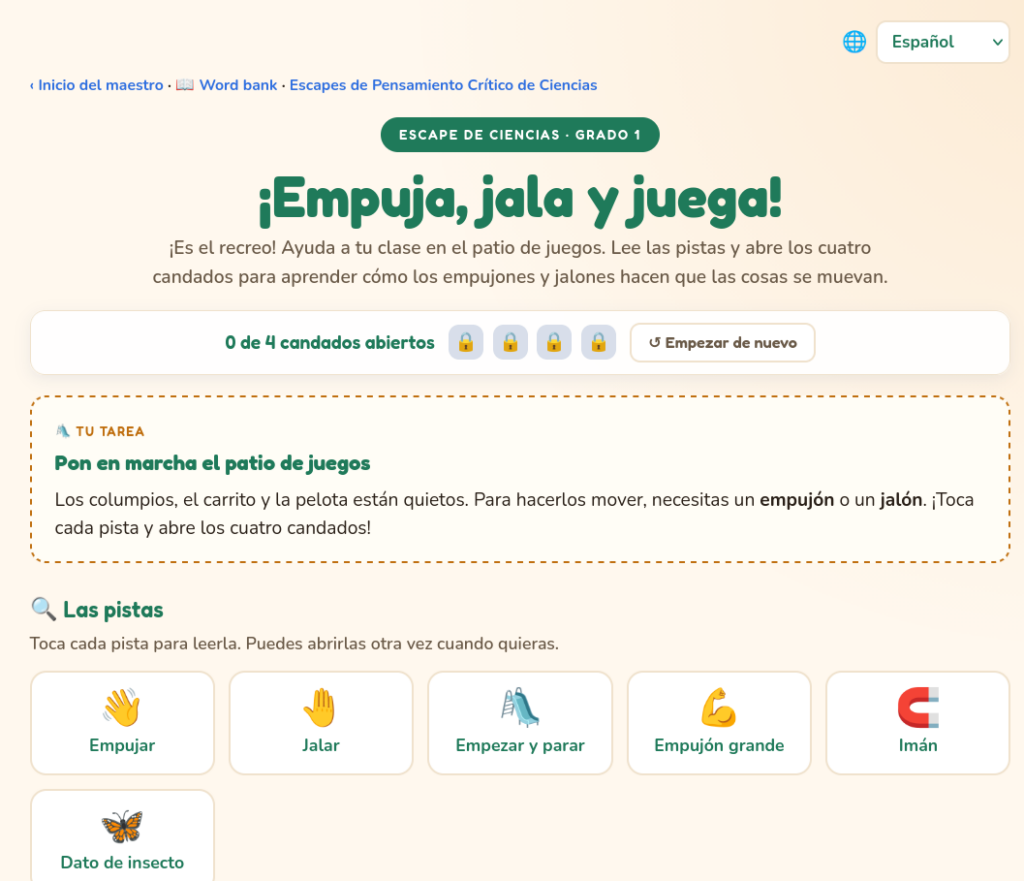
Grade 1: Push, Pull, and Play!
First graders get Push, Pull, and Play!, set on a playground. Students help the class figure out how a push or a pull makes things move. It pairs with a STEM ramp challenge, so you can take the on-screen thinking straight to a physical build.
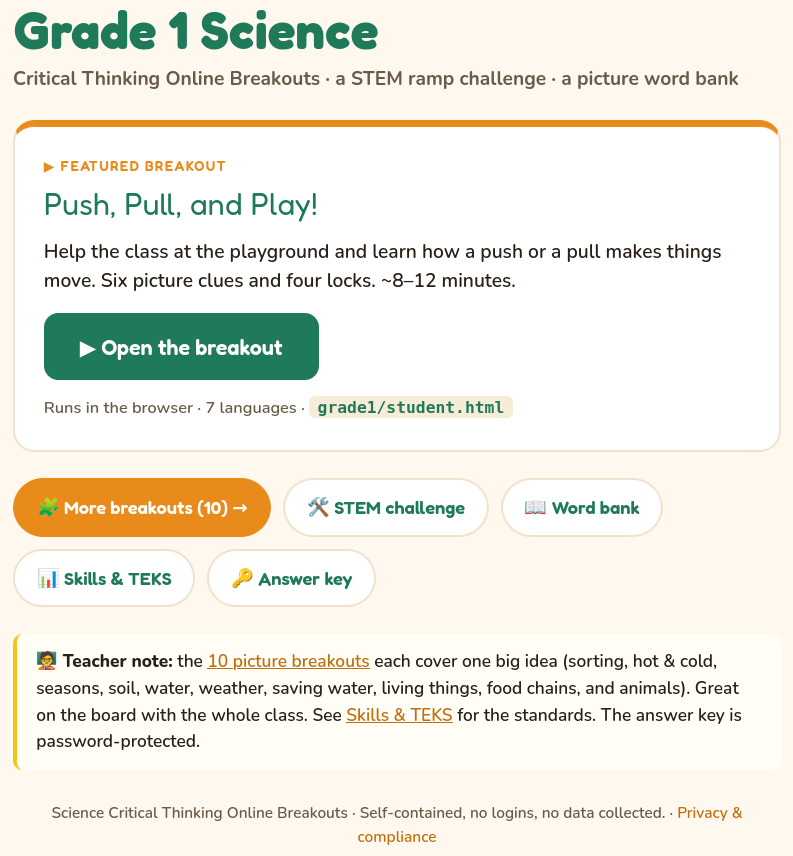
The ten concept breakouts here cover sorting, hot and cold, seasons, soil, water, weather, saving water, living things, food chains, and animals. Each one stands alone if you want to use with a specific unit.
Try this: After the breakout, hand out a ramp, a car, and a few books. Ask kids to predict, then test, what makes the car go farther.
Grade 2: Make Some Noise!
Second grade brings Make Some Noise!. Students put on a show and learn that sound comes from things that vibrate, then travels to your ears. The paired STEM piece is a string-phone challenge, the classic two-cups-and-a-string build.
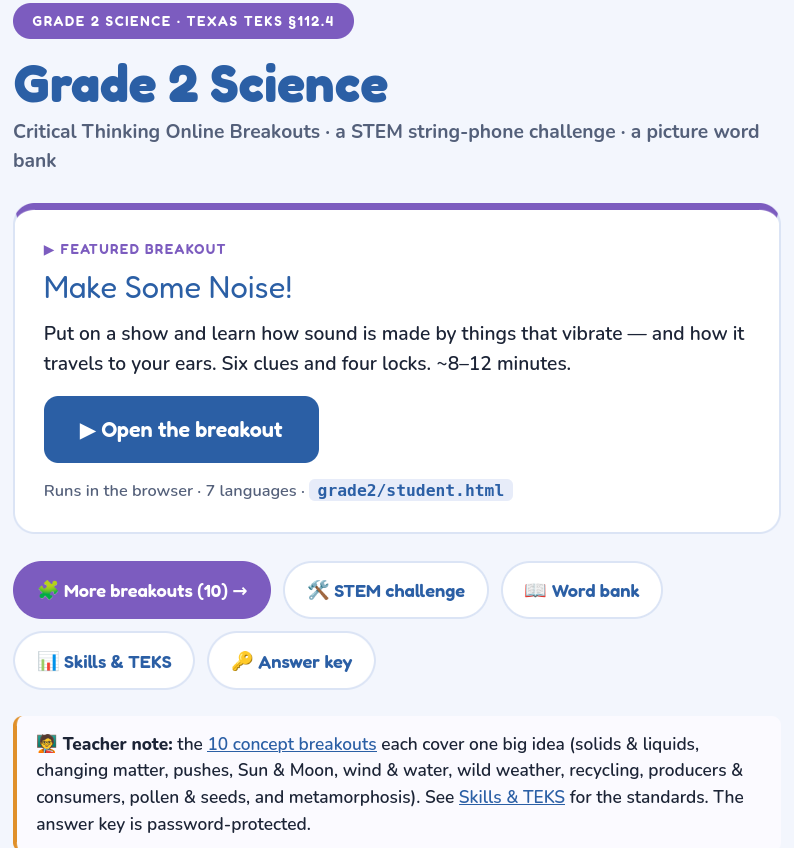
The ten concept breakouts cover solids and liquids, changing matter, pushes, Sun and Moon, wind and water, wild weather, recycling, producers and consumers, pollen and seeds, and metamorphosis. By second grade the clues start mixing in more text, which fits where these readers are.
Try this: Run Make Some Noise!, then build string phones. Have partners test whether the string has to be tight or loose to carry sound. Ask them why. The goal is to get a real hypothesis out of a seven-year-old, so they’ll want to keep testing.
What Comes With Each Grade
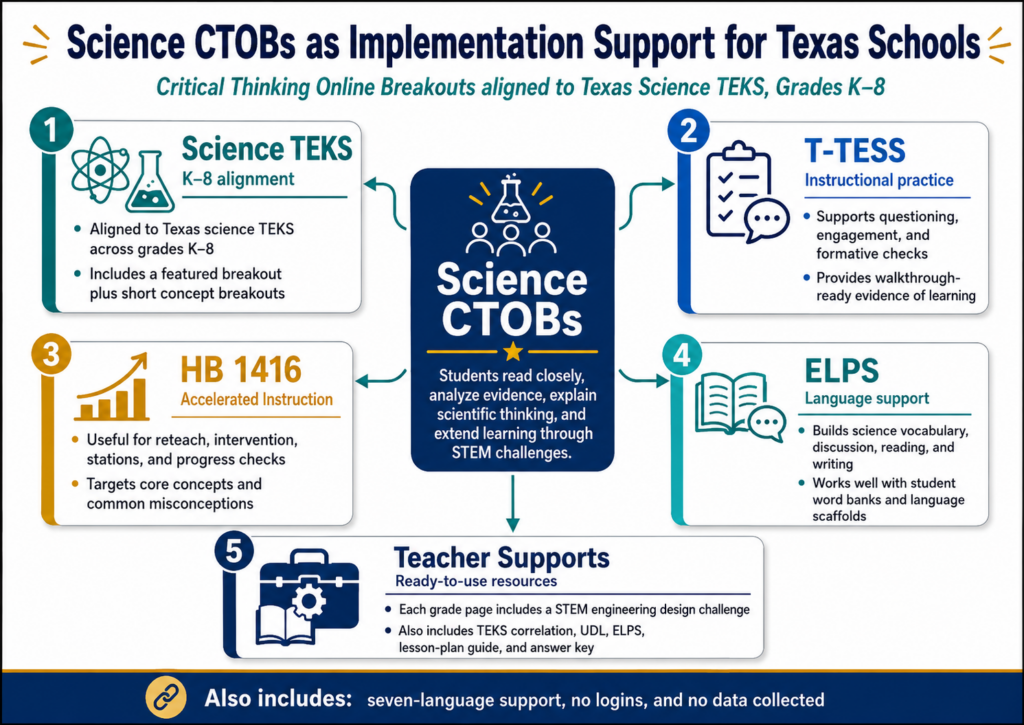
Every grade is more than the puzzles and includes:
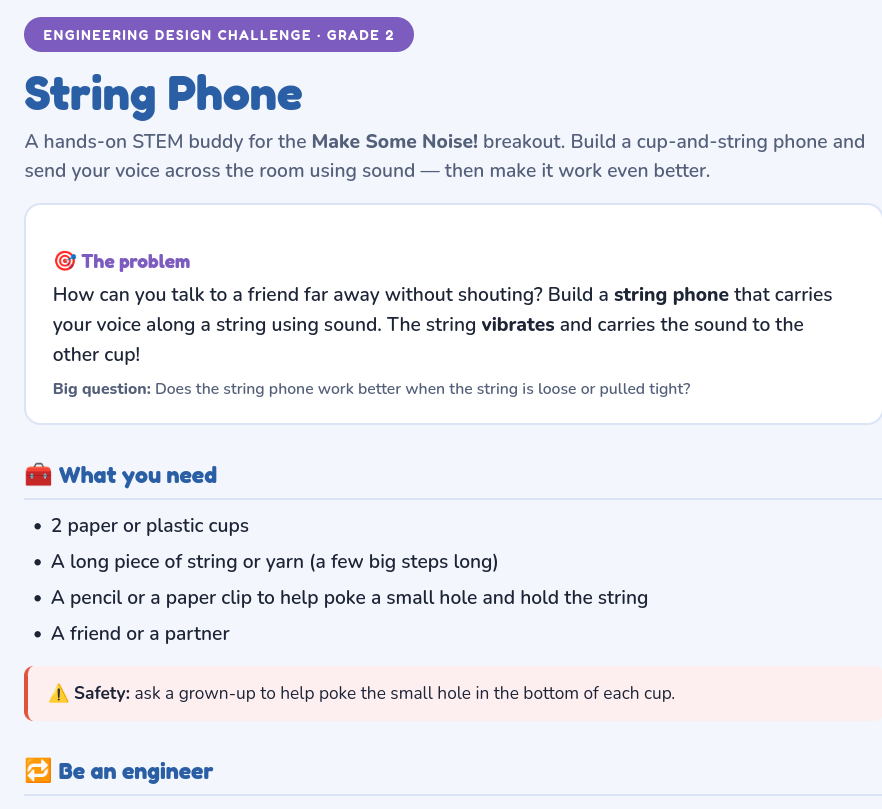
- A STEM engineering challenge you can print, tied to the featured breakout (shadow play, ramps, string phones).
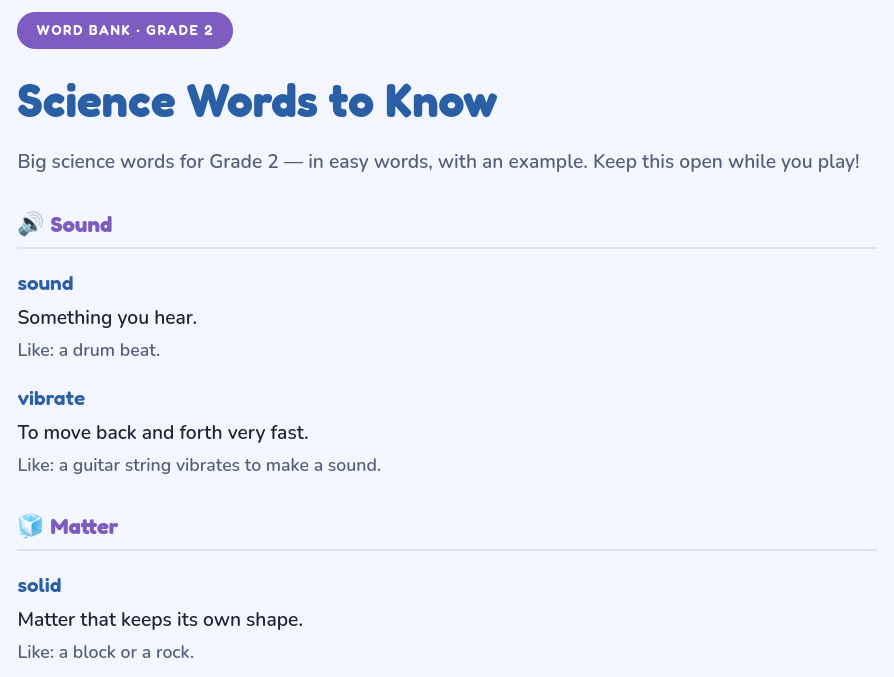
- A picture word bank with vocabulary at grade reading level.
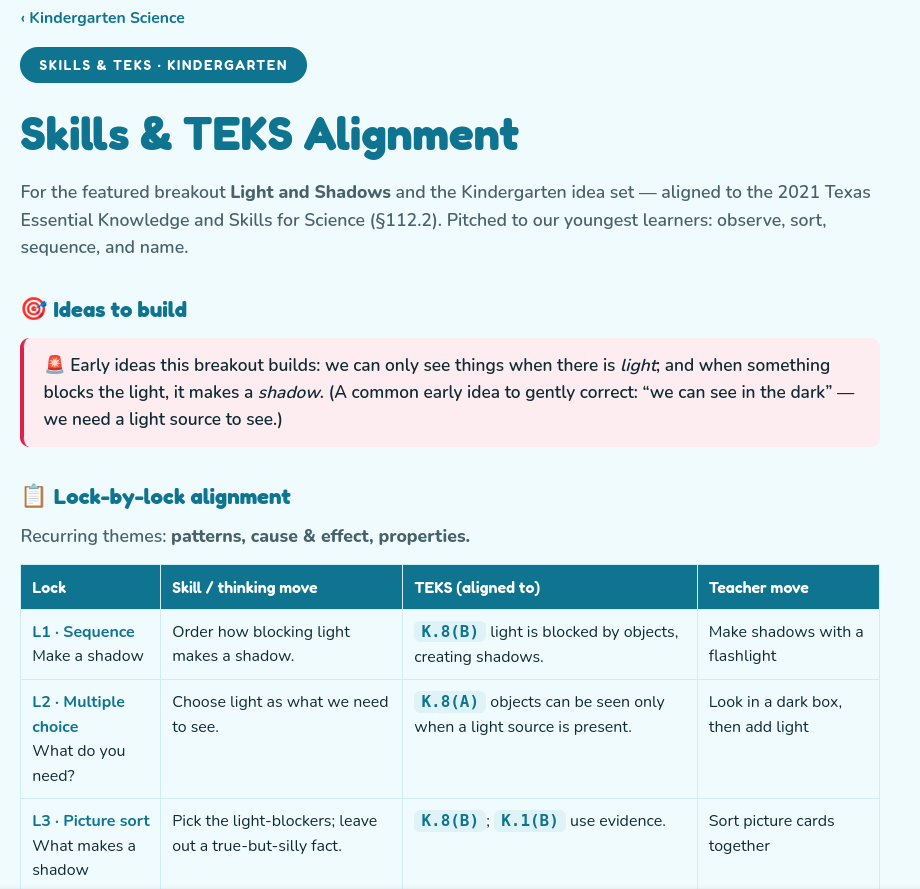
- A Skills and TEKS page that maps each breakout to the standard it hits, so you can defend the time to an administrator in about thirty seconds.
- A password-protected answer key kept separate from the student pages, so a curious kid can’t just click through to the answers.
The whole collection is aligned to the 2021 Texas Essential Knowledge and Skills for Science. Confirm against your own scope and sequence before you build a unit on it.
Why This Works for Little Learners
Three things make these worth your time.
First, the decoy clue. Ruling out irrelevant information is a skill we usually don’t teach until much later. These puzzles build it in kindergarten, quietly, through play.
Second, no data and no logins. That removes the FERPA and COPPA worry that comes with so many “free” ed-tech tools. Nothing is collected. You can point a parent to the privacy page and have a great conversation about how this resource does not collect any data.
Third, seven languages, fully translated. For your emergent bilingual students, the science thinking doesn’t wait on English. A student reasoning in Spanish or Vietnamese or Arabic is still reasoning about shadows, forces, and sound. In addition to those, Chinese, Hindi, and Urdu are other supported languages.
A Conversation, Not a Point and Click Activity
Remember, with young learners, it’s the engaging interaction you provide as a teacher (or peer to peer) that makes the difference. Avoid simply giving a five-year old a tablet, or these activities become simple clicking exercises. The thinking lives in the conversation you build around it, not in the software. Plan for the talk.
Start Here
Pick your grade and open the featured breakout:
Run one this week. Watch what happens when you ask a kindergartner to defend an answer. That moment when a small hand goes up and says “no, that one’s a trick,” is the whole reason to do this.
Grades 3 through 8 exist too, and I’ll cover those in upcoming entries. For now, start small. Start with a shadow.
Licensing
While this content is available for free classroom use by individual teachers, if your campus or district would like to license this content for use, please don’t hesitate to reach out. The answer keys for each set of activities can be made available.
Connect via this online form
👤 Human-directed (Miguel Guhlin) · 🤖 Gen AI-assisted (Claude, ChatGPT)

2 comments
Miguel,
These are AMAZING!
Thank you!!
Really enjoyed reading this. your explanation was simple and practical. Looking forward to your next post.