
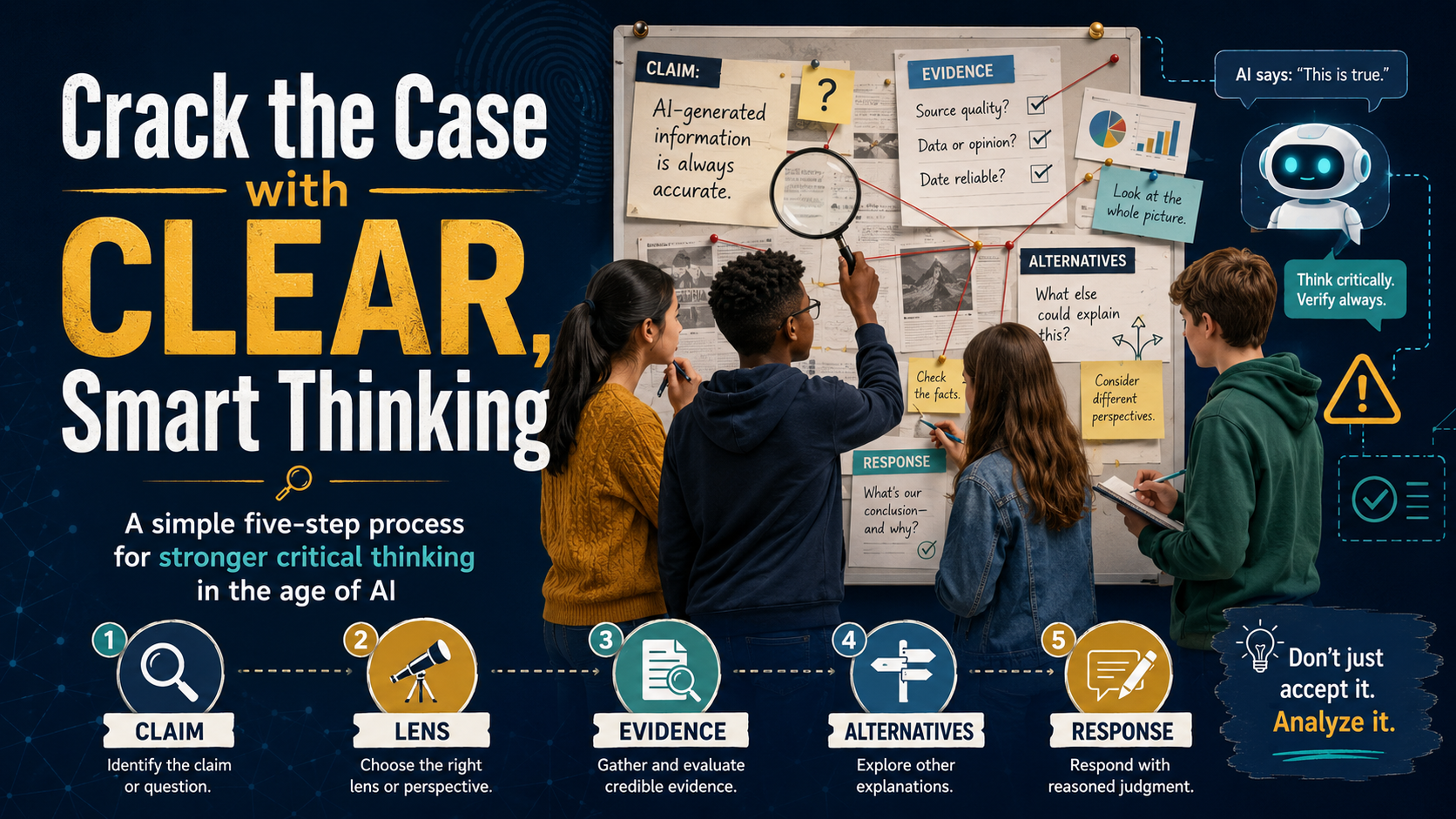
We don’t teach critical thinking as well as we should in K-12 schools. That’s why I have spent so much time on it in past blog entries. Gen AI has uncovered this detail for many. In this blog entry, I share a CLEAR process, a detective games for grades 3-8 with lesson plan, and, for Part 2 (dropping July 20, 2026), I promise a series of digital breakouts for grades 3-5, 6-8, and 9-12.
The Challenge
Today, schools face a profound challenge. Reconfiguring assessment in the face of Gen AI, motivating students to embrace learning for growth, and fostering critical thinking. For the first challenge, I offered some suggestions in previous blog entries. For the second, engagement has always been the attraction of PBL scenarios with Ed Tech. It is the last I would like to revisit again…the challenge of critical thinking.
Looking for More Critical Thinking Online Breakouts (CTOBs)?
Be sure to read Science Detectives: Critical Thinking Online Breakouts (CTOBs) for Your K-2, 3-5, and 6–8 Classroom, Celebrate America’s 250th Birthday, as well as the Critical Thinking Online Breakouts blog entries, Part One and Part Two. Science educators may also appreciate the Lab Safety Certification Activities.
As students lean on Gen AI more, the ability to question what a chatbot gives them, matters. The students see it themselves. Per RAND’s December 2025 survey of more than 1,200 young people, many worry the tools are working against them:
“Sixty-seven percent of students agreed that the more students use AI for schoolwork, the more it will harm their critical thinking skills,” up more than ten points in just ten months.
That’s two out of three students saying they can feel their own thinking getting less precise, that’s important to notice. You know, this reminds me of a metaphor for how critical thinking is “supposed to” grow from K-12 through adulthood (graduate work).
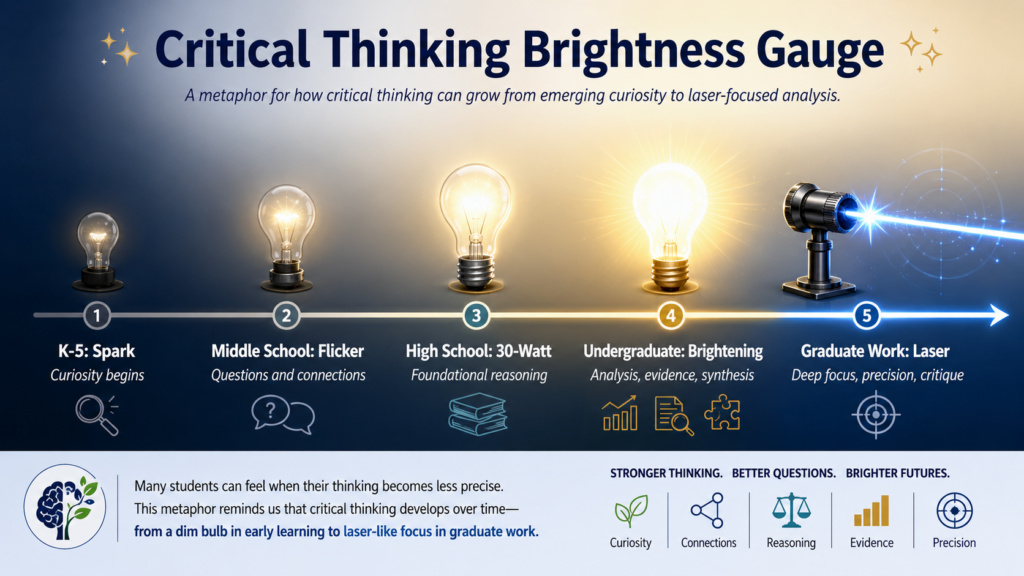
In the metaphor, there’s a natural progression as you learn more and become better able to process tasks and think clearly. You can see that metaphor in the image above and it captures what my friends and I imagined. Of course, it’s only a metaphor and not supported by any reliable evidence or research.
Shifting to Laser Brightness: A Slow, Necessary Journey
So how do you turn it around? Banning the tools does not work, and the skill will not grow on its own. You have to practice it, model it, and invite students to do the same. It involves teaching students a process they can run on any claim. Then, it involves giving them enough practice that it sticks. One possible approach, one process you can try, is CLEAR.
Cognitive Offloading: A Workaround
Cognitive offloading. It happens when students get finished answers from a chatbot. Students end up skipping the analytical work that would have built the skill. A 2025 study by Michael Gerlich found frequent AI users scored lower on critical reasoning. The youngest users leaned on it most. A K-12 scoping review saw the same. More time on AI, less cognitive engagement. This means that students hand off the part that is supposed to be hard.
When students got errors from a chatbot, they often took the answer anyways. They had stopped checking, because checking no longer felt necessary (The chatbot was obviously laser focused, and they knew it).
I saw a version of this with my own third graders, years before chatbots existed. Hand a kid a confident voice and an easy answer, and most will accept it without a second look. This highlighted the power of ill-structured problems for me. The chatbot just made that voice louder, and a lot faster.
Question, Not Obey
The better news sits in the same body of research. AI does not dull thinking when students learn to question it instead of obey it. One AI-powered approach produced real gains in reading and writing. This media-literacy increased students’ skepticism about unverified text. A grade five framework had students pull apart automated decision systems. Then it asked them who was accountable for those automated systems.
So the move is simple to name, if not always easy to teach. Quit asking students to trust the output. Get them taking it apart instead.
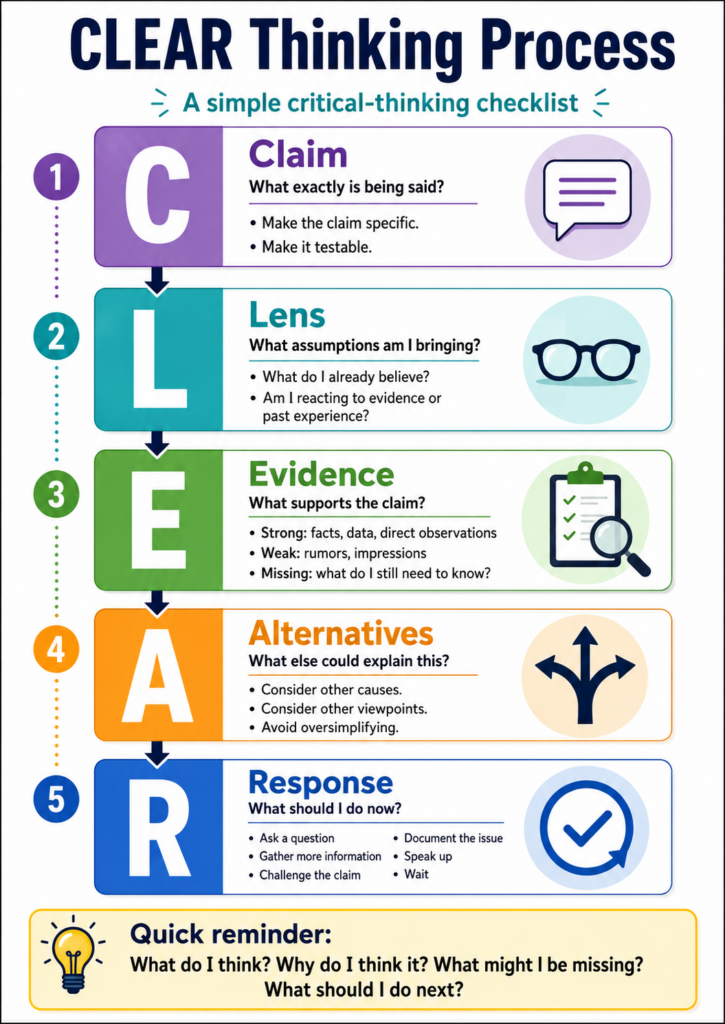
A Simpler Process: CLEAR
Here are the five steps most people can hold in their mind. Doing this in the middle of an argument is the hard part, as I’ve found. That’s why I like the ACE Framework so much, but that’s something to use when presenting. CLEAR works for when you are dealing with someone else’s claim, even a boldly asserted one from an authority figure (your boss, your neighborhood know-it-all, your department head, or classroom discussion partner).
| Step | The question | What it builds |
|---|---|---|
| Claim | What exactly is being said? | Pinning down a specific, testable statement |
| Lens | What am I assuming before I even start? | Naming your own bias |
| Evidence | What actually supports this? | Sorting strong proof from rumor and feeling |
| Alternatives | What else could explain it? | Resisting the first easy answer |
| Response | What should I do now? | Acting after thinking, not before |
The order does the work. A claim shows up. You name your own assumptions before anything else. Then you weigh the evidence. After, you hunt for more explanations. After that is done, you decide what to do. Response is the step most frameworks leave off. Students do not live in a world where analysis is the finish line. They live in one where they have to choose, right now, whether to reshare the post.
Meet the Problem: Applying CLEAR Under Pressure
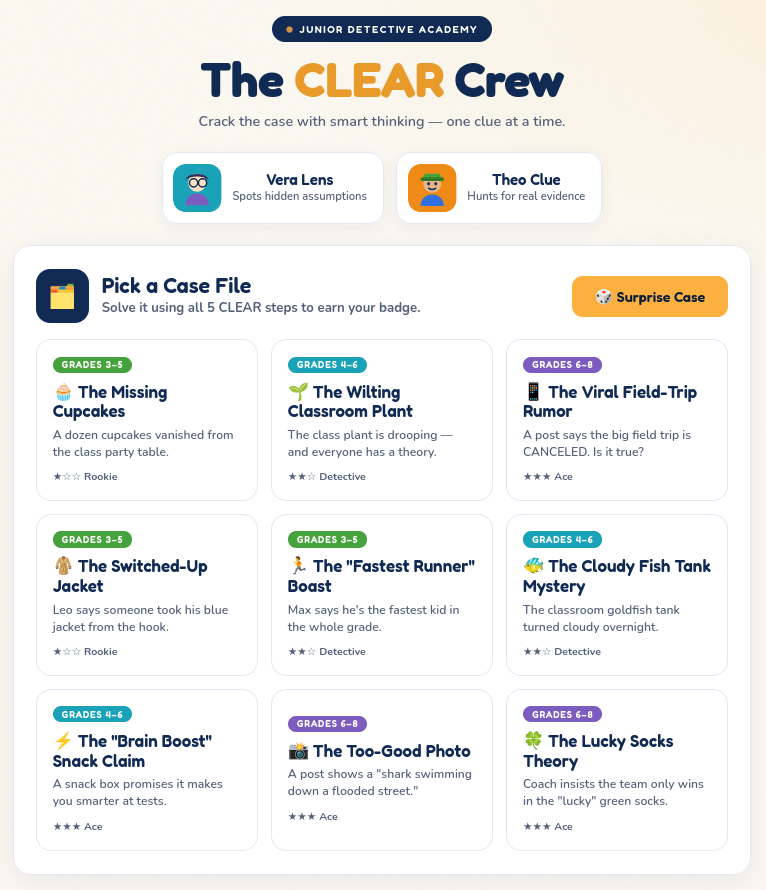
Knowing the five steps is not the same as running them under pressure. So I built a free browser tool with Claude Code (for the curious), the CLEAR Crew Detective game, that drops students into cases pulled straight from their own lives.
A Quick Aside
I hate to interject here, but I have to share this quote about the nature of Gen AI use. If you look at the game linked above and think, “Wow, Miguel used Gen AI to build something, why does he say he built it?” The truth is Gen AI built it, I only asked the AI questions and made suggestions as to what I hoped to see. It reminds me a bit of old wisdom that might go something like this, putting the AI in the role of the horse, the person using AI as the rider:
“Call the horse beautiful if it runs well; call the rider beautiful only if he governs himself well. The excellence of the instrument is not yours. Yours is the use you make of it.” — in the spirit of Epictetus, Enchiridion §6
“CANCELLED!” says a viral post about the field trip. Two hundred likes, no source. A snack box brags about higher test scores, based on six kids who also studied extra and slept well. A photo flood turns out to be the same shark image. It’s shown up in five other cities. Students take each case through all five steps. They sort strong evidence from weak. They name the assumption that lets a rumor travel, and landing on a fair response at the end. Cases carry grade-band tags from three through eight, so you can match the difficulty to your room.
I aim for middle school readability in my own writing, and the game holds to that same line. The grades three through five cases keep the language plain and the mysteries small. A missing jacket. A wilting classroom plant. The reasoning is the same for a sixth grader. The process is the same, no matter the viral hoax.
There’s also a lesson plan available for you to adapt.
Student Data: Not a Concern
If you coach teachers or sit in the technology director’s chair, you already know what comes next. What happens to student data? The CLEAR Crew is a single HTML file that runs entirely inside the browser. No server, no account, no database. Students tap answers, the page checks them on the spot, and nothing leaves the device. Once it loads, it runs offline.
The full privacy and compliance page walks through FERPA, COPPA, GDPR, and Texas requirements in language your privacy officer can actually read. The short version: there is no student record to breach, because the tool never creates one. I wanted a thinking tool you could use right away, not have to vet through your tech department.
Did You Know? TCEA’s Artificial Intelligence Educator course (twelve CPE hours, badge and certificate) helps you build the classroom practices that keep students thinking with AI rather than around it.
Where to start this week
Pick one case that fits a grade you support. Put it on the projector as a five-minute warm-up and let students argue each step out loud before the game shows its hand. Then send them the link and let them work a case on their own.
Try the CLEAR Crew Detective game with your students this week, then tell me in the comments which case sparked the best argument.
👤 Human-directed (Miguel Guhlin) · 🤖 Gen AI-assisted (Claude, ChatGPT)

5 comments
Where can we get the CLEAR poster to use with the lesson?
Jo, try this link – https://drive.google.com/file/d/1jyF2HsuA2dchmXuLQLfpMFBT3P-7rXh0/view?usp=drivesdk
Thanks so much!
So we’re having this discussion right now as we are reading the book More Than Words by John Warner. The difference is that the horse will run on its own. It will move, graze, whinny, and a whole bunch of independent actions. The LLM will not. I can only respond to your prompts. Then you have to do something with those responses. The AI didn’t come to you and say, “Hey, I built this game you oughta try…” You had to direct it first.
Ha, I have read that book. I don’t disagree with the idea that in classrooms critical thinking wasn’t a thing. It was something other people did. From my observations, kids in school weren’t taught critical thinking. We are more often taught WHAT to think, enough to pass a test, graduate, get a job, and continue to do what we are told. Isn’t it amazing that K-12 schools today are surveillance rich, video cameras recording every act for good or ill? And, that conformity to the rules, unfair or not, is prized above all in a “free” society?
When I consider the idea of “writing and thinking,” I’m drawn again to Patrick Finn’s work. He says it like this:
It IS possible to cause a prediction machine, an LLM, to produce writing that may be considered as “powerful literacy.” But that set up, that arrangement of files and knowledge sources, that knowledge base must be carefully curated from writing that is powerful.
I suspect most writing today, often what ends up in blogs and articles, is the result of the domesticated education we’ve arranged for ourselves, or if you prefer, that others have carefully arranged for us…and that our anemic writing skills, our nonexistent critical thinking skills, are as weak as an LLM without Retrieval-Augmented-Generation (RAG) consisting of those ideas.
Let us shake off this domesticated education, learn to use the tools of the rich and powerful, and become a little more dangerous. Will you join in, Herb?
😉
-Miguel