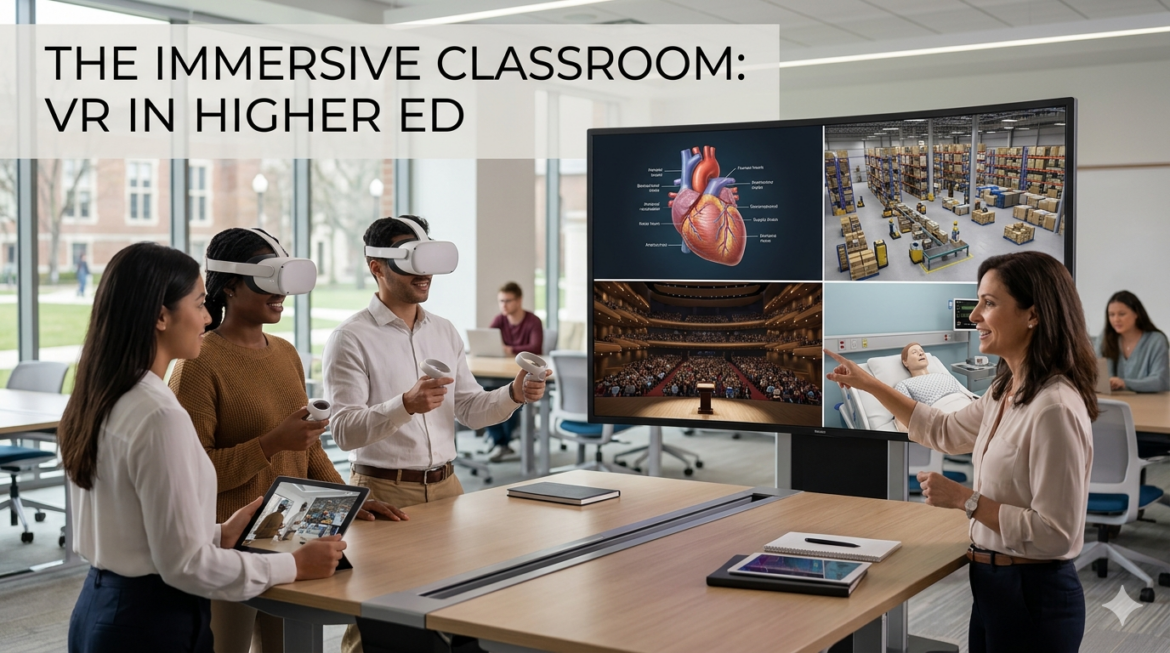
Virtual reality (VR) is quickly moving from classroom novelty to a practical tool for teaching and learning. Across disciplines, educators are using immersive environments to transform abstract concepts into lived experiences, give students safe spaces to practice high-stakes skills, and expose learners to places and scenarios that would otherwise be impossible to visit.
Why VR Fits Higher Education Teaching So Well
VR aligns naturally with experiential learning models that emphasize doing, reflecting, and applying rather than passively receiving information. When instructors bring students into simulated environments such as a supply chain hub, a nursing unit, or a virtual office, abstract ideas become concrete and memorable. Students can then analyze these experiences, link them to theory, and apply what they’ve learned in new contexts (Nguyen et al., 2025).
Because VR can model complex spaces, procedures, and social situations, it is especially powerful in professional and graduate education. Faculty in business, health, engineering, and cybersecurity use VR to let students rehearse real-world tasks without the risks, costs, or logistics of staging equivalent in-person scenarios. The ability to immerse students in realistic scenarios, let them experiment safely, and repeat activities as needed makes VR a valuable supplement to conventional teaching tools (Campos-Castillo et al., 2023).
How Faculty Are Using VR in the Classroom
VR in STEM and Laboratory Learning
In STEM fields, instructors are using VR to give students lab and field experiences that would otherwise be constrained by time, safety, or resources. Some universities have built VR modules that allow biology students to explore simulated ecosystems, examine ecological processes at multiple levels, and investigate scientific questions as if they were working in a research facility (Quintana, 2025). Faculty design these activities to reinforce key concepts, increase engagement, and narrow equity gaps by making advanced lab experiences accessible to every student in a course.
Similarly, chemistry and engineering instructors are designing virtual laboratories where students can practice procedures, manipulate equipment, and see immediate feedback on their actions. By navigating these spaces in VR before they enter physical labs, learners build procedural knowledge and confidence, which can reduce errors and make in‑person sessions more efficient and focused (Johnson et al., 2025).
VR in Business, Leadership, and Operations
Business schools have embraced VR as a way to bring markets, operations, and leadership challenges to life. In supply chain and operations courses, faculty use VR to immerse students in ports, warehouses, farms, and factories so they can visualize flows of goods, identify bottlenecks, and debate trade‑offs in realistic contexts (Quintana, 2025).
Leadership and management instructors are also turning to VR to simulate people‑centered scenarios. In one business program, students enter a virtual retail environment where they must make marketing and staffing decisions under conditions of uncertainty, drawing on frameworks from their coursework (Quintana, 2025). In other settings, faculty use VR to stage difficult conversations, negotiations, or team interactions, giving learners a safe space to experiment with communication strategies and see how different choices play out.
Business schools are also integrating VR into real estate and cybersecurity curricula. In real estate courses, students explore virtual home tours and 360-degree travel experiences to analyze how technology shapes buyer behavior, market transparency, and the value proposition of property technology (proptech). In cybersecurity, instructors guide students through virtual offices to identify security breaches, translating abstract risk concepts into spatial, tangible problems that can be solved collaboratively.
VR for Communication and Public Speaking
Platforms like Ovation provide highly realistic environments for practicing presentations. Faculty can assign students to a virtual auditorium, boardroom, or interview setting where they deliver talks to AI-driven audiences that respond contextually to each student’s delivery. The system then tracks metrics such as filler words, eye contact, and speaking pace and provides detailed feedback.
For students, this offers repeated, low‑stakes practice that feels more authentic than rehearsing alone. For instructors, it enables scalable coaching in communication‑intensive courses, from core MBA presentations to capstone project pitches. When faculty embed VR practice into structured assignments and reflection activities, students often gain confidence and are better prepared for internships, interviews, and early‑career roles where communication skills are critical.
VR in Health and Clinical Education
Health and nursing programs are using VR partnerships to expand clinical learning opportunities. In these contexts, faculty implement VR simulations to recreate common nurse-patient interactions and clinical decision points (Kalunga & Elshobokshy, 2024). Students can practice assessments, communication, and prioritization in a safe environment that can be paused, replayed, and debriefed as often as needed.
These partnerships, often with publishers, ed tech companies, or simulation vendors, help instructors address shortages in clinical placement sites and give students exposure to a broader range of cases than they might encounter locally (Every Learner Everywhere, 2025). They also position students to engage with tools that are becoming more prevalent in hospitals and health systems, supporting both equity and workforce readiness (Ray & Turner Lee, 2022).
VR for Storytelling, Media, and Social Impact
Faculty in media, journalism, and communication programs are leveraging VR to place their students at the intersection of storytelling, technology, and social impact. Through collaborations with organizations such as Games for Change, instructors integrate VR documentaries that explore topics like nuclear threat or environmental justice (Salvant, 2023). Students analyze narrative design, audience experience, and ethical considerations while gaining hands‑on exposure to immersive production workflows (Salvant, 2023).
Projects like metaverse campus twins also illustrate how faculty can use VR to support entire course experiences, not just one‑off activities (Every Learner Everywhere, 2025; Quintana, 2025). In these initiatives, instructors hold class sessions in virtual replicas of a campus, guide students through reconstructed historical sites, or supervise simulated chemistry experiments (Quintana, 2025). This model combines instructional innovation with institutional visibility.
Benefits for Teaching and Learning
The most effective implementations focus less on the novelty of the technology and more on intentional learning design that connects immersive experiences with clear learning outcomes.
Several benefits consistently emerge when faculty design VR experiences with care.
- Deeper engagement and retention: Students describe VR activities as more memorable and engaging than traditional formats, and instructors report richer discussions because students share a common, immersive reference point (Martínez et al., 2024; Tegg et al., 2025).
- Safer practice for high‑stakes skills: VR allows repeated practice of skills like public speaking, clinical decision‑making, or incident response without real‑world consequences, making it easier for faculty to scaffold practice and feedback (Carnegie Mellon University XR Lab, n.d.; Johnson et al., 2025; Martínez et al., 2024).
- Expanded access and equity potential: When institutions provide shared equipment, multi‑device access, and inclusive content, VR can help level access to experiences, such as global sites, advanced labs, or high‑end clinical settings, that are otherwise limited or unreachable (Every Learner Everywhere, 2025; Ray & Turner Lee, 2022).
Designing VR with Faculty Intent
When instructors integrate VR as one part of a broader sequence, preparation, immersive activity, and guided reflection, they can turn headsets into catalysts for deeper thinking rather than distractions. And when institutions support faculty with training, partnerships, and equitable access models, VR becomes a practical, sustainable extension of good teaching practice.
Ultimately, bringing VR into the classroom is not about chasing the latest technology. It is about expanding the ways educators can help students experience, analyze, and apply what they learn. When immersive tools are paired with thoughtful instructional design, VR can become a powerful extension of the educator’s toolkit rather than a distraction from it.
Exhibits
Practical Tips for Educators Considering VR
- Start with learning outcomes, not technology.
- Use VR for experiences that are difficult, dangerous, or impossible to replicate physically.
- Pair immersive activities with reflection or discussion.
- Begin with short modules rather than full-course integration.
- Work with instructional designers or learning technologists when possible.
Sample VR Applications
| Application | Link | Description |
| Biology Dissection Lab | https://www.meta.com/experiences/biology-dissection-lab/24232180253062666/ | Virtual biology lab for Quest where learners perform realistic dissections (e.g., frog, fish, crayfish) with guided steps and hand tracking, supporting safe, repeatable anatomy and lab‑skills practice. |
| Ovation | https://www.ovationvr.com/ | Public speaking, presentations, mock interviews, role play scenarios, and more. |
| VRLab Academy | https://www.vrlabacademy.com/en | Browser‑ and headset‑accessible virtual laboratories offering interactive experiments in biology, chemistry, physics, and more, designed to replicate real lab workflows and instruments for education and training. |
| Cybersecurity Awareness | https://www.meta.com/experiences/cybersecurity-awareness/6582898445109404/?srsltid=AfmBOop95644Uh-E_hmdIzK8H2qMXdBCNufNWaf9BoChW7zsQIVZG3_h | This VR experience immerses learners in realistic cyber threat scenarios to build practical, hands-on cybersecurity skills. Participants strengthen their awareness and learn strategies to protect their digital presence and valuable information. |
| Courseta VR | https://www.meta.com/experiences/courseta-vr/6322888564476383/ https://intulect.com/ | Nursing and healthcare training platform on Quest that provides virtual clinical scenarios, AI‑driven patients, skill assessments, and instructor dashboards for simulation‑based learning. |
| Supply Chain and Logistics Training | https://tech-labs.com/videos/mimbus/logistics-warehousing | VR Logistics & Warehousing Simulator lets learners experience core logistics in a safe, immersive environment. It supports career exploration and workforce development by providing hands-on, scenario-based insight into the skills and challenges of modern logistics roles. |
| Meta Campuses | https://www.okcu.edu/admissions/ocu-virtual-campus | Oklahoma City University’s Virtual Campus |
| https://jplt-dialogplus.com/metaverse/ | Japanese Language Training Online School | |
| https://medium.com/@paulsimonkenya/vr-for-social-good-b07cc97ac336 | Africa VR Campus and Center – this article has a link to the Center’s Facebook and YouTube. You can find them in the metaverse on Engage VR. |
References
- Campos-Castillo, C., Parry, D. A., & Keipi, T. (2023). Classrooms in the metaverse: Educational applications and levels of immersion. Communication Education, 73(1), 1–22. https://doi.org/10.1080/03634523.2024.2312873
- Carnegie Mellon University XR Lab. (n.d.). Virtual reality for public speaking. Carnegie Mellon University.
- Every Learner Everywhere. (2025, February 9). Inspiring examples of digital learning at minority-serving institutions. https://www.everylearnereverywhere.org/blog/inspiring-examples-of-digital-learning-at-minority-serving-institutions/
- Johnson, M., Rivera, K., & Wang, L. (2025). Using immersive augmented reality (AR) or virtual reality (VR) in a classroom setting: A systematic review. Journal of Higher Education Theory and Practice, 25(3). https://articlegateway.com/index.php/JHETP/article/view/7571
- Kalunga, R., & Elshobokshy, F. (2024). A multipronged approach to harnessing virtual reality to advance diversity, equity, and inclusion. Faculty Focus. https://www.facultyfocus.com/articles/equality-inclusion-and-diversity/a-multipronged-approach-to-harnessing-virtual-reality-to-advance-the-hbcu-mission/
- Li, X., Chen, Y., & Park, S. (2022). The effect of virtual reality therapy and counseling on students. BMC Psychology, 10, 217. https://doi.org/10.1186/s40359-022-00924-w
- Martínez, A., Gupta, R., & Lee, H. (2024). The impact of virtual reality on student engagement in the classroom. Education and Information Technologies, 29(4). https://doi.org/10.1007/s10639-024-12345-6
- Nguyen, T., Smith, L., & Jackson, P. (2025). Impact of immersive VR-enhanced experiential learning on student outcomes. Journal of Educational Technology and Distance Education, 18(2). https://aquila.usm.edu/jetde/vol18/iss2/9/
- Ovation. (n.d.). Ovation: Speak confidently. From virtual to reality. Retrieved March 10, 2026, from https://www.ovationvr.com
- Quintana, C. (2025, May 26). Seven examples of students learning with virtual reality. Inside Higher Ed. https://www.insidehighered.com/news/student-success/academic-life/2025/05/27/seven-examples-students-learning-virtual-reality
- Ray, R., & Turner Lee, N. (2022, September 6). Ensuring equitable access to AR/VR in higher education. Brookings Institution. https://www.brookings.edu/articles/ensuring-equitable-access-to-ar-vr-in-higher-education/
- Salvant, L. (2023, March 27). G4C’s first HBCU partnership supports gathering research on virtual reality storytelling. Games for Change. https://www.gamesforchange.org/blog_posts/g4cs-first-hbcu-partnership-supports-gathering-research-on-virtual-reality-storytelling
- Tegg, R., McLean, S., & Borgese, S. (2025). Experiential learning through virtual reality by-proxy. Frontiers in Virtual Reality, 6, 1620905. https://doi.org/10.3389/frvir.2025.1620905





 Biology