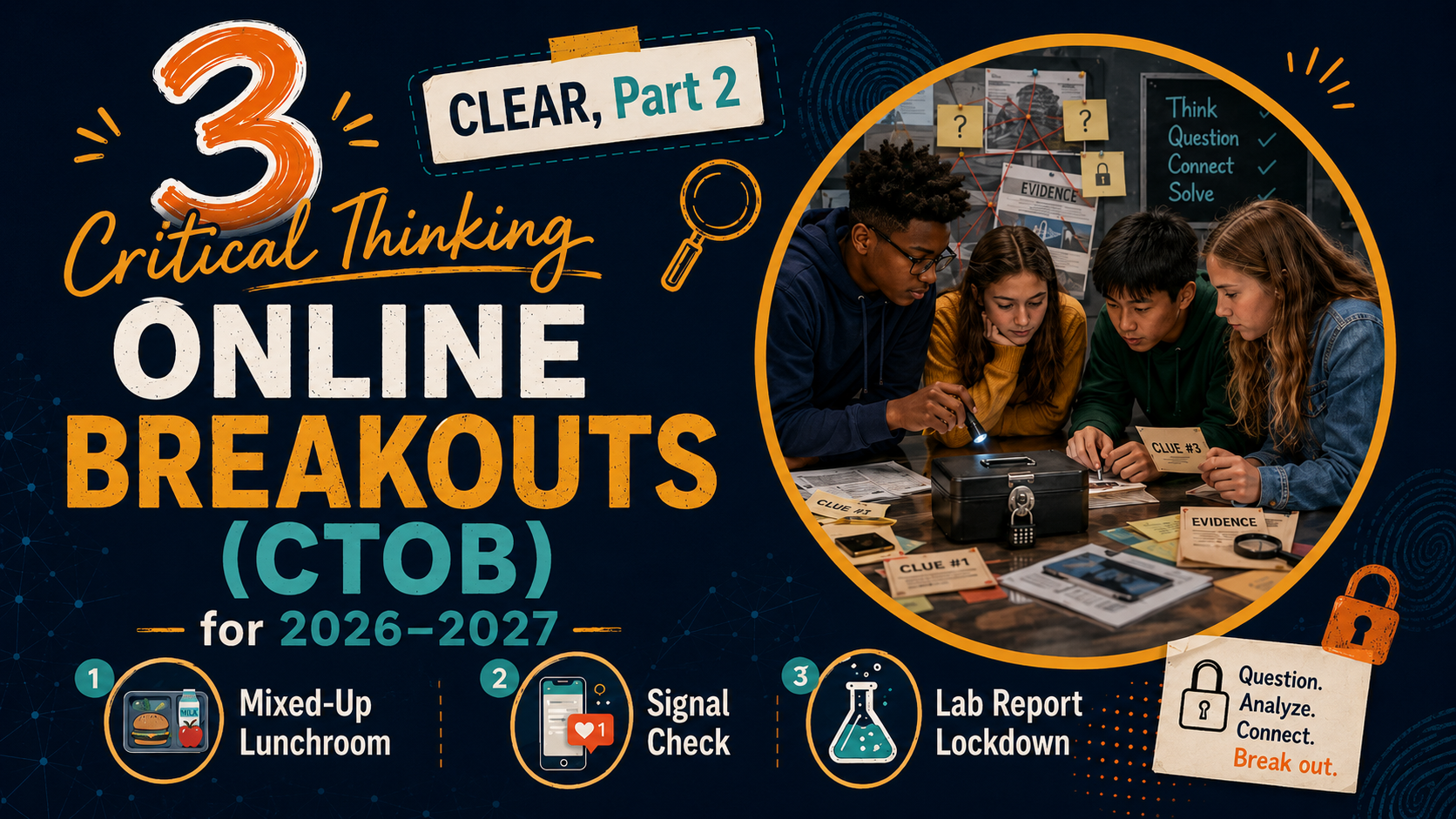
For the 2026-2027 school year, I have three brand new digital breakouts to share. Well, that’s not exactly accurate. Let me share the first three of thirty-nine breakouts aligned to the TEKS by grade level band and multi-lingual (five plus languages). These are designed to be low-prep, easy to use, and just the right mix of thinking and fun. You can use them as bellringers, partner activities, morning work, station rotations, or quick fillers when your lesson wraps up a few minutes early. Be sure to read part one of this blog series, Crack the Case with CLEAR, Smart Thinking.
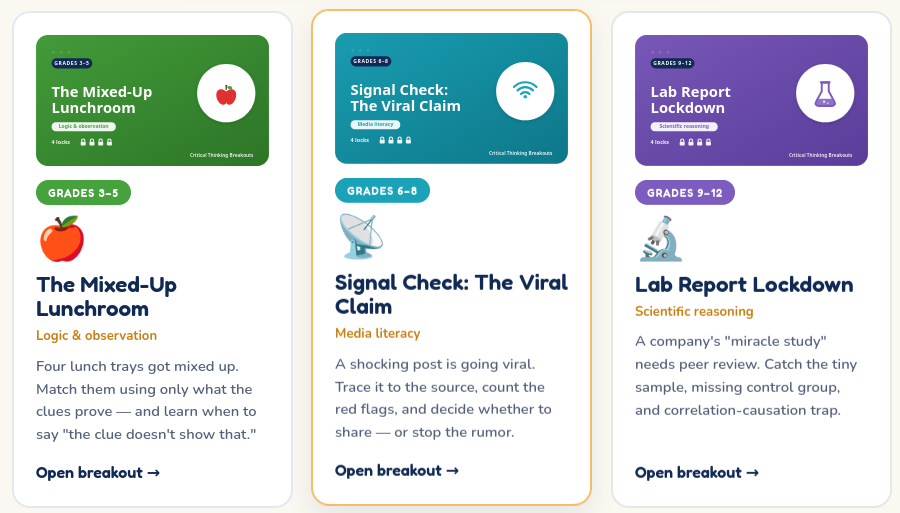
Each one is a digital escape room built around a real reasoning skill. Students open clues, weigh what each one actually proves, and crack a set of locks to finish. No login, no prep, no answer guessing. A lock will not open until the reasoning holds up. I am excited for you all to take a look.
1. The Mixed-Up Lunchroom
The Mixed-Up Lunchroom is all about looking closely, sorting evidence, and knowing when there just is not enough information to answer. Four lunch trays got mixed up, and students have to match each one back to its owner using only what the clues prove.
The goal is simple. Students use the clues to crack the locks. But there is a twist. When a clue does not actually support an answer, students have to say so out loud instead of filling the gap with a guess. I like that move because it stops the thing we have all watched happen. One tiny detail turns into a full backstory, a friend group, and possibly a pet iguana.
This one is built for grades three through five. The mysteries stay small and concrete, but the reasoning underneath is the same work an adult does with a suspicious headline.
2. Signal Check: The Viral Claim
Some students share first and think later. Some pause. And some will absolutely have strong feelings about whether a screenshot counts as proof.
Signal Check drops students into a shocking post that is going viral. Their job is to trace it back to the source, count the red flags, and decide whether to share it or stop the rumor. It is perfect for the stretch of the year when you want students questioning their feeds instead of forwarding them.
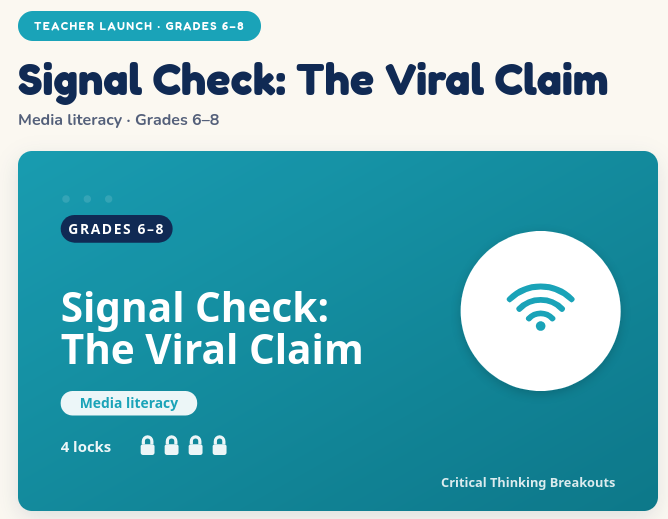
This breakout is for grades six through eight, and it adds a fifth lock the others do not have: an evidence sort. Students have to select every strong piece of evidence and leave the noise behind. Not most of it. All of it, and only it. Grab a weak clue or miss a strong one, and the lock stays shut. I added that lock on purpose, because sorting strong evidence from weak is the exact skill students tend to skip.
3. Lab Report Lockdown
Lab Report Lockdown is a fun way to introduce or review scientific reasoning without starting from a worksheet. A company is pushing a miracle study, and students have to peer-review it before it passes.
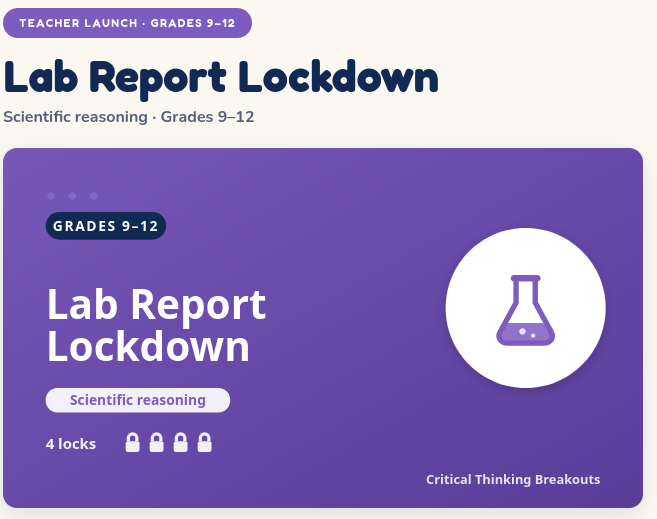
They hunt for the tiny sample size, the missing control group, and the correlation-causation trap. It is a quick way to get students thinking about what makes evidence trustworthy, and how easy it is to dress up a weak claim in lab-coat language. Honestly, bad studies are everywhere. We see headlines about what one food cures and what one habit prevents, and somehow we are all supposed to nod along.
This one is built for grades nine through twelve. Same reasoning muscle as the younger breakouts, just heavier weight.
How Breakouts Work
Every breakout works the same way, so you only learn the format once. Project it and crack the locks as a whole class, or let pairs race and compare how they got there. Every lock ends with a short “why,” so students keep the reasoning, not just the code.
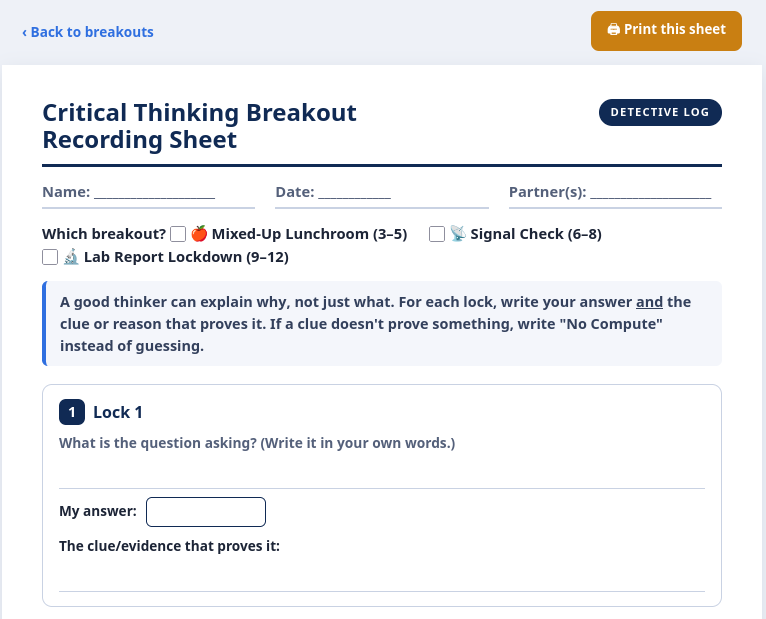
There is also a printable student recording sheet that works with all three. I use it when I want a paper trail of student thinking, so I can see where the reasoning bent and catch it before it becomes a habit.
But Wait, There ARE Many More!
If you had fun exploring these three digital breakouts, please know that there are more…many more. Each has been lovingly hand-crafted via agentic AI and verified as high-quality. If you needed a way to teach critical thinking, these activities align to grade 3-5, 6-8, and 9-12th grades. Click the MORE buttons below.
What’s more, these are all multi-lingual and available in these languages common to Texas. You can see the languages below:
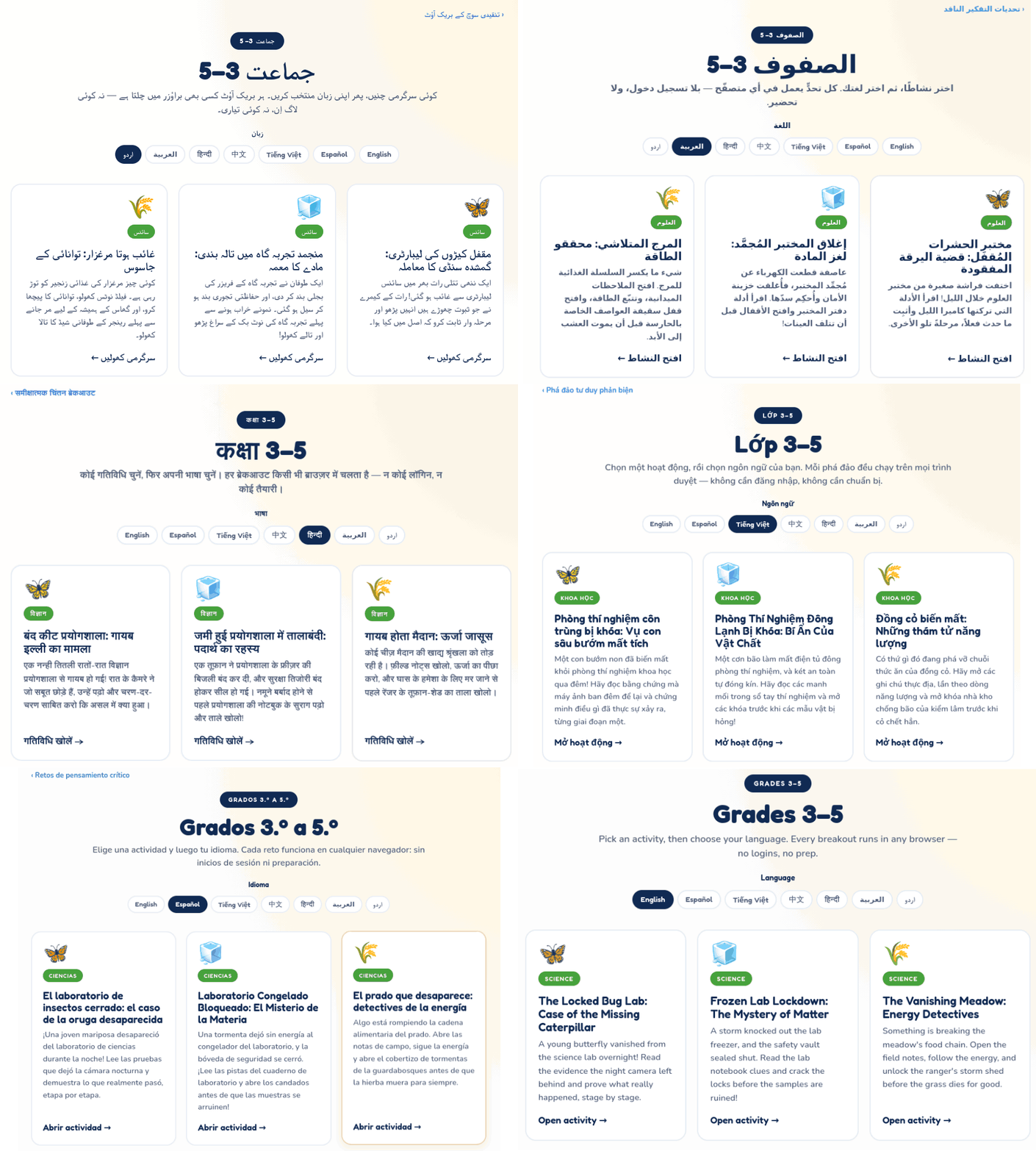
But here’s a list:
- English
- Spanish
- Vietnamese
- Chinese
- Arabic
- Urdu/Hindu
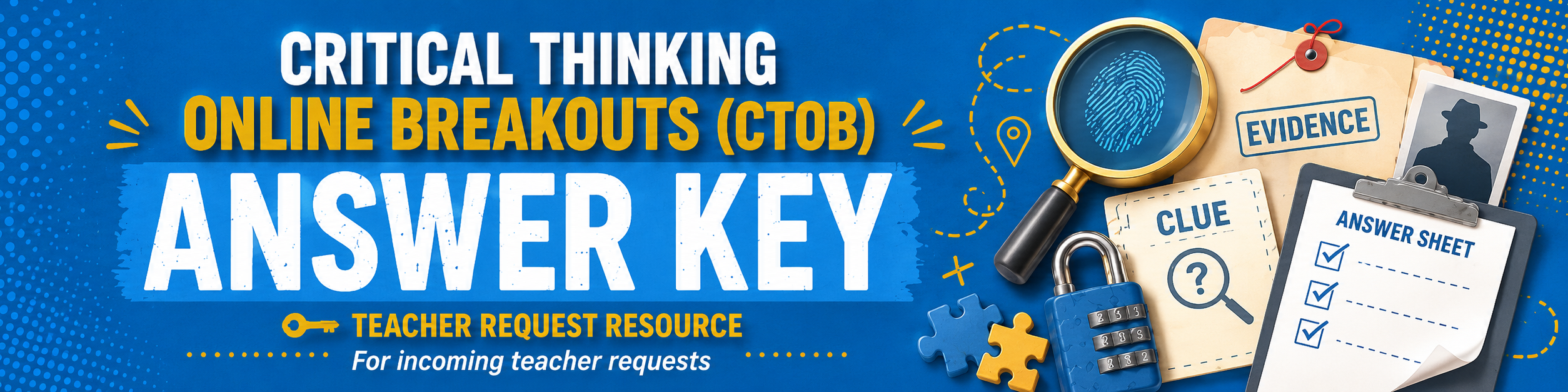
Each comes with its own answer key. If you need an answer key (students need not write or comment), please fill out this Google Form and I’ll consider your request. 😉
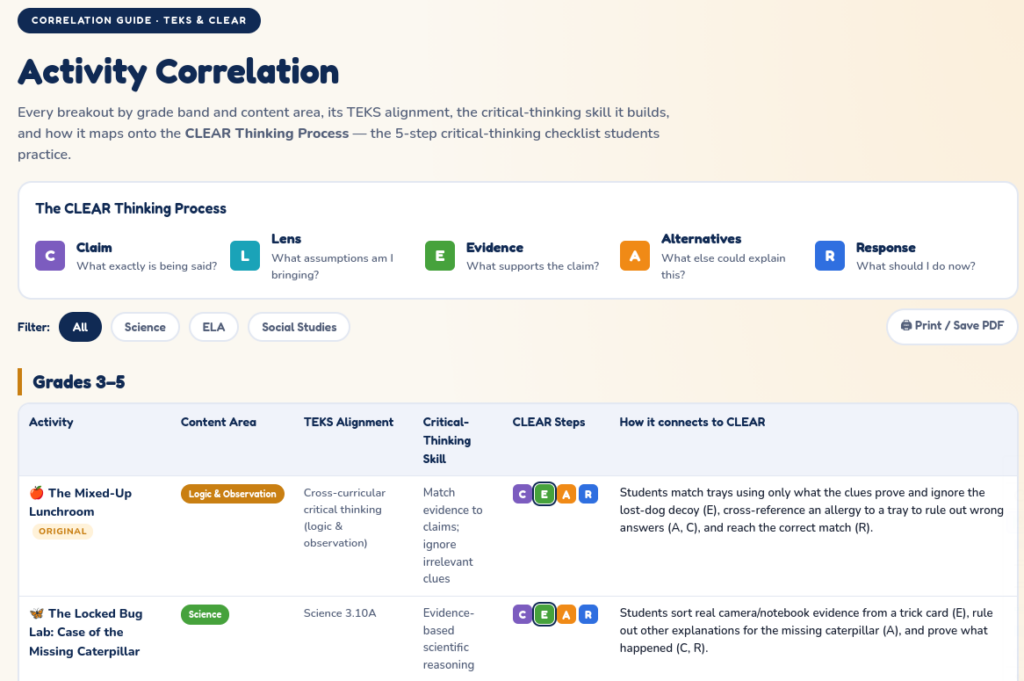
Content Area TEKS Correlation as well as CLEAR
Every breakout band (e.g. 3-5, 6-8, 9-12) now comes with correlations to TEKS Alignment, Critical Thinking Skill, and how it connects to CLEAR.
Privacy and Compliance: Covered!
Each breakout is a single web page with no login, no server, and no data collection. The only outside request is to Google Fonts. The full privacy and compliance page covers GDPR, FERPA, COPPA, Texas requirements, CIPA, and accessibility. The short version: there is no student record to protect, because none gets made.
Did You Know? TCEA’s AI Essentials for Educators course (seventeen CPE hours, badge and certificate) helps you leverage Gen AI, no matter the tool, to get things done faster and spend time on the tasks that need the long road, not a shortcut.
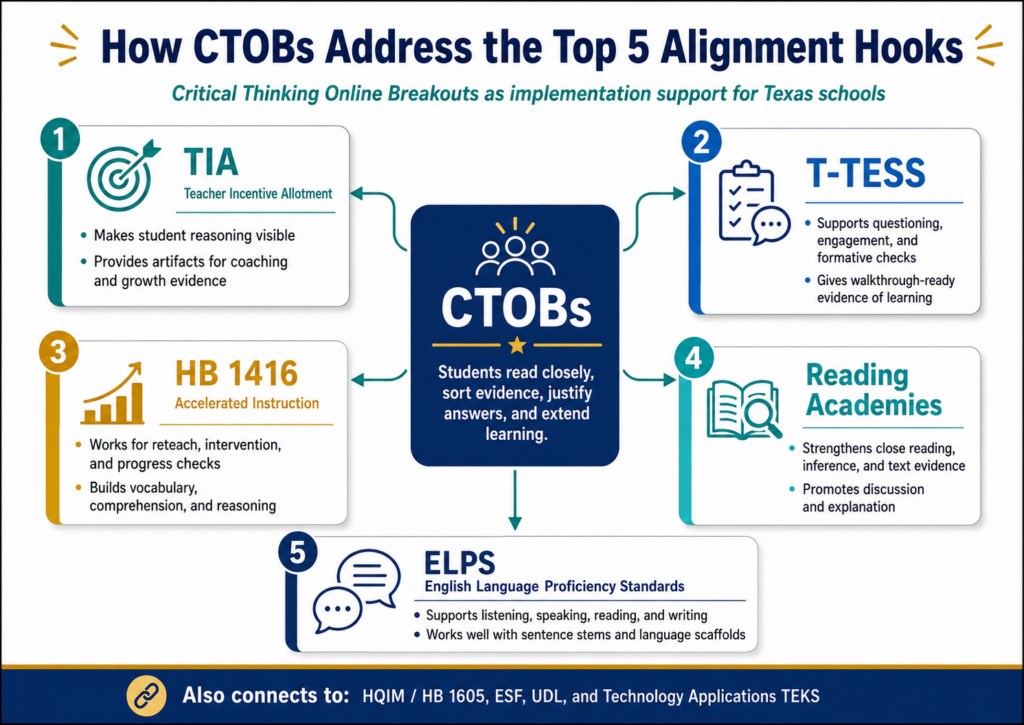
Whether you start with The Mixed-Up Lunchroom, Signal Check, or Lab Report Lockdown, I hope these breakouts help make critical thinking a little easier to teach and a lot more engaging. These pair with the CLEAR Crew Detective game from my earlier post if you want more reps on the same skills.
Open the Critical Thinking Breakouts hub, pick the grade you teach, and run one this week. Then tell me in the comments which lock gave your students the most trouble. Looking for the answer key? Fill out this Google Form and I’ll consider your request. 😉