Explore effective teaching strategies, tools, and resources. Discover ideas to enhance classroom practices and inspire student success.
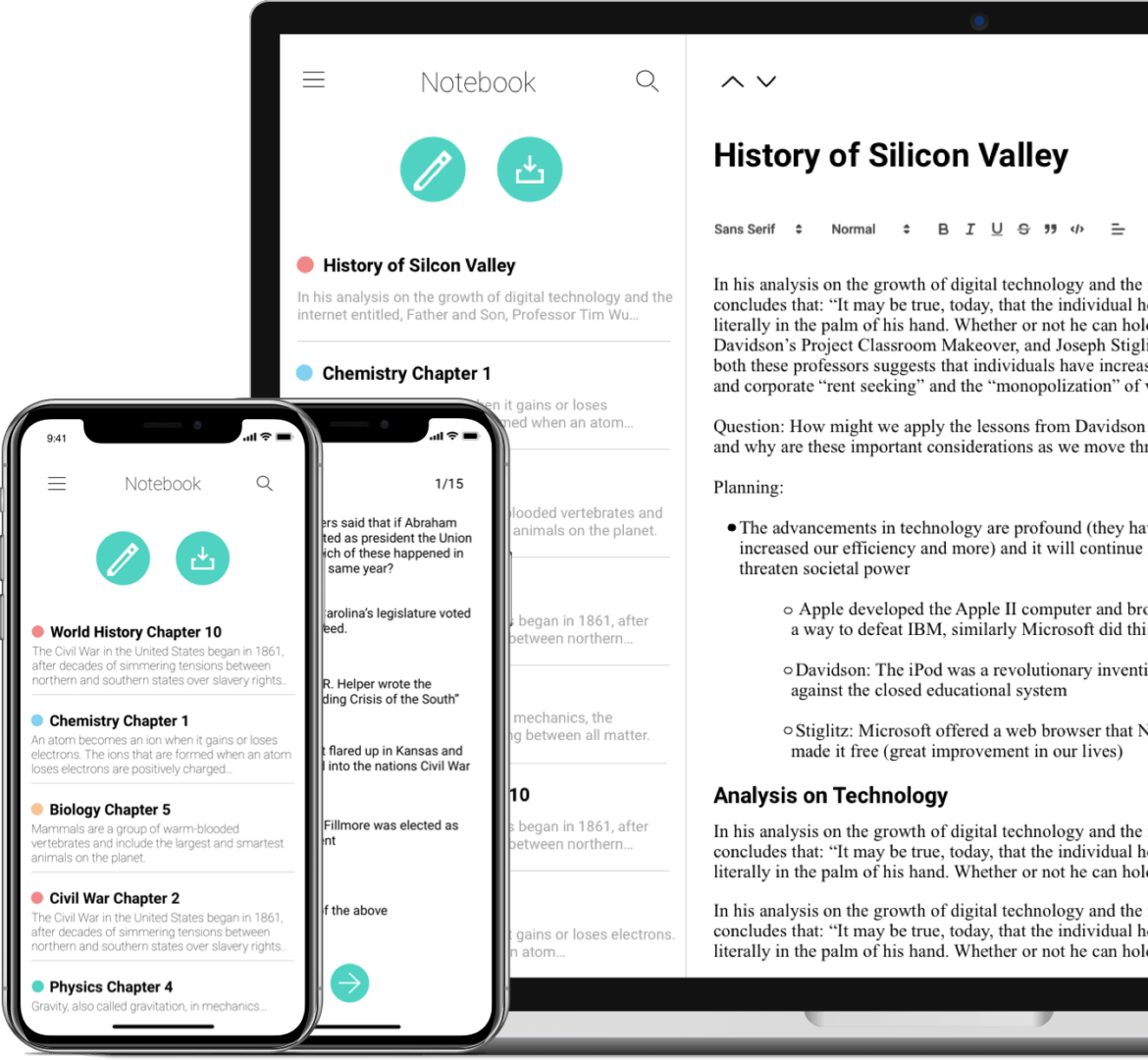
The research is clear: rereading a text doesn’t work as well as taking a test over the material. Known as retrieval practice, it involves students studying a passage of text. Then, students take a low-stakes test about it. In this blog entry, we’ll explore a tool that empowers students to make their own tests.
The Testing Effect
“Retrieval practice” involves frequent testing or quizzing. Students take practice tests over a period of time. This pushes them to recall material from memory. In time, this assists students with remembering the material. Research shows that students recall more information from practice testing than rereading.
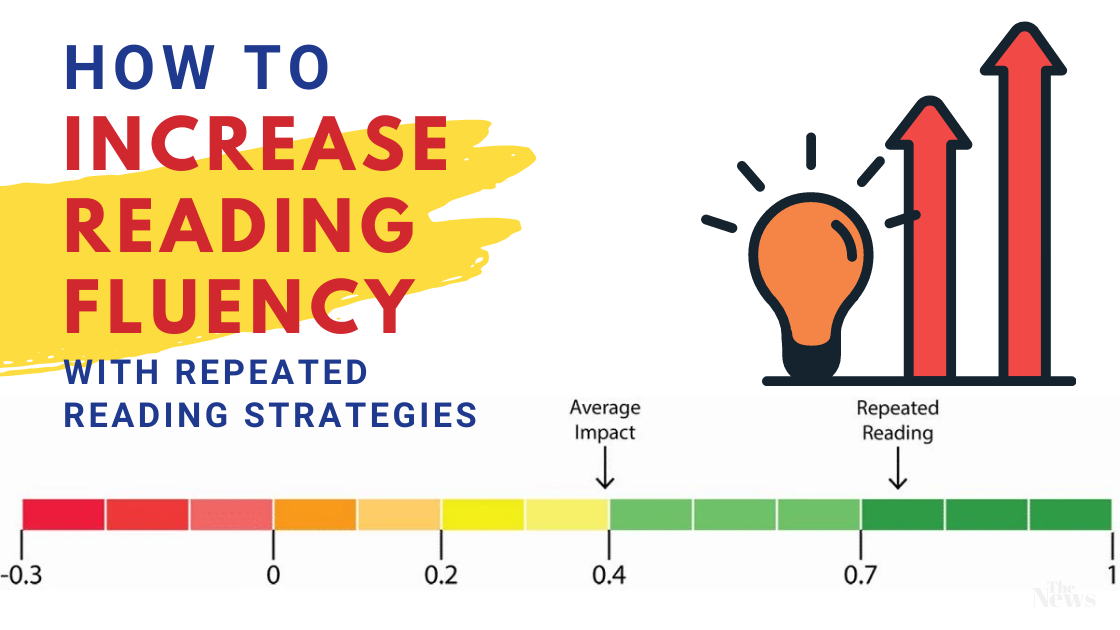
Practice testing has an effect size of .46. The Visible Learning Meta X database describes it in this way:
Practice testing is a well-established strategy for improving student learning. The aim of practice testing is to support long-term retention. It is also to increase access to retrieving the “to-be-remembered” information. Sometimes called retrieval practice, practice testing, or test-enhanced learning.
Let’s take a look at some research. These results compare studying versus practice testing as a way to increase retention:
- Studying
- Need information retained for a short time? Study it.
- Studying over fewer, longer sessions is less effective than its alternative. The alternative is spacing out the intervals of study over a longer period of time. This is called Spaced vs massed practice and enjoys an effect size of .65.
- Practice Testing
- Need long-term retention of information? Use practice testing.
- Testing has a greater impact than repeated study when done over time.
- Testing after reading improves students’ ability to answer questions. That includes questions that are “in the text” and “in the head.”
- Testing done once a day after covering material increased retention
- Students tested often had increased retention.
- It doesn’t matter what form the questions take. Students gain the benefit of practice testing regardless of question type. All questions were as effective as the others at enhancing the students’ learning. Question types include:
- multiple-choice,
- short-answer, and
- hybrid questions
You can deepen the impact of practice testing if students receive feedback. Delayed feedback yields better results. That’s no surprise since feedback has an effect size of .64 itself.
What’s convenient about practice testing is teachers or students can create the test. The question is, what’s the best way to do that?
Reviewing High-Effect Size Strategies
Before we jump into the technology side of this, notice that there may be a happy confluence. The confluence is of high-effect size strategies that include the following:
- Spaced vs Mass Practice (.65)
- Feedback (.64)
- Note-Taking (.51)
- Practice testing (.46)
It’s easy to see how these powerful strategies speed growth in a year and a half in a school year. Ok, now that’s out of the way, let’s review some technology tools.
Ways to Create Practice Tests
Although teachers can make a practice test, there’s a benefit to students making it. No doubt, teachers are making tests using various tools that support quizzing.
Some of those tools teachers use include the following:
- Google Forms: Create quizzes with this easy to use tool
- Kahoot!: Check out these TCEA TechNotes blog entries on Kahoot!
- Microsoft Forms: Learn more about Microsoft Forms via this blog entry
- Quizlet: Explore this tool via these blog entries
- Quizziz: A few blog entries discuss how to use this tool
While students can use these tools, there is another one available.
Student-Created Quizzes
As a high school student, I stumbled upon a technique that I wish someone had told me about earlier. That is, how to read a selection of text then select content that might appear on a test. At the time, I did not create a test. I highlighted, wrote down or summarized critical test information. It was only later that I would reformulate my notes into test questions. This technique was quite effective in history classes, which I made straight “As” in.
Students can now use a free service to turn their notes into practice quizzes. Students can use an online notebook, or import their notes. The imported notes can be in Google Docs, or Word format. Once imported, the student click a button and their notes get turned into a quiz.
Wondering what the digital tool is that can students can use? Asking yourself what tool can they use to get a .47 effect size boost to knowledge retention? Let’s find out.
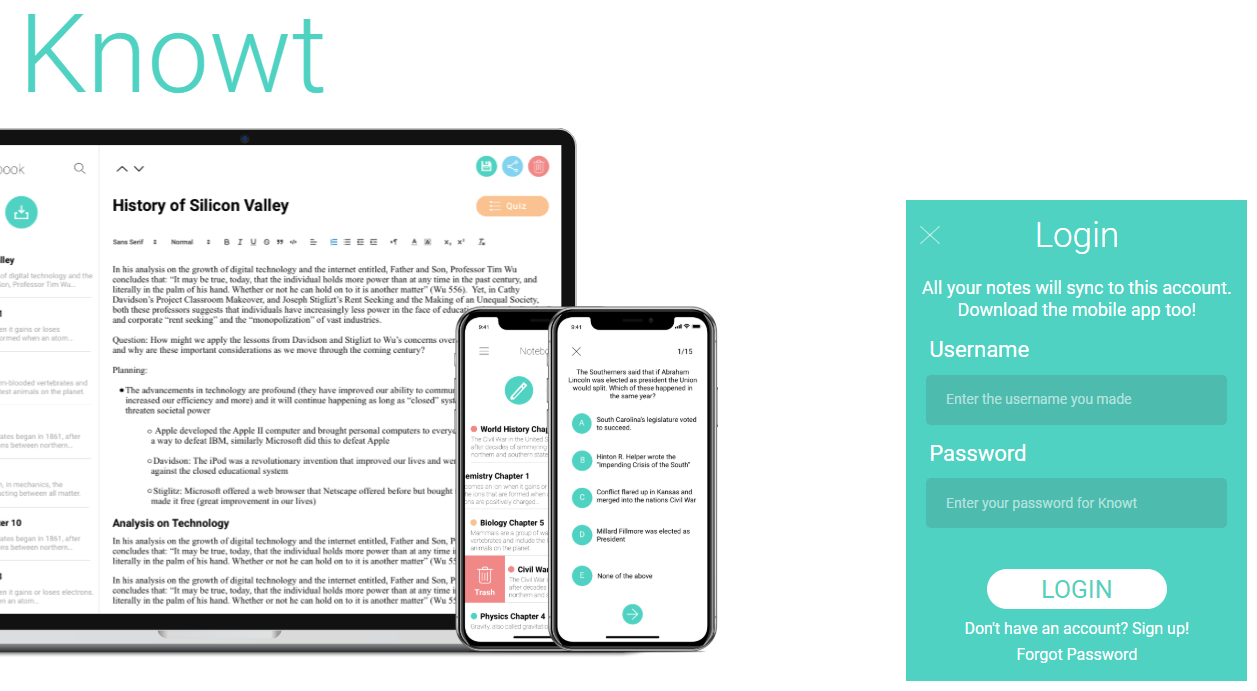
Meet Knowt: Get to Know Your Notes
Students can take their online notes, click a button, and a quiz appears. Knowt features fill in the blank, multiple choice or short answer questions. Recall that question type doesn’t matter for practice testing. Instead, it’s the repetition on a daily basis to allow for spaced practice (.65 effect size).
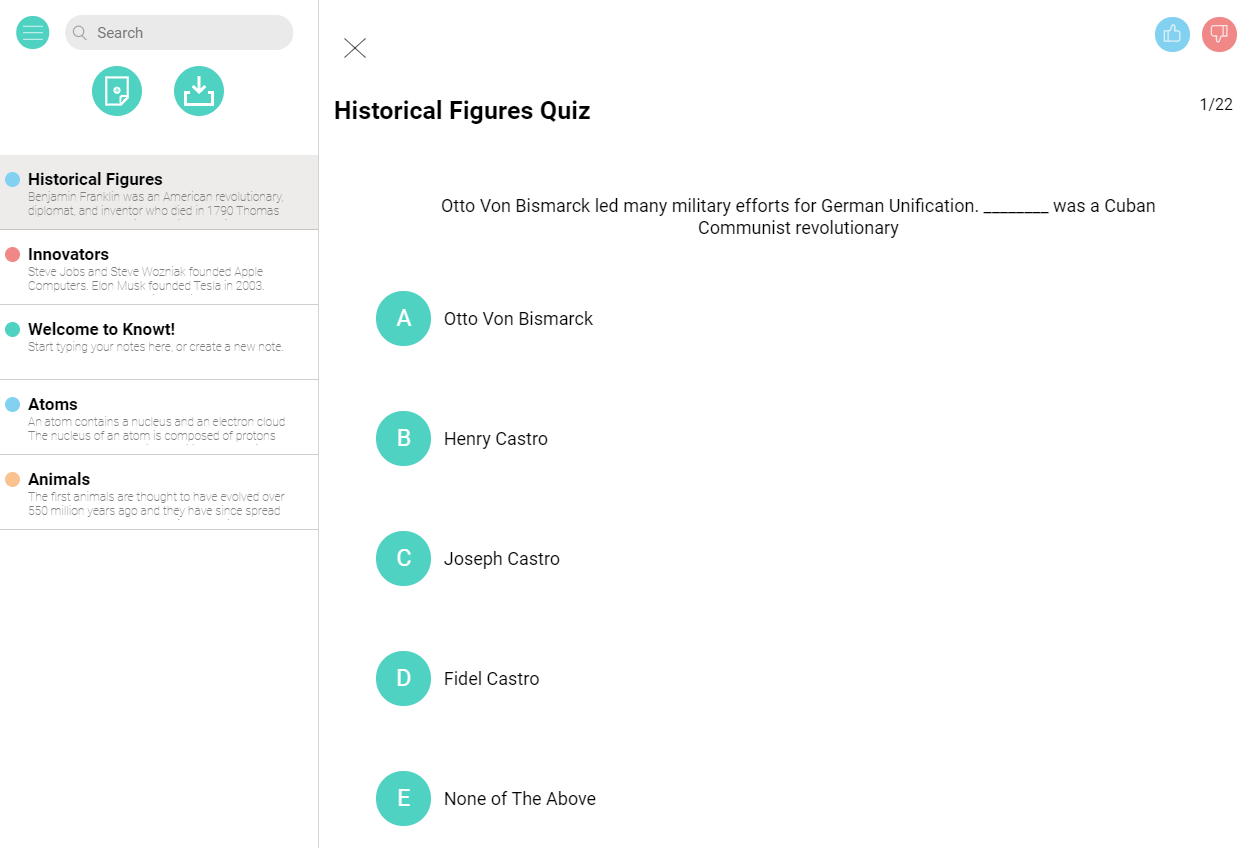
For fun, I asked Knowt to import a tough Google Doc. The Google Doc? Matching High-Effect Size Instructional Strategies and Digital Tools. It created a twenty-five question quiz out of the content.
Here’s the first question:
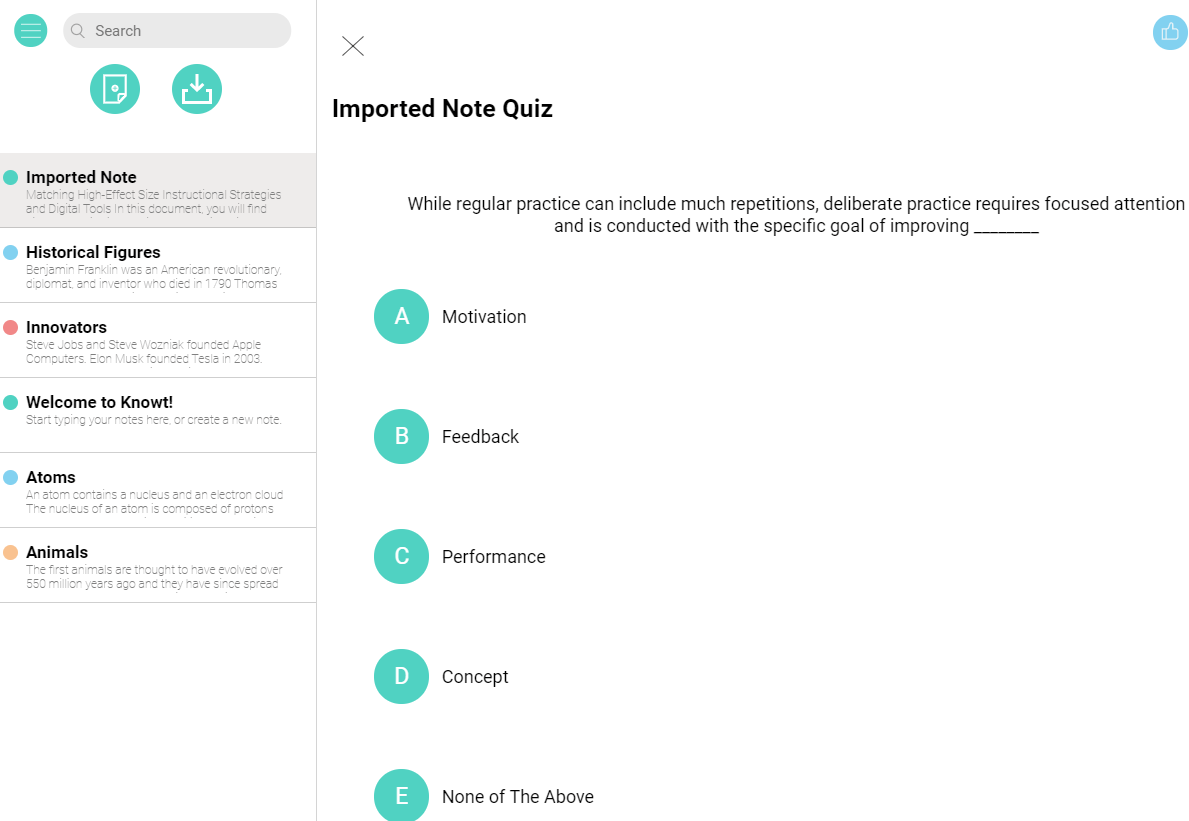
In case you’re wondering, the answer is C. Performance. How did Knowt do this? Knowt describes their process in this way:
First, we take your notes and analyze them using machine learning. On our server, the A.I. determines the best question formats for each sentence. Once it knows the best questions, the algorithm sends it to the web or mobile app for you to take a quiz. It only takes seconds. At the end, you get great quizzes that are custom made from your notes that you can take anywhere you go.
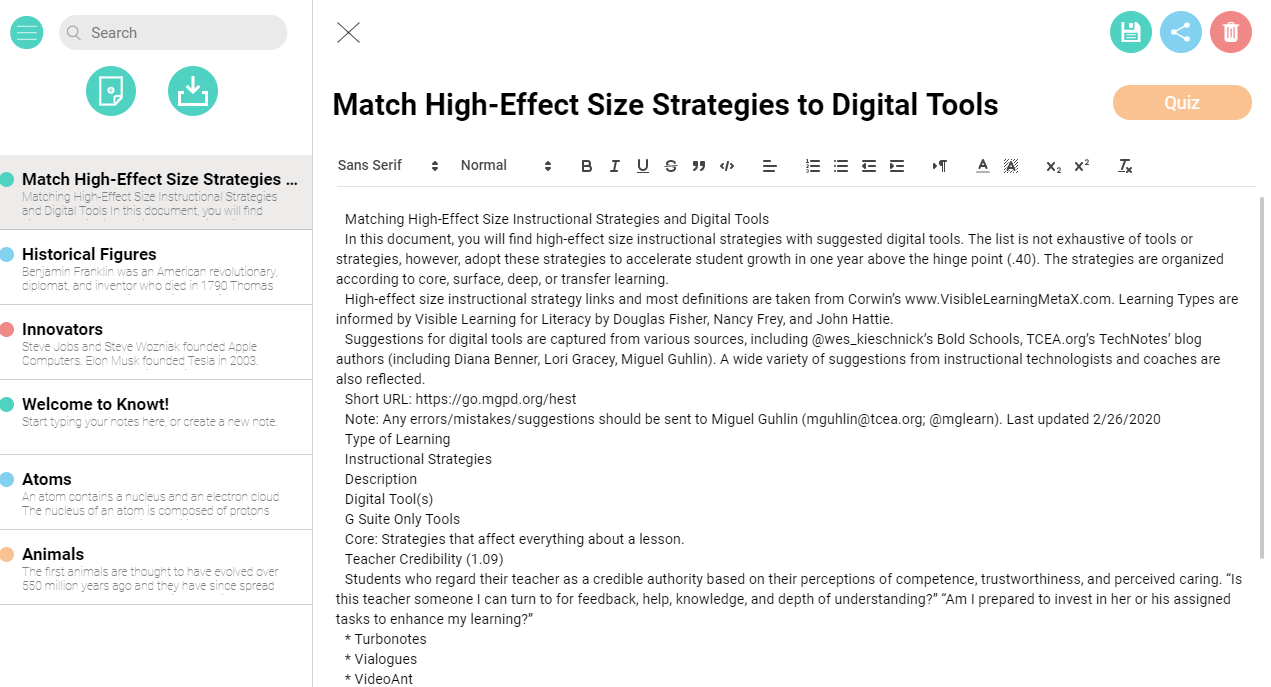
In this 25-question quiz that I created from complicated content, the questions made sense and worked. Here’s what my notes looked like in Knowt:
Fiction vs Non-Fiction
For fun, I decided to drop one of my favorite stories into Knowt. The story? Frank Stockton’s The Lady or the Tiger (online). One of my favorite teachers, Fr Richard O’Shaughnessy, introduced it to my classmates and I. Like everyone else, we agonized over the ending.
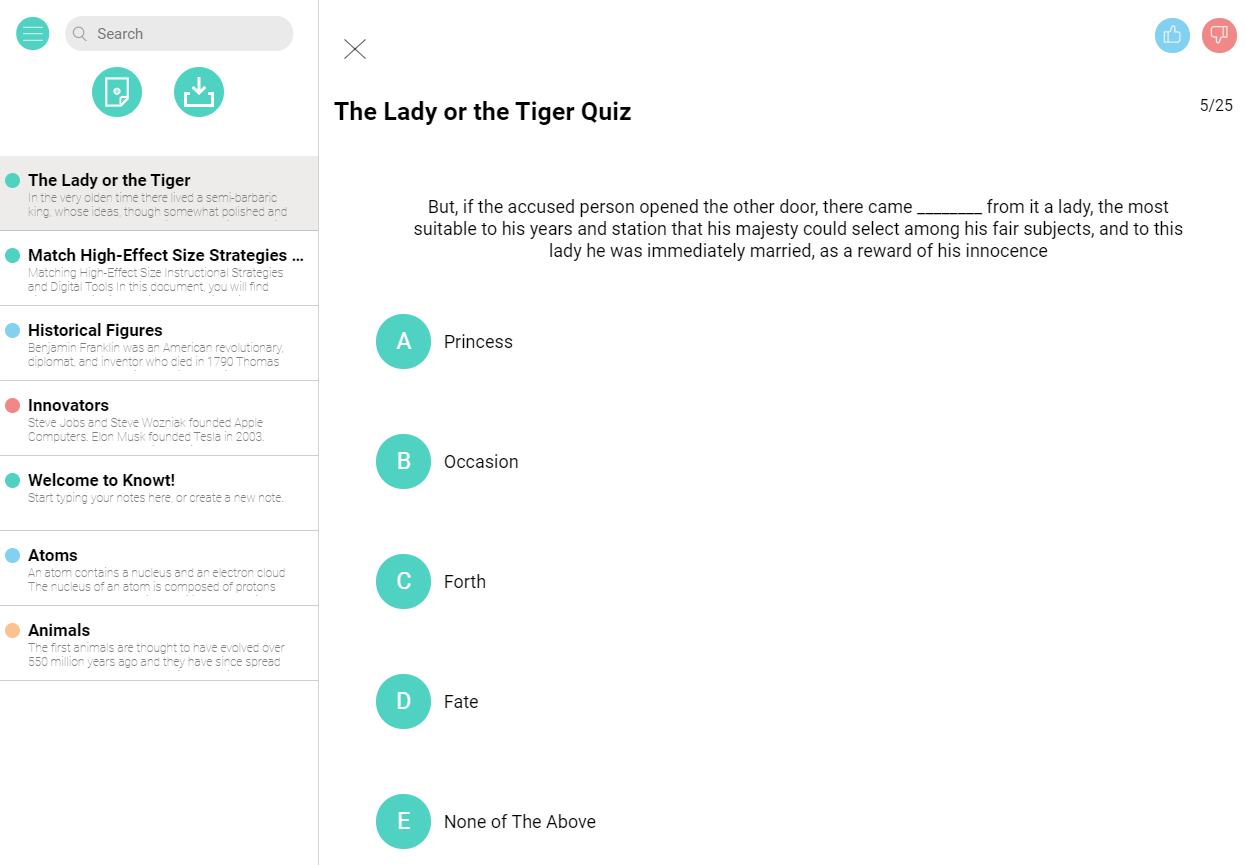
Knowt turned the story into another 25-question quiz. Some of the questions were not reasonable, but if you have to know it cold, Knowt works great.
Watch a Video
Need a quick way to get started? Check out esteemed educator, Richard Bryne, as he shares a demo of GetKnowt.
A teacher’s edition is under development and is due out in April 2020. That’s right around the corner. Sign up for the beta.
Making an AI-powered quiz of study materials has never been easier. Give Knowt a try. Want to share quizzes you create as a teacher? The Knowt Teacher’s Edition makes it possible. It also features a class section, student management, and more. Pilot programs for the teacher’s edition are also available.
Image Source
Feature image. Screenshot by author.