

Summer is quickly approaching and you are probably beginning to make plans for some much needed R&R. While the summer break can be a sacred, quiet getaway, don’t forget to squeeze in a little time for you to explore some new tools and gather a few new ideas to make the 2018-2019 school year even more memorable for both you and your students. Here are a few tips on getting funding for your PD needs this year:
Ask Your Principal
Ask your principal to include PD funding in the school’s budget. This is the time of the year when principals are creating their budget requests for next year. There may even be some unused funds you can use for some summer PD.
Request a Tax Refund
You may know that you can save your receipts for supplies and claim a deduction on your taxes, but did you know that professional development can also be a deduction? You can learn more here.
Share Your Passion with Parents
Many elementary teachers are given a profile form from the homeroom parent requesting gift ideas for holidays and special occasions. Link them to your crowdsourcing pages like Donors Choose which can raise funds for attending a conference or securing new equipment for your classroom.
Look for Special Promotions
While not all promotions will apply to you, it may save previously allocated money that you may be able to ask for later. Our May 15 event offers a free registration for district leadership and a 50 percent discount for administrative support at the campus level. An event later this fall will offer free registration for technology directors – you know you want them on your good side when the technology hits the campuses!
TCEA Educator Awards
Each year TCEA recognizes phenomenal educators in multiple categories. Both the winners and finalists receive cash prizes in addition to their recognition. So, this fall when you see the nominations open, nominate yourself or another stellar educator and start thinking about how to spend that money.
Know Your Funding
Do your research and know who in the district to ask for funds from ESSA, Title I, Title II, and other district-provided education foundations or grants you can apply for. Make sure they know your passion and how your continued professional development will benefit the district and your students.
Educators Are Heroes
Many organizations support their local educators. Seek out grants from organizations you belong to, including the PTA, religious institutions, Kiwanis, or Rotary Clubs, etc.
Grant Writing
You may think of grant writing as tedious and time consuming, but some grants can be simple. Many local companies are seeking out educators ready to make waves in STEM, makerspaces, and other buzz worthy education transformations. Smaller, local companies may have an easy grant application process. Here’s a blog from Dr. Bruce Ellis on available grants you may find helpful and another resource from Miguel Guhlin on grant writing tips.
There is funding available out there. You may just have to be the “squeaky wheel” to obtain some of it for your professional growth.


 of high school students indicate they use the Internet at home at least a few times a week. 54% of the high school students use it every day. The student’s Internet use is not dependent on whether the teacher purposely assigns homework that needs the Internet because only 13% of Texas teachers indicate they do so. Students are going to the Internet for help in their homework because it is the library of the 21st century. Students without this home access are at a distinct disadvantage. They have fewer ways to access content and are not learning the necessary skills of finding accurate information to answer their research questions.
 legislative session and TCEA was working for you. In most instances, all of our hard work in gaining support for our issues came down to the last weekend in May. Most legislation fails to pass largely because there is not enough time for the bills to get passed. The Texas Legislature only meets every other year, and for only 140 days. Our forefathers purposely made it difficult to pass a bill for fear that the government might grow and have too much power. Out of the 6,631 bills that were filed, only 1,089 passed and became law. Fortunately, eight of those bills were supported by TCEA for the benefit of our members.
  learning process is one of TCEA’s strategic goals. Judging by what legislation was passed, we feel good about the progress we made this session. The efforts that many of our officers and members made to email, call, or come to the Texas Capitol to testify or visit their state legislator played a critical role in getting the bills passed. Never underestimate your influence on your elected officials. Thank you for all your hard work, and keep it up!



 You might be thinking, why weren’t the teachers using the textbooks? Aren’t they aligned to the state objectives? Why wouldn’t a teacher want to use a “free” resource that is aligned to the objectives? Those are great questions, and there are probably multiple answers. But my theory is that districts slowly began to move away from a heavy dependence on textbooks as the state accountability system began to gain prominence. In order to ensure their students would do well on the state tests, districts began to build their teaching curriculum around the testing standards, especially in the areas in which their students struggled. This led many districts to begin using textbooks as a resource and not the resource. The districts began to purchase additional resources to supplement the textbooks to match their teaching curriculum. This resulted in waste as many textbooks went unused while districts spent their local money to purchase materials to supplement the state-approved textbooks.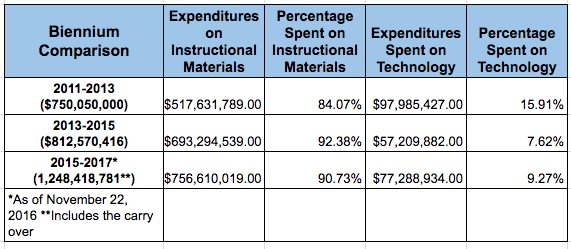
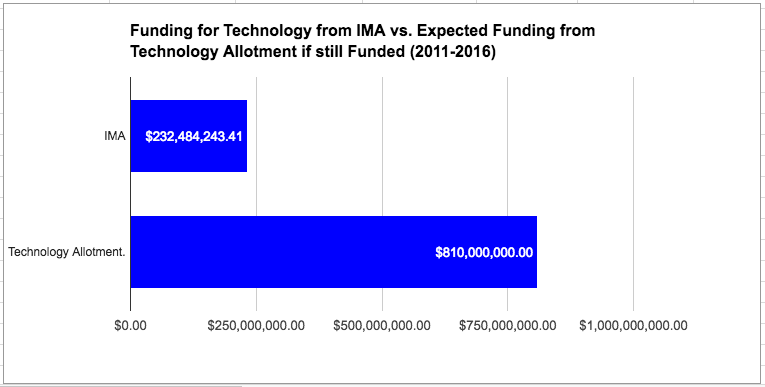
 School districts now live with the uncertainty of not knowing the cost of the next proclamation nor how much funding will be in the IMA. Prior to SB 6, the SBOE would establish a maximum price for any textbook that would be placed on their approved list. As expected, every textbook submitted for SBOE review came under that maximum price. Because the state was doing the purchasing, publishers could afford to offer the books at these prices because they knew they had a chance of selling a large number of books. SB 6 eliminated the maximum price because it was assumed that, with the new flexibility afforded in SB 6, business would decrease for the major publishers, which might mean that they would need to adjust their prices to remain profitable. The result is that the price of textbooks has increased and so has the uncertainty. Districts have no way of knowing how much the next proclamation is going to cost, so they often save whatever they don’t spend on the current proclamation to make sure they have enough for the next one.
 Since TCEA’s mission is to help districts implement a digital learning environment, the reduction in funding for technology is a grave concern. We have supported the structure of the IMA because we believe that technology should always be purchased within an instructional context. Because technology should support the instructional goals of a district, it is healthy for district personnel that support both to work together to determine how best to use district resources to meet the district’s strategic goals. This includes the IMA.