
The students have left for the summer. Teachers are taking a well-earned break. For many educators working as instructional coaches, the pace has finally slowed enough to think beyond the next crisis. That’s exactly why now is the most important time of year for coaching success.
Every fall, instructional coaches begin the school year with ambitious plans for classroom support, teacher development, and instructional improvement. Yet by November, many find themselves covering classes, coordinating testing, managing logistics, and handling tasks that have little to do with coaching.
The problem isn’t a lack of effort. It’s a lack of clarity.
The most effective coaching programs begin long before students arrive. They start with a strategic conversation between the instructional coach and principal that clearly defines expectations, priorities, and boundaries. Summer is your opportunity to establish that foundation before the first day of school creates competing demands.
Before you leave for vacation, or before your principal disappears into back-to-school planning, schedule one meeting. That conversation may be the single most important investment you make in next year’s coaching program.
Step 1: Gather the Evidence Before You Schedule the Meeting
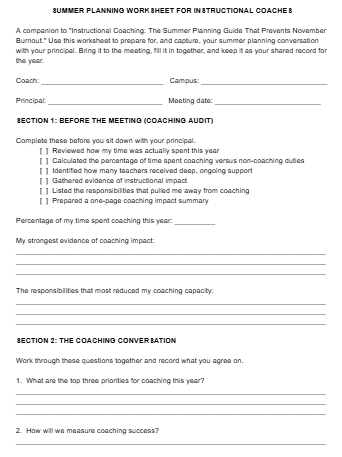
Walking into a meeting with your principal and saying, “I was too busy to coach effectively this year,” is unlikely to produce meaningful change. Walking in with clear evidence of how your time was spent and the impact of your work creates a very different conversation. Before scheduling your summer planning meeting, conduct a simple end-of-year coaching audit.
How Did You Spend Your Time?
Create a breakdown of your major responsibilities throughout the year, collecting data such as:
- Number of coaching cycles completed
- Classroom observations conducted
- Teacher planning meetings facilitated
- Professional learning sessions delivered
- Professional Learning Community meetings supported
- Data meetings attended
- Administrative duties assigned
- Testing coordination hours
- Substitute teaching days
- Other non-coaching responsibilities
A pie chart or percentage breakdown can be especially powerful. Many coaches discover that less than half of their time was actually spent coaching.
How Many Teachers Received Meaningful Support?
Differentiate between:
- Teachers receiving ongoing coaching cycles
- Teachers receiving occasional support
- Teachers attending professional learning sessions
- Informal coaching interactions
This distinction helps demonstrate the difference between broad exposure and deep instructional impact.
What Evidence of Impact Exists?
Gather evidence connected to instructional improvement, such as:
- Teacher survey feedback
- Walkthrough trend data
- Adoption of instructional strategies
- PLC implementation successes
- Student engagement indicators
- Student achievement trends connected to coaching initiatives
The goal is not to prove causation. The goal is to show contribution.
What Pulled You Away from Coaching?
Document responsibilities that reduced coaching capacity, such as:
- Days spent covering classes
- Hours coordinating testing
- Discipline support responsibilities
- Administrative projects unrelated to instruction
- Parent communication duties
This is not about assigning blame. It is about identifying opportunity costs. Every hour spent on non-coaching responsibilities is an hour unavailable for teacher support.
Create a One-Page Coaching Impact Summary
Keep your report simple and include:
Coaching Impact
- Teachers coached
- Coaching cycles completed
- Professional learning delivered
- Instructional successes
Time Allocation
- Percentage of time spent coaching
- Percentage of time spent on non-coaching duties
Recommendations
- Responsibilities that should continue
- Responsibilities that should be reassigned
- Priorities for next year’s coaching program
The goal is not to defend your work. The goal is to help your principal make informed decisions about how coaching resources can create the greatest impact for teachers and students.
Step 2: Clarify the Coaching Role
Once you have your data, schedule a planning conversation with your principal, and start by discussing what instructional coaching should look like on your campus.
Questions to ask:
- What are the top three priorities for coaching this year?
- How will coaching success be measured?
- What responsibilities are outside the coaching role?
- What does effective coaching look like from your perspective?
Without clarity, coaches often become the default solution for every staffing or operational challenge. Role clarity is one of the strongest predictors of coaching success.
Step 3: Establish the Evaluation Boundary
Trust is the foundation of coaching. Teachers must know that coaching is a space for growth, reflection, and risk-taking, not evaluation.
Coaching tied with evaluation is a recipe for disaster; in order to be able to work with a coach and really learn, you have to be able to feel like you can really take risks.
Elena Aguilar, The Art of Coaching: Effective Strategies for School Transformation
Discuss these questions with your principal:
- What information remains confidential?
- What information can be shared with administration?
- How will teachers be informed about these expectations?
Then communicate those agreements clearly to staff. Teachers are far more likely to engage deeply when they understand the boundaries of the relationship.
Step 4: Identify the Hats You Won’t Wear
One of the fastest ways to derail a coaching program is through role drift. Because coaches often have flexible schedules, they become easy targets for task reassignment.
Review expectations related to:
- Substitute coverage
- Testing coordination
- Discipline support
- Administrative duties
- Non-instructional projects
The goal is not to be unhelpful. The goal is to protect the work that has the greatest impact on teaching and learning. If your coaching data shows significant time spent on non-coaching responsibilities, use that evidence to discuss alternative solutions with your principal.
Step 5: Determine a Realistic Caseload
Effective coaching requires time, trust, and consistency. Research consistently suggests that meaningful coaching relationships require manageable caseloads, and coaches who work intensively with a smaller group of teachers often create greater instructional impact than coaches who lightly touch dozens of teachers.
Discuss:
- How many teachers will receive intensive coaching?
- How often coaching cycles will occur
- What level of support can realistically be provided
- Whether priorities should focus on depth or breadth
A coach who supports 10 teachers deeply may create more lasting change than one who briefly interacts with 40.
Step 6: Learn the Landscape Before Launching Initiatives
Whether you’re new to the campus or entering a new school year with returning staff, resist the urge to arrive with a fully developed plan. Every campus has a unique culture shaped by previous experiences.
Spend time learning:
Informal Leadership
Who are the teachers that others trust and follow? These individuals often influence school culture more than organizational charts.
Teacher Culture
Is collaboration the norm, or is teaching viewed as an individual practice? Understanding this dynamic will influence how you introduce coaching.
Current Pressures
What challenges are teachers already carrying? The most successful coaches avoid becoming “one more thing” on an already full plate. Sometimes the most strategic thing you can do is listen before you lead.
Before School Starts: Your Alignment Checklist
Before teachers return, make sure you and your principal can clearly answer these questions:
✓ What is the coach’s primary purpose?
✓ What responsibilities belong to the coach?
✓ What responsibilities do not belong to the coach?
✓ How will coaching time be protected?
✓ How will confidentiality be maintained?
✓ How will coaching impact be measured?
✓ What outcomes are expected by the end of the year?
The clearer these answers are in July, the fewer surprises you’ll face in October.
Final Thought
The success of your coaching program next year will not be determined by what happens during the first week of school. It will be determined by the conversations you have before school begins. Use the quiet weeks of summer to gather evidence, reflect on your impact, and schedule a strategic conversation with your principal.
Enter that meeting not as someone asking for fewer responsibilities, but as an instructional leader using data to maximize impact. Because the best way to avoid becoming the campus cleanup crew in November is to define your role in June and July.
The question isn’t whether you’ll be busy next year. The question is whether your time will be spent doing the work that matters most for teachers and students.
Your Next Step: TCEA Instructional Coach Certification
Defining your role is the first step. Strengthening the skills behind it is the next one. The TCEA Instructional Coach Certification is a self-paced online program designed to help you do the work this guide describes, including clarifying your responsibilities, building trusting relationships, adapting to your campus culture, and leading effective coaching cycles. Across nine modules, you’ll gain practical strategies and resources you can put to use right away.
The program is $349, and enrollment includes a one-year TCEA membership (a $49 value), a digital badge, and a certificate. You can start anytime and move at your own pace. Learn more or enroll at tcea.org/courses/instructional-coach-certification.