Stay updated on the latest education trends. Explore tools, strategies, and insights to keep your teaching and learning practices innovative.

I absolutely, not once, never-ever-ever desired to be an online teacher. I would be willing to bet 95% of you reading this did not have this dream either!
Plot Twist: During this unprecedented, history-making, social-distancing, self-isolating, unbelievable and incomprehensible health crisis, we have all become online teachers. If I didn’t laugh, I would cry. But as we’ll explore, Transactional Distance Theory may help us identify tools and techniques that can improve our remote teaching and learning.
My Story
My job over the last four weeks has been to drag, push, and shove my staff – I mean prepare them – for a quick and efficient dive into the pool of online learning. And once we were all in the water, my job was to cheer them on to mastering the “deep end” of the pool, or to help them back to the shallow end where they could stand up. Many of them actually jumped in with both feet and swam off into total success. I threw a few floaties at them and they waved “bye!” Additionally, there were a few who were so excited to swim into the deep end that they ran into a few issues like “zoom-bombing” and an adolescent’s idea of a funny virtual background.
But I am sure my teaching story is not that different from many of you. Throughout my teaching career, I have focused on good pedagogy for my content area and for the age group that I serve. And most importantly, I have perfected my “teacher look” that will squash any misbehavior in the back of the room without a word spoken.
Finding Something New
However, now that I am teaching from home, I find my bag of tricks not to be as useful. My “teacher look” doesn’t really work on the dog, and not all teaching methods that work inside the four walls of a classroom are applicable to online learning. I found myself needing some new tools and techniques in my teaching bag that would work in this abnormal environment.
Mostly, though, we have settled into a basic routine, and the students are responding. I started to notice right away, though, that if the students did not answer my emails or show up to my online webinar meetings, their work tended to slack off for the week. The work was incomplete, or it seemed hurried and rushed, definitely not meeting my in-class expectations. But we are not in class, are we?
I immediately began researching distance learning.
Transactional Distance Theory
I read about Transactional Distance Theory about a year ago in a graduate class. At the time, I just filed it under “more educational theory,” but now, this was exactly what I was looking for to explain my situation.
Michael G. Moore proposed Transactional Distance Theory in 1973. It is a way of analyzing the interactions between learner and instructor in both space and time. Moore suggests that separation in distance learning is not just physical, but “a psychological and communications space to be crossed, a space of potential misunderstanding between the inputs of instructor and those of the learner.”
This psychological and communications distance could be fatal to our goal of continuing to educate students during school shutdowns.
Keeping Students Engaged
I believe that as the ed tech community, we have more tools than anyone to help the educational body at large continue to advance student learning. And with this theory in hand, we can continue this endeavor, no matter the circumstances.
All teachers know what happens to the student who sits in the back of the class. If we are not diligent in keeping them engaged, this student will travel to a far-away distant place where there are no teachers and no assignments.
The student who “distances” himself or herself from the teacher within the walls of a classroom can easily be guided back on task just by standing beside their desk or involving them in the conversation. They know their teacher is watching and will not ignore them.

However, what about the student who joins the online webinar, leaves his camera off, and goes back to bed? I can’t walk up to his bed and gently whisper that he needs to pay attention. There are ways, however, using TDT, that I can keep this student connected to his classwork, his classmates, and me.
Our goal in this online learning situation is to keep the Transactional Distance to a minimum – to keep students connected. Using a model of TDT can help us achieve that. Moore suggested that there are three main variables in a distance-learning situation – Dialogue, Structure, and Autonomy. Less of one variable means more dependence on the others.
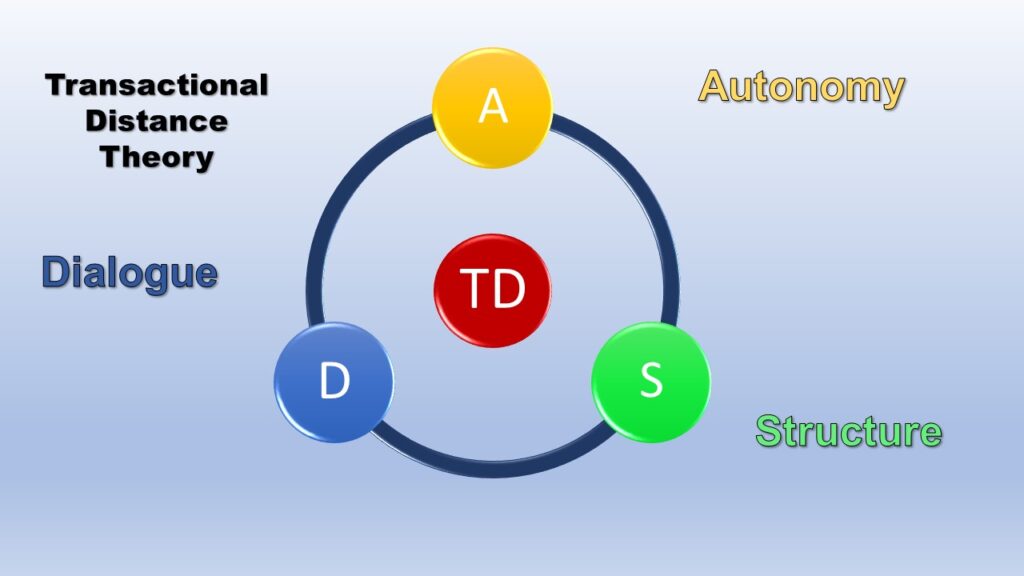
Moore developed his theory in the beginning of Distance Learning, when the few tools instructors had access to included the telephone and videos that students had to watch on their own. Thanks to today’s educational technology, we have a multitude of tools we can employ to keep students engaged and connected. And with Transactional Distance Theory, we can target which tools to use and share with others that will influence student learning the most during this difficult time.
Transactional Distance Theory and Dialogue
Dialogue between teacher and learner are key to staying connected to a student. If you do not talk to them, how will they ever know what your expectations are or what they should be learning? In our current situation, however, teachers do not have nearly enough of this commodity.
By examining the TDT model, you can see that as the opportunities for dialogue shrink, the distance between the learner and instructor grows, and thus, the student’s academic achievement can become more difficult. He will have to rely on his own independence to understand what to do and how to do it. Personally, I know several middle school students that have yet to master this set of skills.
Figure 3 – Dialogue Shrinks. As Dialogue decreases, the distance between learner and instructor increase.
Online learning pushes students away from us. It is hard to stay connected when we can only talk to them through email, or worse, through paper instructions when they do not have internet at home.
A Few Tools
Fortunately, we have so many resources available to message, converse, and give feedback to students. Here are a few tools and strategies that we can use to increase dialogue and decrease distance:
- Check-in with students frequently – Use Remind or another messaging tool to send messages to students daily or a few times a week. Ask students to respond with an emoji to let you know how they are doing. Responses don’t have to be elaborate, but knowing that you are a text message away decreases the transactional distance significantly. For Remind,iIf you turn on replies, students can even ask for help when needed. This type of communication recreates what they are already familiar with and increases your chance of connecting with them and their families.
- Give personal feedback – Students will feel closer to you when your feedback is personal and meaningful. “Zach, I really like the way you organized this poem,” carries more significance than “Great job.”
- Use screen recording software – Give personal feedback so that students can observe facial expressions and hear meaning in your voice. Use the Moderated Posts setting on Flipgrid to converse with students one-on-one. If the posts are not public to the entire class, students might feel more open to discuss issues with you. You could also use Screencastify or Screen-cast-o-matic to record feedback and then share the link to your personal message with the student.
- Require responses – When you email or message students or families, ask open-ended questions. “How are you managing your family sharing devices?” or “What is one piece of advice you could give to your classmates during this chaotic time?” Any way that you can connect with students or families is beneficial, even if it is not about schoolwork.
- Use humor and emotion– Leverage your relationship with your students to bring them closer to you. Remind students of happy or memorable things that happened in the classroom earlier in the year. Include funny memes or pictures in your emails and messages. Be open and honest about how things are going for you during this time as well. Evoking emotional responses can create meaningful connections.
Two-Way Communication
Dialogue is two-way communication. When students are physically far away from teachers, we must create opportunities for this communication to continue. Transactional Distance Theory would suggest that this dialogue is key to successful distance learning. In 2020, with all the technology tools available to us, we should be able to connect to our students in a multitude of ways, virtually keeping them closer to us than they actually are in reality.
How are you staying connected to your students? Share with me in the comments. I’m sure my teachers would love to hear other methods of staying afloat in the deep end of the pool! Some of the floaties I tossed them may be losing air.
In the second part of this series, we will discuss the Structure and Autonomy variables of Transactional Distance Theory and tools we could use to manage them.
Photo: Sharon McCutcheon