

If you’ve ever wished you could quickly see what students truly understand without grading a stack of papers, then Formative Assessment Human Bingo might be your new favorite strategy.
Most educators think of Human Bingo as an icebreaker. But when you redesign the squares with prompts tied to your lessons, it becomes a powerful, interactive formative assessment tool that gets every student thinking, speaking, and reflecting.
Let’s take a closer look at how it works.
What Is Formative Assessment Human Bingo?
Instead of “Find someone who has a dog,” your bingo squares might say:
- Can explain today’s learning target in their own words
- Solved a problem
- Can give a real-world example of today’s concept
- Can identify a common misconception
- Completed the practice task correctly
Students move around the room finding classmates who can confidently demonstrate the skill or understanding listed in each square. It’s active. It’s fast. And it gives you instant insight into learning.
Why It Works
Formative Assessment Human Bingo is effective because it involves participation from all students. It encourages academic conversation and promotes peer teaching. In addition, it provides real-time feedback to teachers.
Instead of asking, “Does everyone understand?” (and seeing silent nods), you hear actual explanations.
How to Set It Up
Step 1: Identify Your Learning Target
Start with a clear objective from your lesson. What should students know or be able to do?
Step 2: Create Skill-Based Prompts
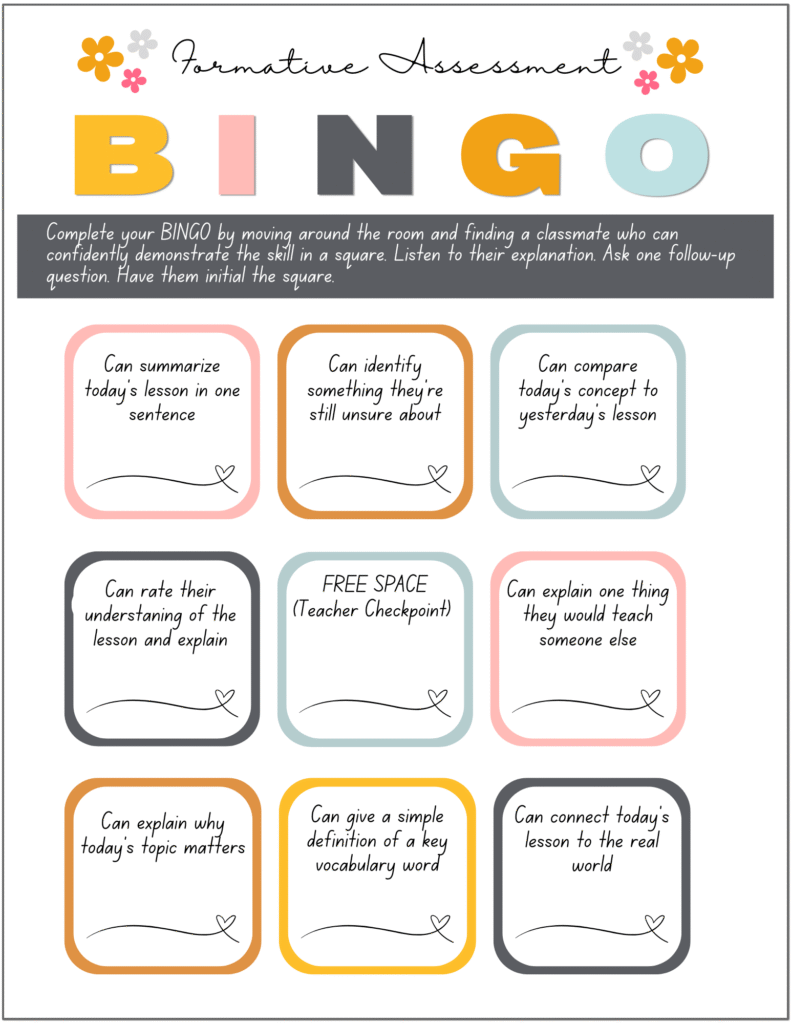
Design 9–16 squares that reflect different levels of understanding. If you are looking for a Bingo template, check out Canva, Bingo Card Generator, or Flippity. Some examples of items to include on your card include:
Surface Understanding
- Can define today’s key vocabulary word
- Can restate the main idea
Deeper Understanding
- Can explain why this strategy works
- Can compare today’s concept to yesterday’s
Application
- Can create their own example
- Can solve a new problem using the skill
Step 3: Set Expectations
Students must:
- Have a conversation (not just get a signature)
- Listen to the explanation
- Ask at least one follow-up question
You can require initials, written evidence, or even a quick teacher check before a square counts.
Ways to Level It Up
Add a Reflection Component
After Bingo, ask students some reflection questions. For example, ask students, “Which square was hardest to fill?” or “What explanation helped you most?”
Use It as a Data Tool
Walk around with a clipboard and take notes. Who explains clearly? Who hesitates? What misconceptions are being repeated? This helps you decide if you need to reteach or if students are ready to move on.
Try a Teacher as Wildcard Option
Include one square that requires students to demonstrate understanding directly to you before marking it complete.
When to Use It
Formative Assessment Human Bingo works especially well at the end of a lesson. You can also use it before a quiz or as a test review. Furthermore, it can be used as a mid-lesson engagement boost. It turns a routine check for understanding into something students enjoy.
Why Students Love It
Students feel more ownership of learning while participating in Human Bingo. There is less pressure than whole-group questioning. In addition, students will feel more confident practicing explanations with their peers. It will feel like a game to students and not an assessment.
Final Thought
Get the Canva template, customize it to your next lesson, and try Formative Assessment Human Bingo this week. Then reflect on what you learned about your students’ understanding.
