Discover resources and strategies for professional learning. Explore tools, tips, and opportunities to enhance educator growth and development.

When you sat down to prepare for the TExES CORE Subjects EC-6 exam, did you read all of those competencies and freak out a little? Too intimidated to start studying? Take a breath! While the CORE Subjects EC-6 exam for Texas certification can seem overwhelming, a lot of people have passed it, and you can, too. The trick is to seem like you know it all without actually having to know it all. Here are seven sure-fire study tips for the CORE Subjects exam.
Find the Weakest Link
We all have our strengths and weaknesses. Maybe you love science and regularly read science-related articles or tutor on the side. Maybe you read the newspaper every day and you can talk confidently about world affairs and the structure of government. While you will still want to review these areas, you should plan to focus your energy on the domains where you struggle.
So how do you figure that out? The best way is to take a practice test before you begin studying. When you’re done, you will see how you scored in each area and where you need to focus your studying.
Think Like a Student
Once you find which areas you need to focus on, think like a student again. Great resources for the CORE Subjects EC-6 exam can be the exact same resources you would refer your elementary students to.
For all subjects, one of the best resources for the CORE Subjects exam are old TAKS and STAAR exams and study guides. What better way to figure out what you need to know to teach students than to look at old student assessments?
Do you need a one-stop preparation experience? Then we would recommend our 240Tutoring CORE Subjects EC-6 study guide.
Hack the Competencies
How can you know which terms to commit to memory? Well, if a term is going to be on the test, it most likely will appear in the competencies, too. Read through them and mark all of the terms that are used. This way, rather than trying to master every term you ever read in an education class, you will have a nice, compact vocabulary list.
Master the Format
Test-takers of the CORE Subjects EC-6 exam regularly report that it is the test question format that trips them up—not the content itself. Familiarize yourself with the question format and you will be halfway there. You can look at the sample questions in the TExES Core Subjects EC-6 Preparation Manual, but that will only give you a taste. This is where practice tests—and practice questions—again will come in handy.
Trust Your Brain
While you do need solid content knowledge in each domain to pass the CORE Subjects exam, the test is actually more focused on critical thinking than on your recall of facts. Rather than trying to remember everything, focus on processes and methods of teaching the content.
Also, remember that while you may not have taken math since high school, you use it every day. For each domain, there will be many questions you can figure out using your own experiences and plain old common sense. If a question asks about information you do not readily know, don’t get scared. Usually you can use context clues to whittle down the answer options.
WARNING: Be careful, though! Critical thinking questions can be a double-edged sword. It is very important that you read each question very carefully to make sure you understand what it is asking you. Just knowing what key words in a question mean is not enough!
Pace Yourself
Think of studying for the CORE Subjects EC-6 exam as a long-distance race. It does not work to sprint it, so don’t try to cram all of your studying into a few intense days. Instead, start early and do a little bit every day. By spending even 30-45 minutes reviewing each concept each day, you will increase your confidence and comfort with the content. Plan to do practice questions regularly throughout the week and to take several practice tests leading up to exam day.
Follow these tips and you will be well on your way to acing the TExES Core Subjects EC-6 exam and earning your teaching certification!
This is a sponsored post provided by Scott Rozell. Rozell is the President and Founder of 240Tutoring, which provides study guides for teacher certification exams. Scott has spent the past six years learning why people fail their certification exams and how to get them to pass. If you need it, get extra help studying for the CORE Subjects EC-6.




 The purpose of this certification is to help educators build foundational skills in using their Chromebook as an effective learning tool in the classroom. As you go through the course, you will also be introduced to several of the Google Suite of tools to promote collaboration and critical thinking, and you will be provided opportunities to apply it to your content area or grade level. The capstone project for this certification is a lesson plan implementing some of the learned skills and tools within the grade level and content area of your choice.
 The purpose of this certification is to help educators build foundational skills in using the iPad as an effective learning tool in the classroom. As you go through this course, you’ll learn how best to use the features of the iPad to differentiate and support student learning. The capstone project for this certification is a lesson plan implementing some of the learned skills, features, and apps within a grade level and content area of your choice.

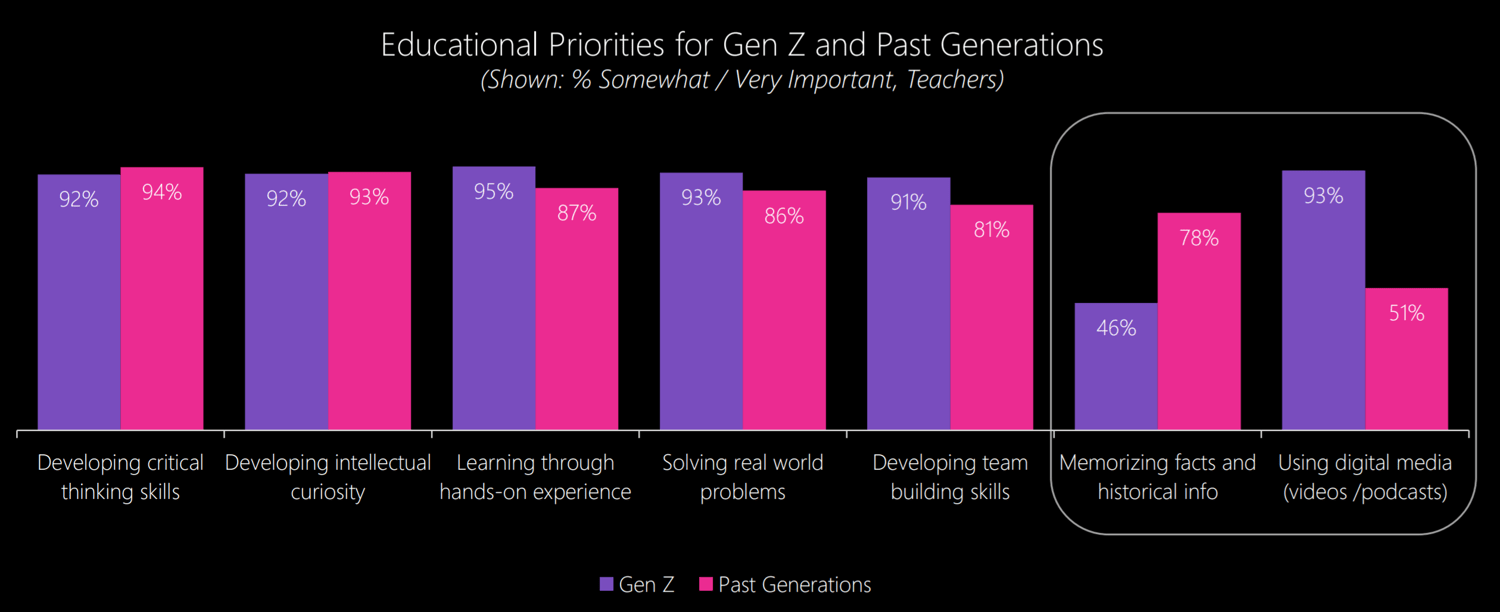 Teachers working with Generation Z have some changes to make in their classrooms. You can break the expectations down in simple ways: