

 The other day, I was talking with my wife. She had just come home from work and was sharing a frustration of her day. Before she was able to complete two sentences, I was ready to provide a solution that only included three easy steps. As I interrupted with what I thought was going to be received as a caring gesture, she looked at me and said “I’m not looking for a solution. I know what to do. I just needed someone that I can share my frustration with.” Ouch! While I didn’t gain any Husband of the Year votes from that encounter, it did get me to thinking about how many times I assume everyone is needing a solution when they talk with me…or at least before they get two sentences out.
As a leader at work we have a lot of people that share information with us. Some sharing is just to inform us, while other sharing may have a bigger need behind it. That bigger need could be “I need feedback,” “I need to hear myself think aloud with someone so I can decide the best solution,” or even “I need you to recommend a solution.” Sometimes I have asked at the beginning of a conversation, “How do I need to listen?” if it isn’t obvious or if I’m not sure. By interrupting with my solution, I have found that I break a connection and reduce their likelihood to share with me – neither of which I want to do.
The Seven Habits Include Listening
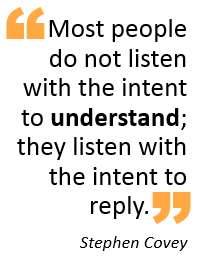
In his book The Seven Habits of Highly Effective People, Stephen Covey had it correct when he said, “Most people do not listen with the intent to understand; they listen with the intent to reply.” That is so true. Even when I don’t blurt out a solution, it is likely that the voice in my head is formulating a solution even as the other person is sharing. Doing this robs me of being in the moment and hearing, I mean really hearing what is being communicated. As a leader, when we do really listen, we might be amazed at the insight of the one sharing, touched by their transparency, or even inspired by their perception or thought process. These are definitely traits I want my staff to emulate and share. In response, I find that I reciprocate by esteeming, having more respect for, and even wanting to know more of what they are thinking.
How Best to Listen
My challenge to you as a leader is to hold off on blurting out a solution so you can move on to the next problem that needs solving or the next item on your to-do list. Instead, take time to be in the moment and really listen to what is being said. Just like teachers give wait time after asking a question, give yourself wait time to hear what is being said. If you need more concrete steps, consider the following:
- Keep your mind from wandering – Learn to stay focused on what the other person is saying. Don’t let your mind wander to other tasks you have waiting or what you might rather be doing.
- Practice mirroring the speaker – Body language can go a long way in letting someone know that we are not only listening to what they are saying, but are interested in what they say. For more information, consider reading Todd A. Fonseca’s post The Power of Mirroring.
- Summarize – Summarize back to the person what you think you heard. Sometimes it is easy to miss an important part or overlook something that the speaker was trying to emphasize. And doing this also tells the speaker that you value them enough to pay great attention to their words.
- Ask open-ended questions – If you need clarification or more information, ask open-ended questions. This will encourage the speaker to elaborate and fill in those missing details while also letting them feel acknowledged and listened to.
I challenge each of you for two weeks to really focus on listening – whether at work, home, or play. Let me know how it goes. I’d love to have a conversation with you; you can email me at bellis@tcea.org or post your comment below. Either way, you’ve got my ear.







 people through a dramatic shift in their professional practice. The types of change require different kinds of leadership skills. Changing a teacher’s planning period takes different skills than telling them every student is going to have a device and most of their lessons and materials will be delivered over that device. First order change usually deals with cosmetic changes, while second order change deals with the paradigms and philosophies. Research indicates that the leadership team should approach the management of these two types of change differently.
  training, and support they will need. Organizations adopt change, but individuals are the ones that implement change. District leadership might have decided to enact the change, but it is the people at the school level that actually make it happen. The change process can’t be dictated from central office.
 Success takes time and commitment to strategic action plans, review, and adjustment. It may take several cycles after implementation to determine if the new initiative is working. Expect an implementation dip.
 legislative session and TCEA was working for you. In most instances, all of our hard work in gaining support for our issues came down to the last weekend in May. Most legislation fails to pass largely because there is not enough time for the bills to get passed. The Texas Legislature only meets every other year, and for only 140 days. Our forefathers purposely made it difficult to pass a bill for fear that the government might grow and have too much power. Out of the 6,631 bills that were filed, only 1,089 passed and became law. Fortunately, eight of those bills were supported by TCEA for the benefit of our members.
  learning process is one of TCEA’s strategic goals. Judging by what legislation was passed, we feel good about the progress we made this session. The efforts that many of our officers and members made to email, call, or come to the Texas Capitol to testify or visit their state legislator played a critical role in getting the bills passed. Never underestimate your influence on your elected officials. Thank you for all your hard work, and keep it up!
 Begin by setting up a brief meeting to introduce yourself. For this meeting, I recommend creating a brief, bulleted list of services and supports you have to offer, along with various ways to contact you and/or your office. Though the administrator should be able to get all of that information from your department website, it is nice to have a hard copy of that information that can be filed away for easy access (the old-school way). Put your information in a
  To go the extra, extra mile, give a copy of the labeled folder and document to their secretary. Recognizing the value of their role in getting things done on the campus can go a long way. While many administrators have good intentions to remember all the details, they typically know they can rely on their secretaries to keep things organized so that that information can be easily accessed when needed.

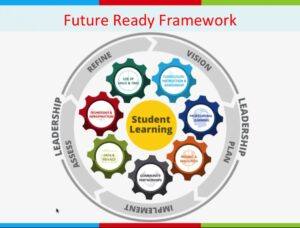 The backbone of FRS is the
 It’s actually pretty simple. Schedule something after work hours that requires you to leave at your scheduled time. It’s funny that anytime my kids have an activity that I have to be at after work or I have an appointment with someone right after the end of the day, I manage to be more productive. Knowing that I cannot stay late or have “extra time” to get things done forces me to push through distractions and be more focused on the tasks I have in front of me. Even if you don’t have a legitimate appointment to put on your calendar, still “schedule” something so that when you look at it, you are reinforcing the expectation that you cannot stay late. This could be something as simple as watching Wheel of Fortune that comes on an hour after the time you should be leaving work. You could also schedule time to get caught up on some enjoyable reading, a date night with your spouse, or taking a walk around the neighborhood to get some exercise in.
 If you find you need a little bit more structure so that you can end your day without staying late, consider using the