Stay updated on the latest education trends. Explore tools, strategies, and insights to keep your teaching and learning practices innovative.

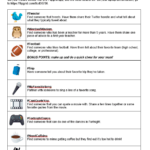
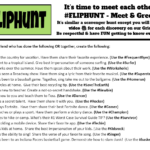
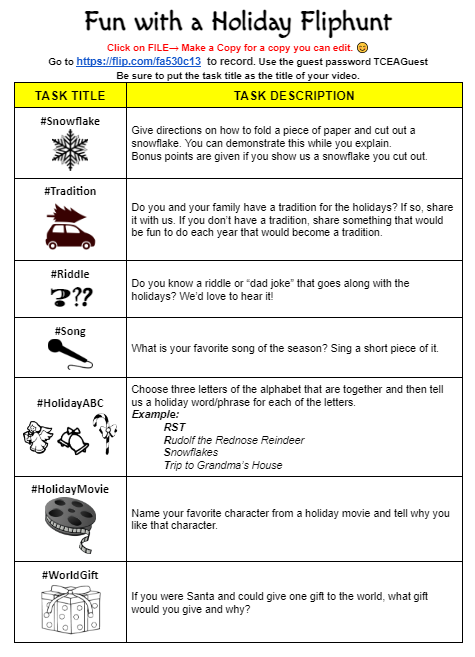
Add some fun to your holiday season and learning by completing this holiday fliphunt. You’ll find a variety of options so you can start with any of the tasks. All you need is the Flip app on a phone or tablet and enter the code fa530c13. Or, if you are using a Chromebook or laptop, then you can point your browser to https://flip.com/fa530c13. Enter the guest password TCEAGuest if you do not want to log in with your Microsoft or Google credentials. Since this fliphunt is open to the world, don’t share your first and last name when recording. Instead, make up a holiday name or use a different fake name to protect your identity. To make it easier, consider printing out the holiday fliphunt tasks sheet.
What Is a Fliphunt?
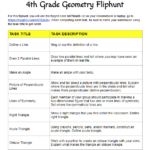
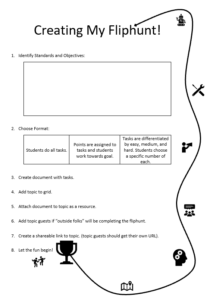
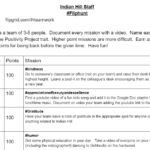
A fliphunt is a fun way for students (and adults) to share their learning, interact with content, or just get to know each other better. Participants refer to a task list that is provided with the specific fliphunt that gives a variety of activities to record. Younger students and “newbies” to Flipgrid may find it easiest to work in pairs as they collaborate with other pairs to complete the tasks. Unless otherwise noted, you can start with any task on the sheet. You can find out more information about fliphunts by reading other blog posts I’ve written on the topic.
There’s Even a Reward!
Complete all the tasks on the holiday fliphunt this month and I’ll email you a special certificate recognizing your accomplishment! To receive your certificate, complete the following:
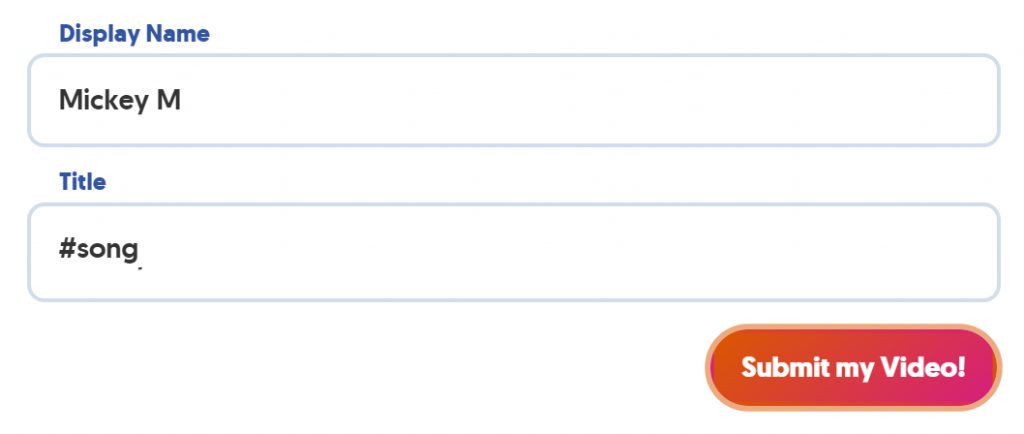
- Use your fake name which should appear as the Display Name (if not, edit the display name to be your fake name).
- Use the hashtagged task title (#tradition, #song, #worldgift, etc.) as the Title. (see the graphic below for an example)
- After you complete and submit all seven tasks, Send Me an Email to let me know. Tell me the fake name you used so I can verify your submissions and your real name for the certificate. I’ll email you a PDF certificate to recognize your accomplishment!




 something because of their interests. This helps me see how students are using technology when they are looking for specific information or want to learn a skill. Only 9% of both middle and high school students post a question on a discussion board or a forum. Do we need to be more intentional in using this type of application? Do they just not know how, or have they found better ways to seek answers to their questions?
  I also discovered that 43% of my teachers are facilitating student collaboration projects using online tools. This is such a great skill. How can I leverage these teachers to help other teachers do this as well? Also, I’m pleasantly surprised that 44% of my teachers are using an online curriculum. However, I want to know more. What is the frequency? Are they occasionally doing this or is this something they use every day? I also want to know what they are using. Are they using the district’s Learning Management System, or is it an online textbook?
  integrate digital content, tools, and resources into their daily instruction. 51% said they wished they had a classroom set of digital devices. 49% said they needed to know that their students had adequate broadband access outside of school and 46% indicated they were concerned that they didn’t have consistent, reliable internet access within school. Maybe I need to have my staff do some focus groups related to internet access and speed. Looking at my network resources, they should have adequate bandwidth, but maybe something is happening on campus that I am not aware of. While my team is on campus, I probably should also have them ask teachers about the availability of technical support since 47% of the teachers indicated it was lacking. And lastly, my teachers still need time to plan with their colleagues (60%) and additional professional development (50%). I need more staff to be able to meet this need!
 Regardless of what you teach, your students will most likely respond well to an adventure of some kind as opposed to worksheets or traditional whole-group learning. So a fliphunt is perfect for your classroom. But, you might be asking yourself, “What is a fliphunt?” Designed by Kathi Kersznowski (