Explore insights and strategies for CTOs and CIOs in education. Discover tools and resources to support technology leadership and innovation.
Great news! On March 22, 2018, President Trump signed the 2018 Omnibus Appropriations bill which included $1.1 billion for the Student Support and Academic Enrichment Grants which are outlined in Title IV, part A of the Every Student Succeeds Act (ESSA). Compared to the 2017 budget, this is an increase of $700 million. Congress also included $2.1 billion in Title II, Part A which districts can use for professional development for their teachers, including training on the effective use of technology through TCEA and other providers. Advocates feel this is a huge win because the president’s original budget cut both Title IV, Part A and Title II, Part A completely out of the budget
Title IV, Part A Grant Funding
Title IV, Part A grants are called block grants because states and districts do not have to compete for the funds. They have to turn in an application, but all districts who comply with the regulations will receive the funding. Districts do not apply directly to the Department of Education. The funding flows to the states and they then disburse the funds to the individual districts. ESSA allows the state agency to keep five percent of their state’s allocation for state initiatives related to the goals of the program.
Title IV, Part A grants are to be used to provide programs in three prescribed areas. Districts are required to spend 20% of their funds on initiatives that will provide well-rounded educational opportunities and 20% of their funds on efforts to ensure that their students are safe and healthy. Districts must also use part of their Title IV funds on activities to support the effective use of technology. In fact, if they so choose, they can spend up to 60% of their funding on these types of activities. However, there is a provision that limits a district to spend only 15% of their funding for the purchase of technology infrastructure. This includes software applications and technology devices.
This means that districts will have more money next year to send their staff to outstanding technology learning events such as the Elementary Technology Conference, the Innovative Learning Strategies Conference, and the 2019 TCEA Convention & Exposition. Or use those same funds to bring in TCEA professional development providers to your district for a customized learning experience for your staff.
Allowable Expenditures

- Provide educators with professional learning tools, devices, content, and resources to:
- Personalize learning to improve student academic achievement;
- Discover, adapt, and share relevant high-quality educational resources;
- Use technology effectively in the classroom, including by administering computer-based assessments and blended learning strategies; and
- Implement and support school- and district-wide approaches for using technology to inform instruction, support teacher collaboration, and personalize learning.
- Build technological capacity and infrastructure, which may include:
- Procuring content and ensuring content quality; and
- Purchasing devices, equipment, and software applications in order to address readiness shortfalls.
- Develop or use effective or innovative strategies for the delivery of specialized or rigorous academic courses and curricula through the use of technology, including digital learning technologies and assistive technology.
- Carry out blended learning projects, which may include:
- Planning activities which include:
- The development of new instructional models (including blended learning technology software and platforms),
- The purchase of digital instructional resources,
- Initial professional development activities, and
- One-time information technology purchases.
- Ongoing professional development for teachers, principals, other school leaders, or other personnel involved in the project that is designed to support the implementation and academic success of the project.
- Planning activities which include:
- Provide professional development in the use of technology (which may be provided through partnerships with outside organizations) to enable teachers and instructional leaders to increase student achievement in the areas of science, technology, engineering, and mathematics, including computer science.
- Provide students in rural, remote, and underserved areas with the resources to take advantage of high-quality digital learning experiences, digital resources, and access to online courses taught by effective educators.
This is great news for school districts. The types of projects that can be accomplished with these funds will be very beneficial to students. I encourage you to review the provisions of Title IV, Part A so that you can engage in conversations with other instructional leaders at your district to determine how these funds can be leveraged to support the effective use of technology. Look for ways you can provide transformative professional development that equip teachers to use digital technology in a blended learning classroom. (TCEA can help with this!)
Resources for ESSA
- Every Student Succeeds Act
- Department of Education’s Guidance on Title IV, Part A
- The Center for Digital Education publication: ESSA, EdTech & the Future of Education
- Texas’ ESSA Plan
Source: Photo by Kari Shea on Unsplash


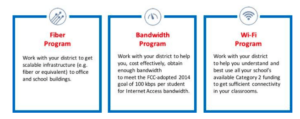
School districts across the state can benefit from the funding, and a majority of those eligible are in rural areas. We’re continuing to work with schools to make sure they understand how to use the funding to improve Internet access for their students.


of high school students indicate they use the Internet at home at least a few times a week. 54% of the high school students use it every day. The student’s Internet use is not dependent on whether the teacher purposely assigns homework that needs the Internet because only 13% of Texas teachers indicate they do so. Students are going to the Internet for help in their homework because it is the library of the 21st century. Students without this home access are at a distinct disadvantage. They have fewer ways to access content and are not learning the necessary skills of finding accurate information to answer their research questions. 

Our district’s journey into OER had begun. During that meeting, I was tasked with finding out how our district could save money by creating our own textbooks using as many OER materials as possible. The district had just gone through the adoption process for science instructional materials and had estimated it would cost close to $2 million for 18,000 students. What if we could use that textbook money in another way? Perhaps to purchase technology for students?