Stay informed on education advocacy. Explore updates, insights, and resources to support policies that empower educators and students.

Since 1998, the E-rate program has provided subsidies to schools across the nation to support the cost of telecommunications and Internet services. At the core of this universal service funding program is the belief that all students in all locations throughout the country deserve equal educational opportunities and the ability to study, work, and thrive in our increasingly digital world. For 20 years, E-rate has made that belief an attainable, affordable goal for school districts across Texas.

“E-rate plays a huge part in our budgeting for technology. It’s a critical program that allows us to be aggressive in our planning knowing that at least for bandwidth we’re going to be reimbursed. It makes our budgeting possible, and we know that as bandwidth needs grow it’s going to be economically sustainable. We may invest more money upfront into our bandwidth, but knowing that the end user experience is boundless and allows them to do much more is worth it – we’re putting [the user] first.” – Chris Cummings, Director of Information Technology, Klein Independent School District
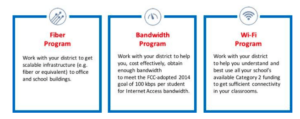
The Classroom Connectivity Initiative, a partnership between the Office of Governor Greg Abbott, the Texas Education Agency (TEA), and national non-profit EducationSuperHighway, recognizes that access to high-speed Internet is non-negotiable for student success. It addresses three key components: fiber, bandwidth, and WiFi.
In addition to those components, the initiative is tackling connectivity challenges in Texas by helping districts access state matching funds. Designed to support schools with the cost of getting scalable infrastructure to their front door, these funds could help solve a major issue schools face in connecting to high-speed Internet. This is all possible because the Second E-rate Modernization Order stated that if a state created a fund to support schools with the cost of special construction, the E-rate program would contribute an additional 10%, on top of a school’s calculated discount to match the state’s contribution.
Here’s an example of how a school district may take advantage of the state matching fund:
- School district applies for 80% E-rate discount.
- Texas state matching fund contributes 10%.
- E-rate state matching provision contributes additional 10%.
- 100% of special construction costs are covered for the school district.
 School districts across the state can benefit from the funding, and a majority of those eligible are in rural areas. We’re continuing to work with schools to make sure they understand how to use the funding to improve Internet access for their students.
Here’s what we are hearing so far:
“Fast Internet speeds are a crucial part of delivering high-quality digital learning to our classrooms, and scalable fiber optic-based Internet connectivity has been an elusive goal for some time now in our district. With the added construction cost of being a rural district, we would always struggle to move forward. While we are still in the middle of the approval process, the availability of the Texas state matching funds this year gave us the momentum to begin the E-rate and state match application process to ensure we provide the best opportunity for our students for years to come.” – Billy Polasek, Technology Director, Stockdale Independent School District
The state match is only available for E-rate funding years 2017 and 2018. The Form 471 Filing deadline is March 22, so it’s important to get started by visiting TEA’s Classroom Connectivity Initiative website.
As the end of the E-rate cycle approaches, additional tools are available for school districts that already have scalable infrastructure. School leaders can find their district on Compare & Connect K-12, EducationSuperHighway’s free tool designed to compare broadband speeds and pricing to neighboring districts to power negotiations this year. More details on eligibility can be found on the Classroom Connectivity State Match FAQ. For questions, email classroomconnectivity@tea.texas.gov.
Guest authors: Kai Addy and Alyssa Cubello, EducationSuperHighway
Photo Credit: iPhone and Backpack by Josh Felise on Unsplash; Photo of Governor Abbott taken by ESH.
 legislative session and TCEA was working for you. In most instances, all of our hard work in gaining support for our issues came down to the last weekend in May. Most legislation fails to pass largely because there is not enough time for the bills to get passed. The Texas Legislature only meets every other year, and for only 140 days. Our forefathers purposely made it difficult to pass a bill for fear that the government might grow and have too much power. Out of the 6,631 bills that were filed, only 1,089 passed and became law. Fortunately, eight of those bills were supported by TCEA for the benefit of our members.
  learning process is one of TCEA’s strategic goals. Judging by what legislation was passed, we feel good about the progress we made this session. The efforts that many of our officers and members made to email, call, or come to the Texas Capitol to testify or visit their state legislator played a critical role in getting the bills passed. Never underestimate your influence on your elected officials. Thank you for all your hard work, and keep it up!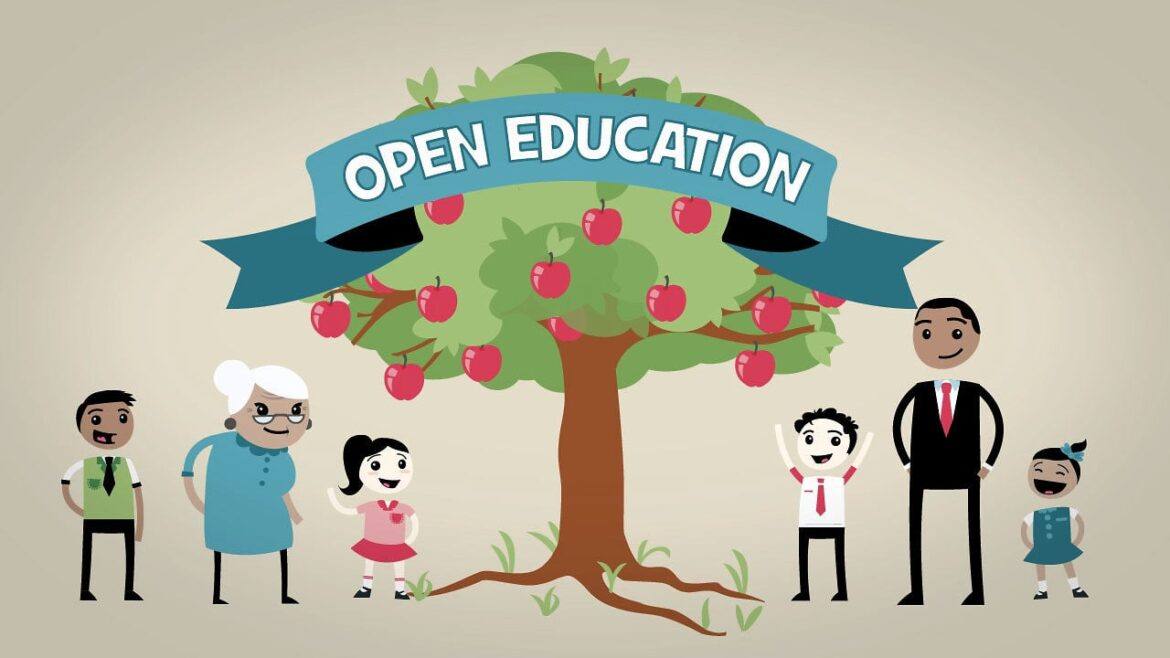
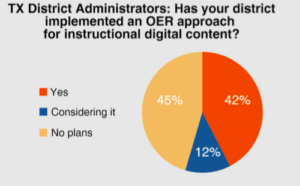
 In addition, the state budget for the next two years includes $20 million for the state to arrange for an outside entity to produce open educational resources for the state’s use. It is expected that TEA will begin with instructional materials that meet the specifications for the English Language Arts adoption that will be implemented in the 2019-2020 school year. This would give districts the ability to use high-quality OER materials for this adoption, which has the potential to save them money.
 outside of school time to be successful in school. The survey also revealed that 75 percent of Texas 6th through 12th graders use the internet at home for school work. Those who do not have internet access at home are at a distinct disadvantage. Not only do they have fewer options in terms of access to content; they are unable to develop the technical skills necessary in an economy driven by technology.

 You might be thinking, why weren’t the teachers using the textbooks? Aren’t they aligned to the state objectives? Why wouldn’t a teacher want to use a “free” resource that is aligned to the objectives? Those are great questions, and there are probably multiple answers. But my theory is that districts slowly began to move away from a heavy dependence on textbooks as the state accountability system began to gain prominence. In order to ensure their students would do well on the state tests, districts began to build their teaching curriculum around the testing standards, especially in the areas in which their students struggled. This led many districts to begin using textbooks as a resource and not the resource. The districts began to purchase additional resources to supplement the textbooks to match their teaching curriculum. This resulted in waste as many textbooks went unused while districts spent their local money to purchase materials to supplement the state-approved textbooks.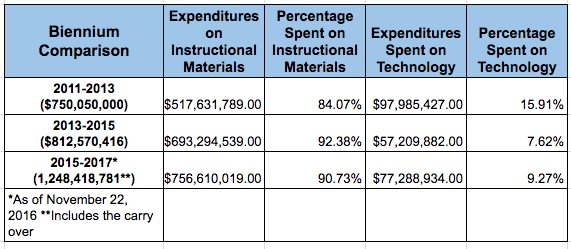
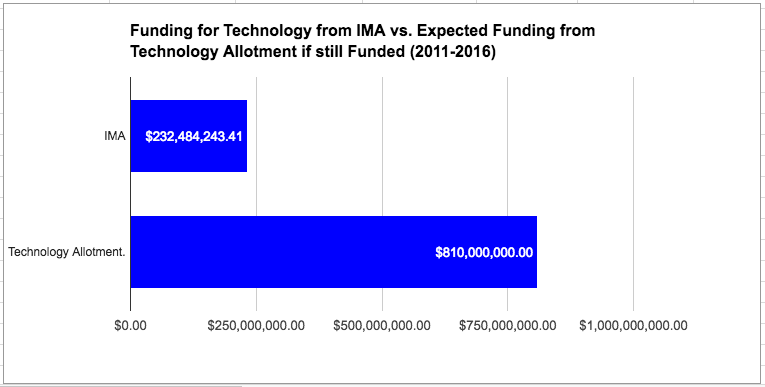
 School districts now live with the uncertainty of not knowing the cost of the next proclamation nor how much funding will be in the IMA. Prior to SB 6, the SBOE would establish a maximum price for any textbook that would be placed on their approved list. As expected, every textbook submitted for SBOE review came under that maximum price. Because the state was doing the purchasing, publishers could afford to offer the books at these prices because they knew they had a chance of selling a large number of books. SB 6 eliminated the maximum price because it was assumed that, with the new flexibility afforded in SB 6, business would decrease for the major publishers, which might mean that they would need to adjust their prices to remain profitable. The result is that the price of textbooks has increased and so has the uncertainty. Districts have no way of knowing how much the next proclamation is going to cost, so they often save whatever they don’t spend on the current proclamation to make sure they have enough for the next one.
 Since TCEA’s mission is to help districts implement a digital learning environment, the reduction in funding for technology is a grave concern. We have supported the structure of the IMA because we believe that technology should always be purchased within an instructional context. Because technology should support the instructional goals of a district, it is healthy for district personnel that support both to work together to determine how best to use district resources to meet the district’s strategic goals. This includes the IMA.

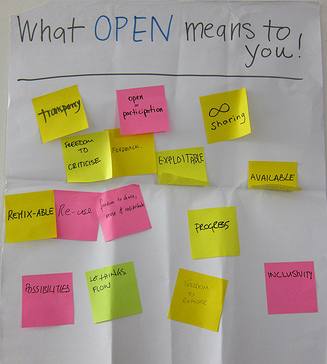 How does a district get started? In order to support districts who are interested in developing some openly licensed educational resources, the #GoOpen campaign has developed a network of states and districts to serve as models and provide support and assistance. A great place to start is by downloading the
  dedication of the instructional staff who have led the process throughout. He noted that the teaching staff has been empowered by the curation process and that the students have positively responded to the change. So far, there have been around 100 teachers involved in the curation process, and he expects that number to grow to more than 200 by the end of this year. He feels that what these teachers have created is a better product than what they could purchase. Their initiative started at the secondary level and, because of their success, the elementary instructional staff is beginning to curate open educational resources as well.
 El Paso ISD is a #GoOpen Launch district. They have