
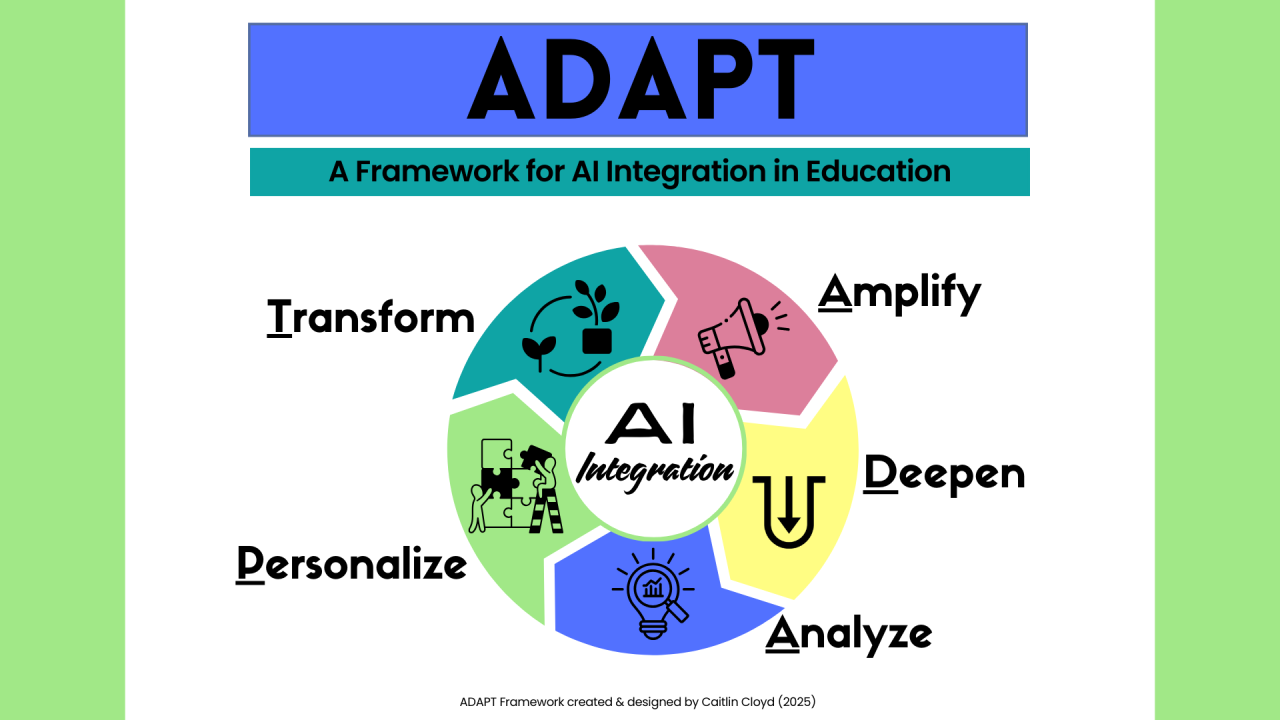
I was talking with colleagues recently about something we’ve all been noticing regarding AI integration in education.
Teachers are finally trying AI—which is great—but most are stuck in the same pattern: worksheet generator, quiz maker, text simplifier. It’s a start, sure. But it’s also the problem.
Because AI isn’t just another tech tool. It’s a thinking partner that can coach students, spot patterns in learning, adapt on the fly, and scale what good teachers already do. And if we only use it to crank out worksheets faster, we’re missing the entire point.
That’s why I created the ADAPT Framework for AI integration—a practical, flexible model for integrating AI in ways that are actually meaningful without requiring teachers to overhaul everything at once.
Why Old Frameworks Don’t Work for AI Integration
SAMR—the Substitution, Augmentation, Modification, Redefinition model developed by Dr. Ruben Puentedura—has been incredibly helpful for thinking about technology integration through the Web 2.0 era. It helped teachers move from simply digitizing worksheets to genuinely transforming learning experiences with interactive tools and collaborative platforms.
But SAMR was built for tools that delivered or digitized content. Generative AI is different. It doesn’t just display information—it responds, analyzes, generates, and coaches in real time.
AI can give personalized feedback to 30 students simultaneously. It can identify misconception patterns from exit tickets in seconds. It can scaffold rigor without watering down the goal. It can coach a student through a problem at 10 PM when you’re not available.
That’s not “Substitution.” That’s a fundamentally different kind of tool.
So instead of asking, “How can I use AI to do what I already do… but faster?” ADAPT asks: “What can AI help me do that I couldn’t realistically do before?”
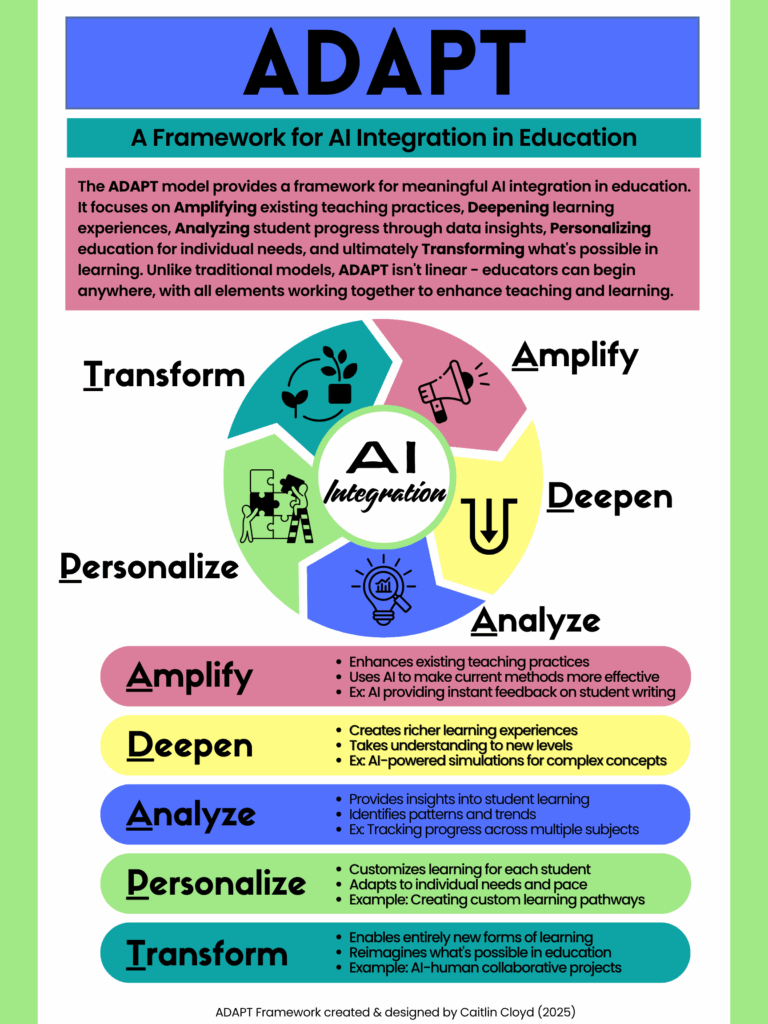
The ADAPT Framework for AI Integration (And Why It’s Not a Ladder)
ADAPT has five elements, and they’re intentionally interconnected:
- Amplify – Strengthen what already works
- Deepen – Push learning into richer thinking
- Analyze – Spot patterns and needs faster
- Personalize – Provide targeted support without lowering expectations
- Transform – Enable learning experiences that weren’t realistic before
You can start anywhere. Most teachers use multiple elements at once. Think of ADAPT less like a staircase and more like a puzzle—each piece matters on its own, but the real power shows up when they connect.
Let me show you what that looks like in practice.
A — Amplify: Make Your Current Moves More Effective
Goal: Strengthen what you already do well—don’t replace it.
Try this tomorrow: 60-second feedback
Instead of spending hours writing comments, let AI draft feedback that you review and personalize.
Prompt:
“Give feedback on this student response. Format: (1) Two strengths, (2) One next step, (3) One question to push thinking. Grade level: []. Skill focus: []. Keep it under 60 words.”
Why it matters: You can give more feedback, more often—which research shows is one of the biggest drivers of student growth.
Question for you: If every student got meaningful feedback twice as often, what would change in your classroom?
D — Deepen: Push Thinking, Not Just Output
Goal: Use AI to improve the quality of thinking, not just generate stuff.
Try this tomorrow: Discussion ladder
Generate questions that move students from surface-level understanding to deeper analysis and real-world connection.
Prompt:
“Create 10 discussion questions on [topic]. Progress from: clarifying → interpreting → evaluating → connecting to current events. Add 2 follow-up prompts for each question.”
Better yet: Build a MagicSchool chatbot
Create a teacher-customized “Socratic Coach” chatbot that students use to:
- Practice discussion responses before class
- Get coached on adding evidence
- Prepare counterarguments for debates
- Refine claims before speaking
Question for you: What if students could practice academic talk with a coach before the discussion even started?
A — Analyze: See Patterns Faster, Teach Smarter
Goal: Stop guessing. Use AI to spot actual misconceptions and learning gaps.
Try this tomorrow: Misconception scan
Paste 15–30 exit ticket responses and let AI group them into patterns.
Prompt:
“Group these student answers into 3–5 misconception patterns. For each: name it, explain it in student-friendly language, suggest one practice question to address it, and recommend small groups.”
Why it matters: You can make small-group instruction way more targeted without spending your entire planning period sorting data.
Question for you: What would happen if your small groups were based on actual thinking patterns every time—not just who scored low?
P — Personalize: Differentiate Without Drowning
Goal: Give every student what they need without creating three different lessons.
Try this tomorrow: Same target, three scaffolds
Use AI to build supports that keep the rigor intact while adjusting the access points.
Prompt:
“Create 3 versions of this task aligned to the same learning target: [__].
Version A: sentence stems + word bank
Version B: standard
Version C: extension with higher-order thinking
Include success criteria for all.”
Better yet: Build a MagicSchool “Study Buddy” chatbot
Train it on your unit expectations so students can:
- Review key concepts with examples/non-examples
- Practice vocabulary in context
- Generate their own practice questions
- Get explanations in different ways (without getting answers handed to them)
Question for you: How many students would feel more confident if the support changed—but the learning goal stayed the same?
T — Transform: Enable What Wasn’t Possible Before
Goal: Use AI to create learning experiences you couldn’t scale on your own.
Transformation doesn’t always mean flashy. Sometimes it’s just:
- More practice than class time allows
- Better coaching than one teacher can provide alone
- More student ownership over revision and growth
Try this tomorrow: “Don’t give me the answer” tutor
This is one of the most powerful shifts—AI as a thinking coach, not a solution machine.
Student prompt:
“I’m stuck on [problem]. Don’t solve it for me. Ask me up to 5 questions to help me figure it out. After I answer, give me a hint—not the answer.”
Better yet: Build teacher-customized MagicSchool chatbots like:
- Debate Partner – Practice rebuttals and counterarguments
- Revision Coach – Identify unclear sections, suggest edits, explain why
- Real-World Connector – Link concepts to current events, careers, everyday life
- Role-Play Simulator – Historical figure interview, mock trial, lab safety inspector, customer service scenario, etc.
Question for you: If students could get high-quality coaching outside of class without waiting for you, what would that unlock?
The Real Power? When ADAPT Elements Connect
Each piece of ADAPT works on its own. But the magic happens when they work together:
Amplify → Analyze → Personalize:
Better feedback → clearer patterns → targeted support
Deepen → Analyze:
Richer student thinking → clearer misconceptions and reasoning gaps
Personalize → Transform:
Students get what they need → independence grows faster
When those pieces start connecting, transformation isn’t some distant goal. It becomes the natural result of better teaching moves happening more consistently and at scale.
A Quick Note on Guardrails
Meaningful AI integration means modeling responsible use:
- AI drafts, teachers decide
- Students explain their thinking and cite sources when appropriate
- Use tools and settings aligned with your district expectations
The goal isn’t to hand learning over to AI. It’s to amplify what great educators already do.
Final Thoughts
If we use AI to make traditional tasks slightly better, we’ll get slightly better results.
But if we use AI to increase feedback cycles, deepen thinking, analyze learning faster, personalize support, and coach students toward independence… we don’t just improve school.
We change what’s possible.
I’d love to hear from you: Which part of ADAPT feels most urgent in your context right now? What connections between the pieces seem most promising for your students?
Want to dive deeper? Check out my book AMPLIFIED Education for more examples of how these elements work together in real classrooms.

2 comments
I love your blog.
This is fantastic, Caitlin! I have added a link to it in the “FAQs, Guides, Resource Collections & Tip Sheets” section of my “AI in Education” resource doc:
http://tiny.cc/ai-in-education