
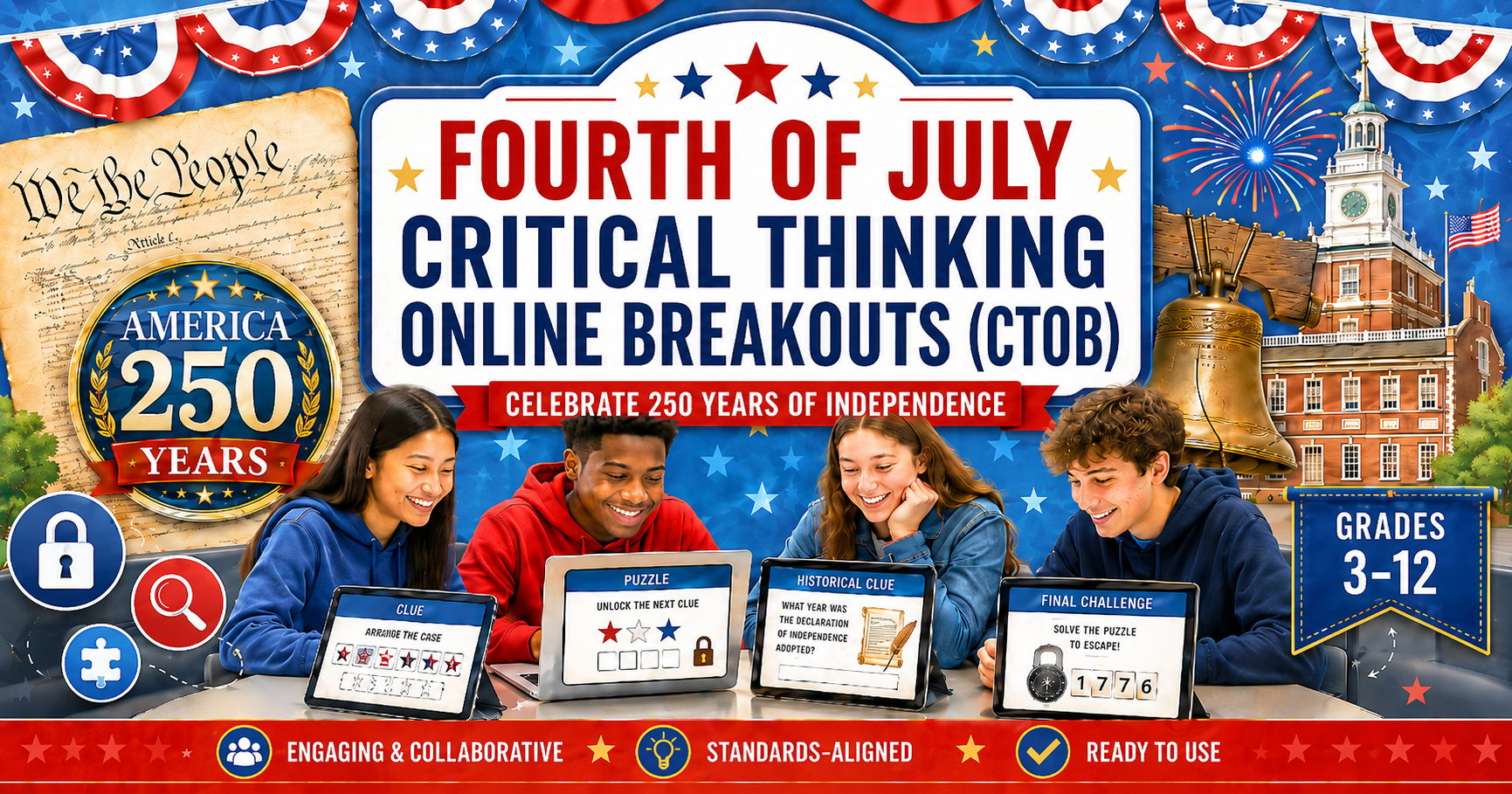
Looking forward to the July 4th this year is different. You know what I mean. Not ONLY is it Independence Day, but with the backdrop of America’s 250th Birthday, it’s also a time to cherish the sacrifices everyone has made in the history of the United States. In this blog entry, I will share a few critical thinking, online breakouts (CTOBs) for you to share with your students. They are relevant to July 4th, as well as other significant events after July 4th in history.
Looking for More Critical Thinking Online Breakouts (CTOBs)?
Be sure to read Science Detectives: Critical Thinking Online Breakouts (CTOBs) for Your K-2, 3-5, and 6–8 Classroom, Celebrate America’s 250th Birthday, as well as the Critical Thinking Online Breakouts blog entries, Part One and Part Two. Science educators may also appreciate the Lab Safety Certification Activities.
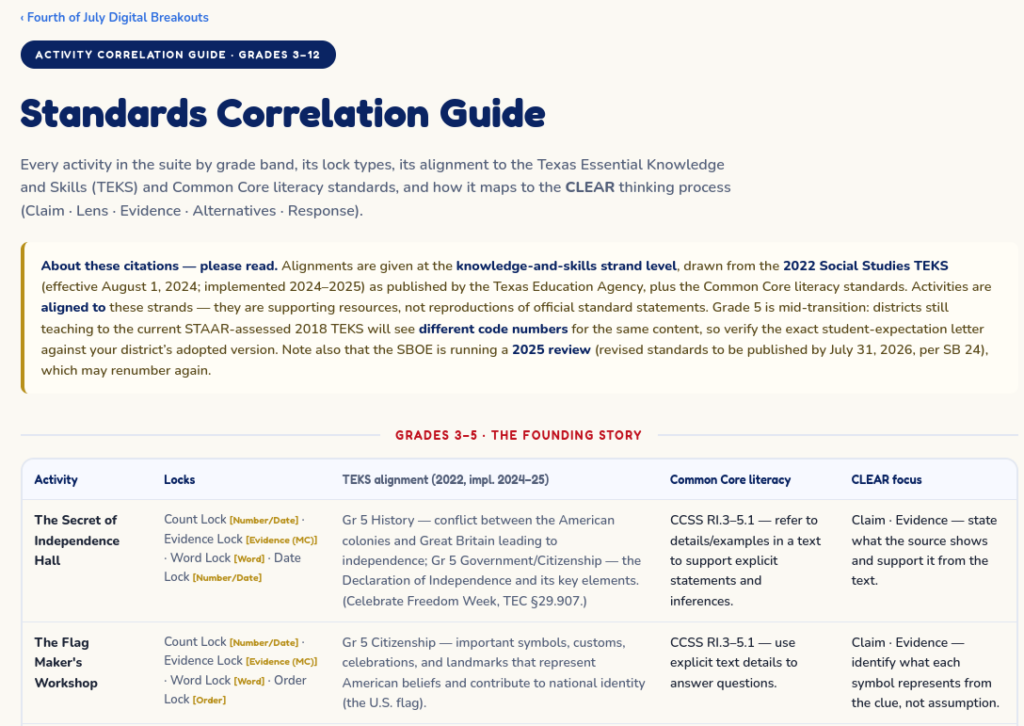
Since they are aligned to the Texas law, TEKS and Common Core, you will find them useful any time you want to remind students about America’s treasured history. And since America is diverse, every effort has been made to make these multilingual. All activities are available in English, Spanish, Vietnamese, Arabic, Chinese, Hindi, and Urdu, languages found in Texas classrooms.
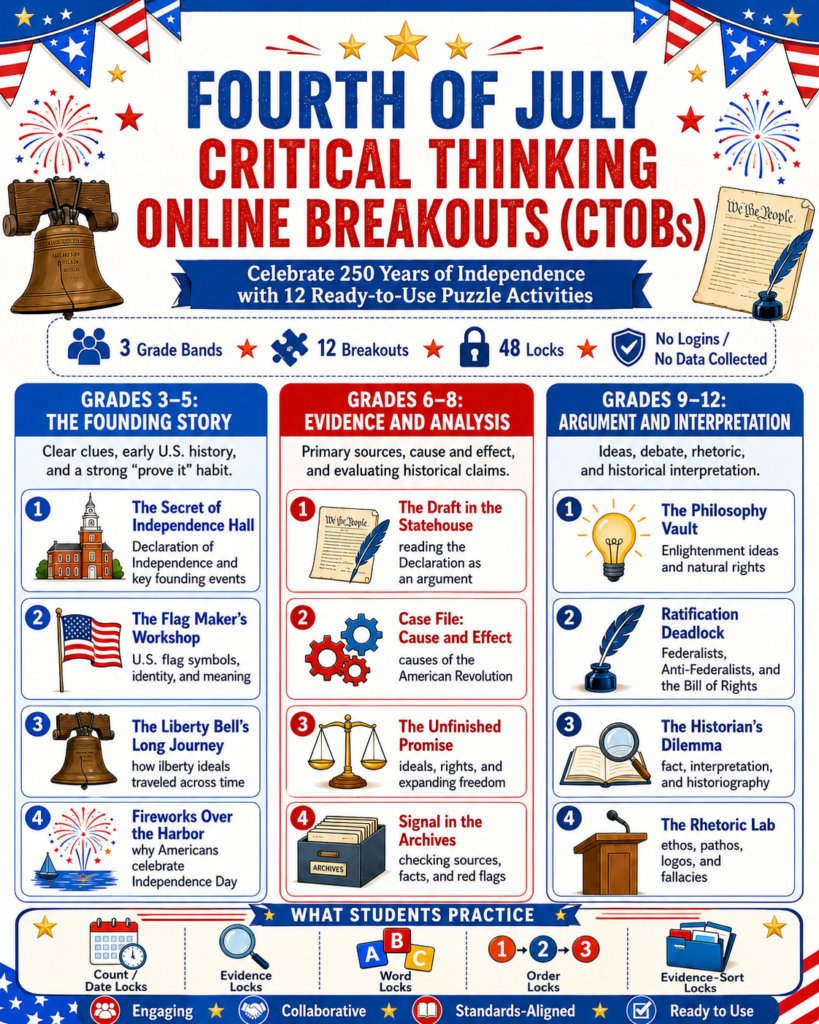
See the complete list in the printable infographic below.
With July 4, 2026, marking the 250th anniversary of the signing of the Declaration of Independence, this is a good time to give students a fresh way to explore Independence Day. Digital breakouts offer students a puzzle-based activity where they read, reason, check evidence, and crack the locks. If your students like escape rooms, mystery clues, or “wait, I think I found it” moments, this Fourth of July Digital Breakout suite may be a good fit.
What is included?
The Fourth of July Critical Thinking Online Breakouts (CTOBs) include 12 self-contained activities across three grade bands: grades three through five, grades six through eight, and grades nine through 12. Each grade band has four themed breakouts, and each breakout includes four locks.
That gives you 48 locks total. More importantly, it gives you options.
| Grade band | Focus | Sample activities |
|---|---|---|
| Grades 3–5 | The founding story | Independence Hall, the flag, the Liberty Bell, fireworks |
| Grades 6–8 | Evidence and analysis | Cause and effect, unfinished promises, source checking |
| Grades 9–12 | Argument and interpretation | Enlightenment ideas, ratification, historiography, rhetoric |
The activities are designed as single HTML files, so there are no student logins, no accounts, and no data collected. Students open the breakout, work through the clues, and use their reasoning to solve the locks. That keeps the activity simple enough to run without turning your classroom into a tech support counter. This also means they are data safe…no private data required.
Why use a CTOB for the 250th?
The 250th anniversary is not just a bigger birthday cake for the nation. It is a chance to help students critically revisit founding ideas, symbols, arguments, and contradictions with more care.
- For younger students, that may mean asking what the flag represents or why Independence Hall matters.
- For middle school students, it may mean sorting causes from effects or checking whether a source is reliable.
- For high school students, it may mean tracing ideas like natural rights, consent of the governed, and rhetorical appeals through founding documents.
The breakout format helps because students cannot skim once and move on. They have to notice details, test an answer, and revise their strategy when the lock does not open. That little moment of “nope, try again” is often where the learning happens.
How do students solve the locks?
Each activity uses a mix of lock types. Students may need to count details, identify evidence, enter a word, place events in order, or sort statements into the right category.
Here are the five lock types used across the suite:
| Lock type | What students practice |
|---|---|
| Count or date | Finding precise information |
| Evidence | Choosing the answer best supported by the clue |
| Word | Identifying key vocabulary or ideas |
| Order | Sequencing events or arguments |
| Evidence-sort | Separating supported claims from weak ones |
If your students are new to digital breakouts, you may want to model the first lock as a class. Think aloud. Show them how to look for clues, check the wording, and avoid guessing too quickly. After that, pairs usually work well. Two students can argue productively over a clue in a way that one student staring silently at a screen usually cannot.
Where does this fit instructionally?
This suite works well as a holiday-week activity, a review station, an enrichment option, or a short history connection during the 2026 celebration year. You could also assign different breakouts to different groups and let students report back on the historical idea their activity focused on. It’s totally free, so if you are homeschooling, private/charter school, give these a try, too.
For example:
| Classroom goal | Suggested use |
|---|---|
| Build background knowledge | Start with the grades 3–5 founding story activities |
| Practice source analysis | Use the grades 6–8 evidence activities |
| Extend historical thinking | Use the grades 9–12 argument and interpretation activities |
| Encourage collaboration | Have students solve in pairs or small groups |
| Check understanding | Ask students to explain which clue was hardest and why |
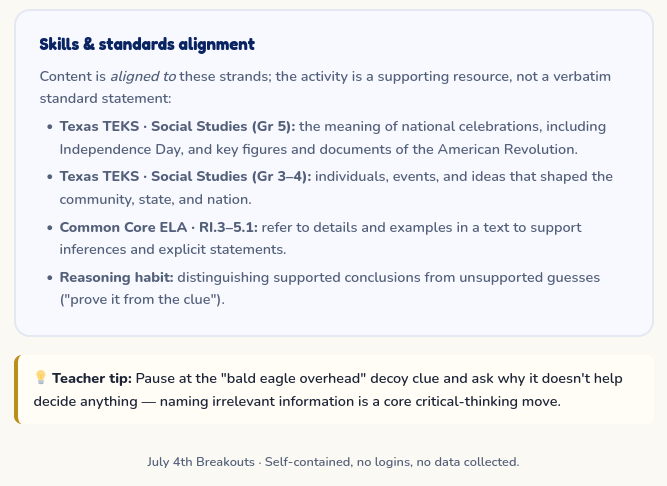
The activities are aligned at the strand level to TEKS and Common Core literacy skills, but you will still want to check the exact student expectations used in your district.
Wish you had more breakouts? Keep reading.
Did You Know about July 5th? Learn More via these Breakouts
July 5 has its own history. On July 5, 1852, Frederick Douglass delivered the address now known as “What to the Slave is the Fourth of July?” at Corinthian Hall in Rochester, New York. The Smithsonian’s National Museum of African American History and Culture notes that Douglass gave the speech at an Independence Day commemoration, but his message pressed directly on the contradiction of celebrating liberty while slavery still existed.
A Note on Standards and Classroom Use of July 5th
These July 5th breakouts are built for Texas classrooms and written to stay inside Texas law. Under Texas Education Code §28.0022, slavery and racism must be taught as “deviations from, betrayals of, or failures to live up to the authentic founding principles of the United States, which include liberty and equality.” That is precisely the lens these activities use. It is also the argument Frederick Douglass himself made on July 5, 1852. Douglass did not reject the Declaration of Independence; he held the nation to it, naming the gap between its promise of liberty and the reality of slavery. Students work from primary-source evidence toward that same conclusion.
Every activity is designed to be explored objectively and free from political bias, as the statute requires. The locks reward one skill above all: proving a claim from the evidence rather than from assumption or feeling. Teachers retain full discretion over how far to extend any discussion, and each activity ships with a teacher launch page, a standards correlation guide, and a plain-language privacy and compliance note.
Content is aligned to the 2022 Texas Social Studies TEKS and Common Core literacy strands (it is not a reproduction of official standard text), and the activities collect no student data, no logins, no accounts, no tracking. The aim is not to replace the Fourth of July, but to add the day beside it, and to ask a question worth a classroom’s time: whose freedom did the calendar remember, and how do we know?
That’s why I’m excited to share these additional digital breakouts focused on July 5th and other Black Freedom Holidays. Here’s an overview of what you get:
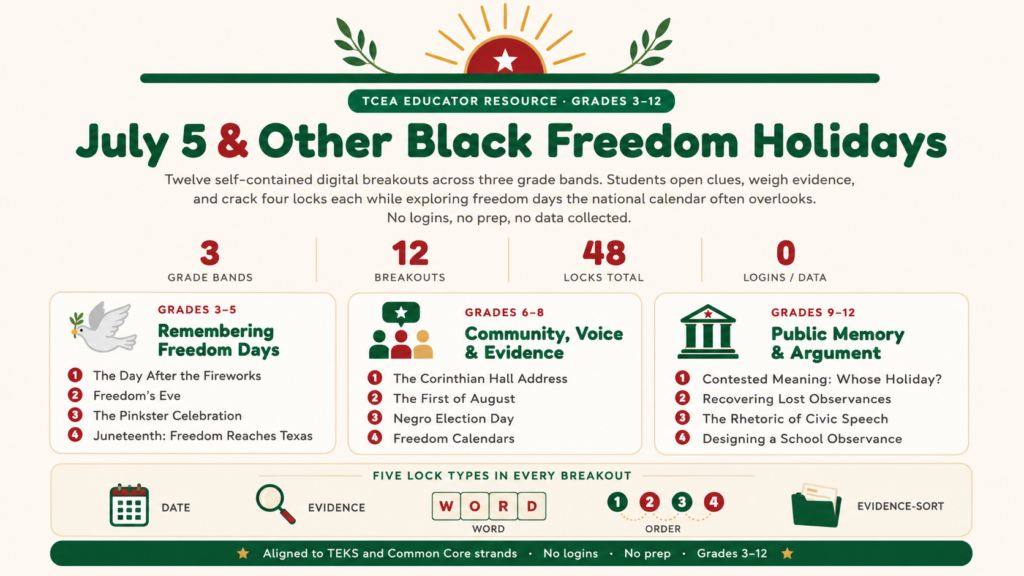
The July 5 and Other Black Freedom Holidays Digital Breakouts include 12 activities across three grade bands. Each activity asks students to open clues, examine short source excerpts, and solve locks based on evidence.
Ready to try these out?
Use the Fourth of July Critical Thinking Breakouts as a way to celebrate the Semiquincentennial while keeping students in the work of reading, thinking, and proving their answers. Explore the the July 5 and Other Black Freedom Holidays Digital Breakouts to get a different perspective.
If you use the breakouts with students, consider ending with one quick reflection: “What did you learn about Independence Day that you did not know before?” That answer may tell you more than the locks do. Speaking of answers, if you need the answer key (AES-256 encryption employed, students) and you’re a teacher, put your request in here. If you notice any issues, please use the same answer key form to share your feedback.
While every effort has been made to ensure accuracy, mistakes can happen and your kind correction is always welcome.
Try one breakout with your students, then share how it went or which lock gave them the best challenge.

![[image]](https://commons.wikimedia.org/wiki/File:America250_logo.svg?uselang=en#Licensing)