“I had an argument with my son today about learning math and coding. He told me he doesn’t need to learn them anymore because he can just use Google’s AI mode to get homework answers and build anything he wants,” said Ebrahim K. His post made me ask the following:
If coding and essay writing are no longer the vehicles for teaching critical thinking, logic, and design, then what physical activity could be relied upon instead?
In this blog entry, I take a stab at figuring that out. And, it turns out that I’m not the only one to ask the question.
The Core Question
“How do we develop critical thinking skills in ways that GenAI can’t reproduce?” The question pushes me to leave my office, to step outside. GenAI has impacted everything from ethical systems to global economies. Now, it’s coming for critical thinking and student cognition.
Embodied learning may be one possibility. It is a tough one given our preference for traditional learning.
Definition: Embodied Learning
Embodied learning uses movement and physical activity to help students learn and remember better. It’s an educational model focused on using the body during lessons to stimulate involvement and improve the learning process (source).

Why Embodied Learning Matters Now
“Our most basic form of learning relies on the body’s knowledge. Our most basic form of learning in childhood is preverbal. However traditional schooling forces us to check our bodies at the door,” says R.L. Lawrence.
What if physical presence and how we experience the world with our bodies help reconnect us with learning in ways that GenAI nullifies? Our bodies facilitate genuine connections with others. These connections and experiences fuel our learning. While GenAI may be our digital friend, nothing replaces a handshake or hug.
Aside: It’s difficult to imagine school staff now having to deal with students involved with AI companions. That’s one more distraction from left field…
Could students learn math through building actual structures? Run classroom businesses with real products? Or, perhaps, create physical displays that respond to human movement? The goal does not focus on GenAI usage, but seeks to encourage building solutions in the real world. These are multi–sensory approaches that develop students’ neural pathways, not train GenAI models.
The Power of Physical Thinking
For many teachers, critical thinking emerges through writing or coding. The goal is to have students externalize their thinking, making it visible. But as GenAI tools make fabricating student work child’s play, teachers wonder: “What can students do instead to make their thinking visible?” Perhaps, what projects can engage students?
Embodied learning requires real-time adaptation and attention. Failing to pay attention has physical consequences. What’s more, students must employ spoken rhetoric to persuade and/or inform others.
Building Through Physical Experience
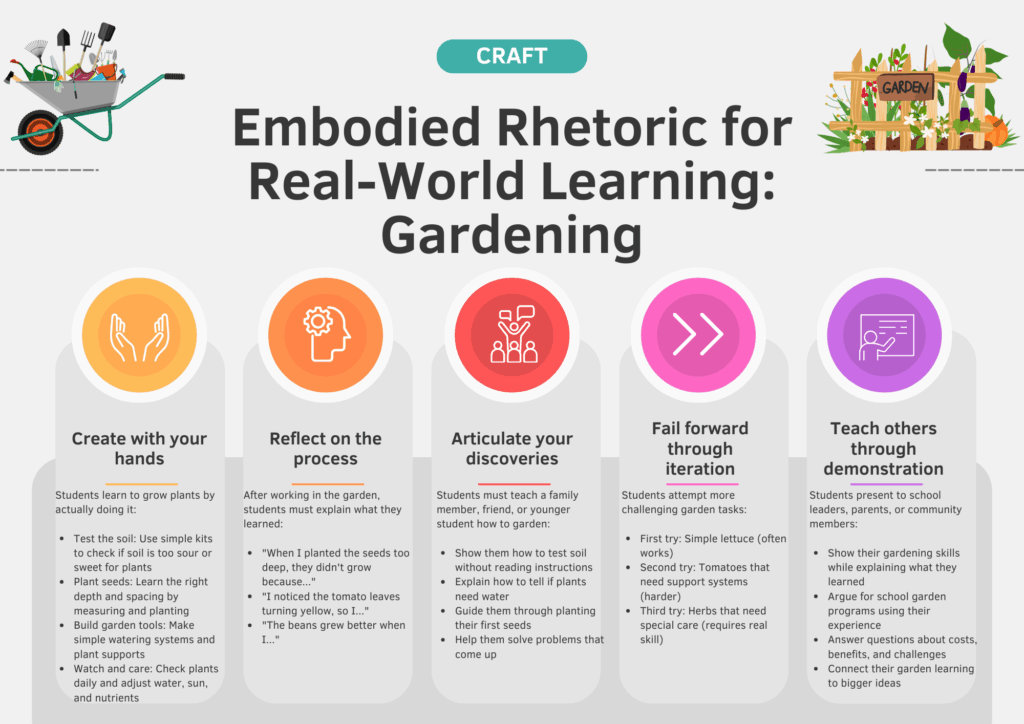
Consider pottery-making: students receive instant tactile feedback about cause and effect. They must be aware of pressures, temperatures, and techniques—a sensory dialogue that teaches problem-solving in ways GenAI cannot replicate.
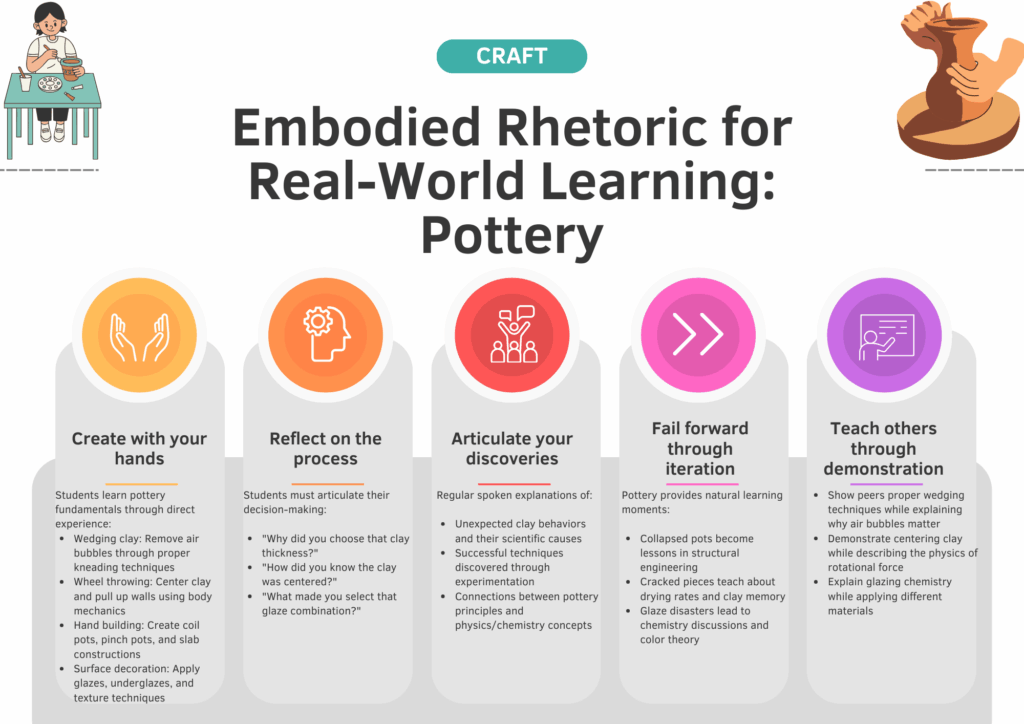
Other hands-on activities that develop critical thinking include:
- Blacksmithing: Reading color changes to determine temperature
- Gardening: Understanding subtle, esoteric knowledge about plants and soil
- Woodworking: Learning material properties through direct manipulation
- Rock-climbing: Problem-solving routes with real physical consequences
Each activity involves developing critical thinking through physical interaction with materials. These activities involve students in discovering rules and knowledge. And, it must all be learned through doing.
The PRISM Framework in Action
The PRISM framework (Patterns, Reasoning, Ideas, Situation, Methods) offers a way to design embodied learning experiences. In a wilderness trek, students:
- Patterns: Identify natural indicators of direction and weather
- Reasoning: Analyze how patterns create survival strategies
- Ideas: Generate multiple solutions to challenges
- Situation: Evaluate which solutions fit circumstances
- Methods: Implement and test approaches with real-world feedback
This progression moves students from surface to deep learning, ending with transfer. This is something rarely achieved in traditional settings, according to one colleague I spoke with a few weeks ago.
AI as Partner, Not Replacement
Rather than fighting AI, educators can design embodied learning experiences where GenAI enhances the process. In school gardens, students might:
- Generate initial design ideas with GenAI, then physically implement and adapt plans
- Brainstorm solutions collaboratively, then apply ideas in real interactions
- Analyze data from physical problem-solving experiences
In this way, real learning happens as students work to physically implement solutions co-developed by humans with GenAI.
The Enhanced Makerspace
In embodied learning situations, students cannot offer AI’s answers as final solutions. The physical experience of being in proximity to others, working with real materials, prevents that. As GenAI infiltrates classrooms, we must move back toward physical, problem-solving spaces. Consider an adaptation of Peggy Reimers’ work on makerspaces:
| PRISM Component | Traditional Making | Embodied Learning Enhancement | Gen AI Integration |
|---|---|---|---|
| Patterns | Students identify patterns in materials, tools, and construction techniques through hands-on exploration | Physical manipulation reveals material properties (wood grain, metal flexibility, cardboard strength) through tactile feedback | AI analyzes project failures/successes to suggest material combinations and structural patterns |
| Reasoning | Trial and error with physical materials teaches cause-effect relationships | Body knowledge develops through repeated physical actions (measuring, cutting, assembling) with immediate sensory feedback | Students query AI for initial designs, then must physically test and adapt based on real-world constraints |
| Ideas | Brainstorming and sketching project concepts | Physical prototyping with found materials allows rapid iteration and collaborative building | AI generates multiple design variations; students physically build and compare outcomes |
| Situation | Adapting projects based on available materials and tools | Real-time problem-solving when materials break, measurements are wrong, or tools malfunction | AI provides troubleshooting suggestions that students must physically implement and verify |
| Methods | Following maker processes: Think→Question→Design→Create→ Struggle→Enjoy→Collaborate→Try→Solve→Fail→ Problem Solve→Reflect→Learn | Physical consequences drive learning (structures collapse, circuits don’t work, robots crash) requiring immediate bodily response and adaptation | AI documents the making process, but students must physically demonstrate mastery through successful builds |
New Possibilities for Embodied Learning
The more GenAI finds its way into our work and classrooms, I have to wonder how we might move back from unnatural, artificial settings into more physical, problem-solving and learning spaces. What do you think? Will all of us begin the slow transition to more physical, embodied learning?
👤 Human-directed (Miguel Guhlin) · 🤖 Gen AI-assisted (Claude, ChatGPT)