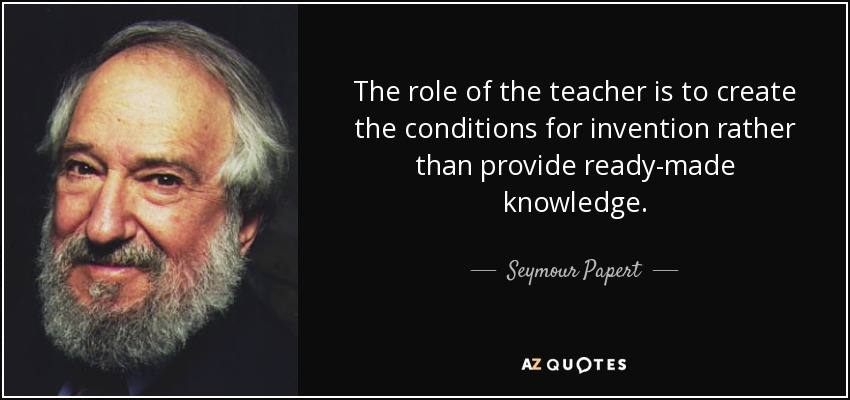
At age 88, Dr. Seymour Papert passed away this July 31, 2016. While you may or may not recognize his name, Dr. Papert had a real impact on your life and your teaching career, especially when it comes to technology in education. Here are just a few of the ways Papert’s work influences teaching and learning today.
1. In the 1960s, decades before laptops and personal computers, Papert postulated that “Computer programming and debugging can provide children a way to think about their own thinking and learn about their own learning.”1
2. Dr. Papert’s book Mindstorms: Children, Computers and Powerful Ideas (1980) has been called the “seminal work on technology and learning.” The book postulated, “technology, rather than threatening traditional education, could enhance and support the type of learning educators believed in.” 2 LEGO’s EV3 Robotics kits are named “MINDSTORMS” in honor of Papert.
3. Papert’s examination of learning and technology led him to champion a Constructionist philosophy. In its simplest form, this is the idea that children create knowledge from experience. If you teach robotics, have a makerspace, or use computers to help students learn, you are following Papert’s Constructionist belief. 3
4. Papert, then a mathematics professor, served as co-director of the Artificial Intelligence Lab at MIT, where his collaboration with Professor Marvin Minsky resulted in the book Perceptrons, “which marked a turning point in the field of artificial intelligence.” 4
5. Dr. Papert, who enjoyed boundless curiosity and intellect, was one of the cofounders of the MIT Media Lab, which, “continues to focus on the study, invention, and creative use of digital technologies to enhance the ways that people think, express, and communicate ideas, and explore new scientific frontiers.” 5 Scratch and Scratch Junior, well-know, programming software, were both developed by the people at the MIT Media Lab.
6. In an August 1, 2016 memorial blog post, Dr. Mitch Resnick, a former student, longtime collaborator, and friend of Papert, is quoted, saying, “For so many of us, Seymour fundamentally changed the way we think about learning, the way we think about children, and the way we think about technology.” 6
Dr. Papert’s legacy is one TCEA proudly celebrates. His understanding of hands-on, minds-on learning and his early recognition of technology’s transformative potential in education laid the groundwork for the limitless possibilities and access to information now afforded to students around the world. While he will be sorely missed, his endowment will live on.
Sources
1. Harel, Idit, and Seymour Papert. Constructionism Research Reports and Essays: 1985-1990. Norwood, NJ: Ablex, 1991. Print.
2. Rifkin, Glenn. (2016, August 1). Seymour Papert, 88, Dies; Saw Education’s Future in Computers. New York Times, A21.
3.Harel, Idit, and Seymour Papert. Constructionism Research Reports and Essays: 1985-1990. Norwood, NJ: Ablex, 1991. Print.
4. “In Memory: Seymour Papert.” MIT Media Lab, 1 Aug. 2016. Web. 1 Aug. 2016.
5. “MIT Medi Lab FAQs.” MIT Media Lab, n.d. Web.
6. “In Memory: Seymour Papert.” MIT Media Lab, 1 Aug. 2016. Web. 1 Aug. 2016.

 In addition to academies, Premium registrants may also select from more than 350 extra workshops, allowing you to get hands-on, minds-on experience with specific software, learning theories, best practices, and technology tools. Add to that the more than 450 sessions that are offered to both Premium and Basic attendees covering a wide range of topics from formative assessment to creating a makerspace to engaging student learners. All of these will ensure that you are powered up for the rest of the school year. And if you’re the chief technology officer in your district, there’s a day of special presentations just for you.



 Did someone say marathon-viewing? Grab a cold drink and a bowl of freshly-popped popcorn and while away the afternoon without a trace of guilt; it’s a two-for-one for knowledge and fun.
 “Are teachers and curriculum departments being disintermediated as students engage in self-transmediation, crafting the story of themselves across time and space?” When I first wrote that question down, I had no idea that The Transmediated Self was actually a real term. Rather, I was searching for a term that defined learning in a hyper-connected present where people AND things were constantly plugged in and communicating information. Yet it is a term that has profound implications for self-determination in learning. We do not yet appreciate the always-connected aspect of technology and its impact on in transforming our