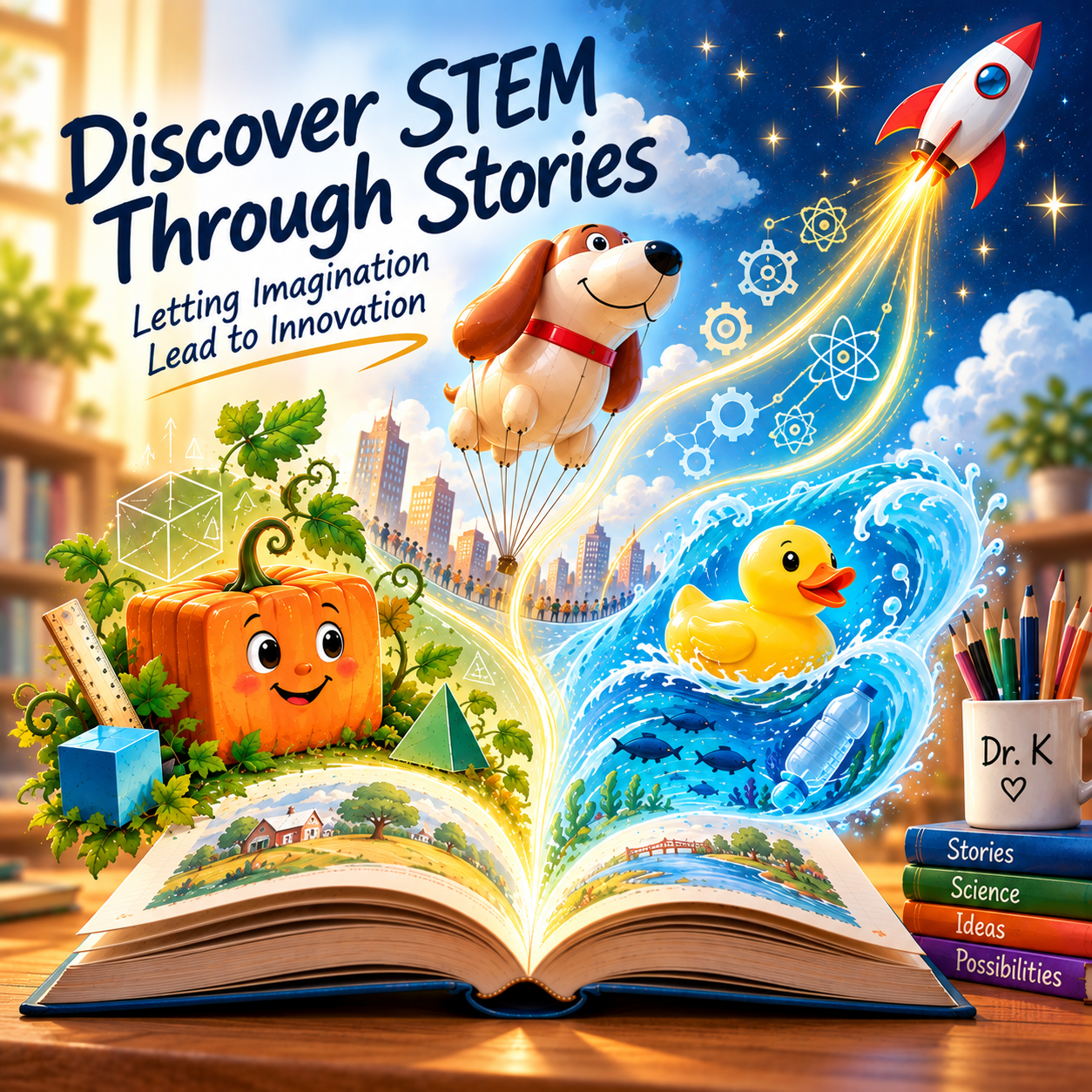
Letting Imagination Lead to Innovation
Is the end of a book really the end of its story? Sometimes the end can create a whole new beginning! Maybe something from the book sparks a student’s imagination during a class discussion. That spark can become a question, a problem to solve, or even an idea for something entirely new. Teachers can help students follow the idea, find a path forward, and give them the tools to bring that idea to life. That’s where STEM enters the story, providing opportunities to investigate, design, create, test, and innovate.
The Integrating Engineering and Literacy (IEL) project at Tufts University explored an approach in which students use children’s literature to identify problems that could be addressed through engineering, then design and test possible solutions while connecting their work back to reading and writing (Wendell, 2014). Teachers play an important role in helping students make that leap from story to problem. Research has shown that classroom discussion can help students understand the text, frame problems, and better understand the engineering challenge itself (Milto et al., 2016, p. 285). Together, the story and discussion provide meaningful context for what comes next.
But what happens when we widen the lens? Maybe new possibilities come into view. What begins with an idea could lead to science, technology, engineering, math, or right back into reading and writing. Let’s consider three examples.
Stories to STEM
📚 “The Legend of Spookley the Square Pumpkin” by Joe Troiano
A square pumpkin immediately opens the door to geometry, but why stop there? Spookley could lead to plant science, measurement, agriculture, engineering, or even conversations about differences, belonging, and individual strengths. Geometry might mean comparing shapes, counting faces, edges, and vertices, or exploring what makes a cube different from a sphere. One familiar story. Lots of possible shapes it could take.
📚 “Balloons Over Broadway: The True Story of the Puppeteer of Macy’s Parade” by Melissa Sweet
Tony Sarg’s story of bringing giant balloons to the Macy’s Thanksgiving Day Parade is filled with possibilities. Invention and engineering connections may be obvious, but look a little closer and you might also see forces and motion, mapping, coding, design, persuasive writing, or research. How long is the parade route? How large are the balloons? What is the history behind this iconic event? Those questions could quickly turn into math, measurement, or research. Give an idea a little line and see how high it goes.
📚 “Ducks Overboard!: A True Story of Plastic in Our Oceans” by Markus Motum
What can happen when thousands of plastic bath toys tumble into the Pacific Ocean? Suddenly there are possibilities involving ocean currents, geography, environmental science, plastics, data, prediction, and more. Students might map where the toys traveled, investigate how plastics in our oceans affect marine life, or use data to predict where another one might eventually wash ashore. One unexpected journey can make waves far beyond the story.
Each of these stories opens a different door, and there are plenty more waiting to be explored.
Ready to Make the Connection?
Look at what’s in your curriculum. Revisit the stories and resources there and consider where a STEM connection might fit naturally. Then think about where that connection could take your students. Could they investigate a question, design a solution, create a model, test an idea, code something, collect data, or research another possibility?
And don’t do it alone! Collaborate with your librarian, a grade-level colleague, a visual or performing arts teacher, or another professional who could bring a different perspective. Together, you might find additional resources, develop a makerspace challenge, incorporate technology, or discover a connection you had not previously considered!
Stories help students imagine what could be. STEM can give those ideas a launchpad for innovation.
Maybe “The End” isn’t really the end after all.
References
Milto, E., Wendell, K. B., Watkins, J., Hammer, D., Spencer, K., Portsmore, M., & Rogers, C. (2016). Elementary school engineering for fictional clients in children’s literature. In L. A. Annetta & J. Minogue (Eds.), Connecting science and engineering education practices in meaningful ways (pp. 263–291). Springer International Publishing. https://doi.org/10.1007/978-3-319-16399-4_11
Wendell, K. B. (2014). Design practices of preservice elementary teachers in an integrated engineering and literature experience. Journal of Pre-College Engineering Education Research, 4(2), 29–46. https://doi.org/10.7771/2157-9288.1085