In Part 1 of this series, you explored the “Secret Sauce” of the ARC Protocol. In it, you learned about the neuroscience of psychological safety, the power of the Crucial Conversations‘ authors’ AMPP technique (Ask, Mirror, Paraphrase, Prime) as applied in instructional coaching. You also saw why validating a teacher’s perspective is the essential first step toward instructional change.
As any instructional leader knows, theory is one thing. The messy reality of a Tuesday morning in a middle school hallway is another. When you’re met with “I don’t have time” or “My students aren’t ready,” you need more than a framework. What you need is a script. You need the exact words that will transform that tangle of dark, knotted resistance into a smooth, golden braid of collaborative action.
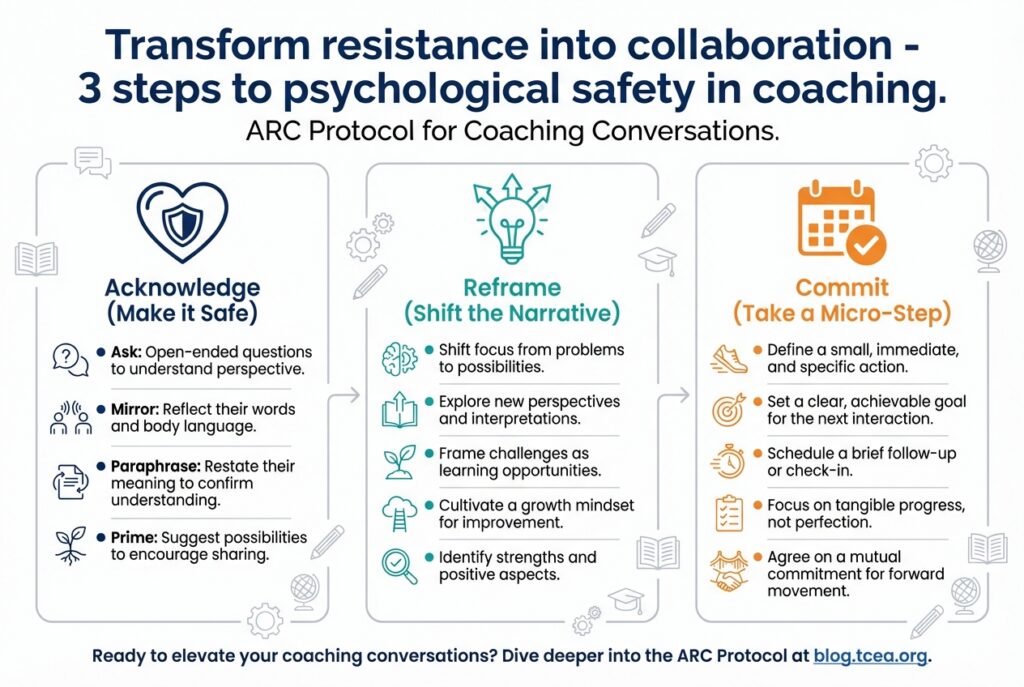
In this blog entry, you will see how to put the ARC Protocol to work. Below are five common scenarios you might encounter as an instructional leader, followed by the specific application of Acknowledge, Reframe, and Commit. Each is enhanced with the AMPP technique for deeper psychological safety.
Remember the core principles:
- A – Acknowledge: Lower the emotional temperature first (Crucial Conversations: “Make it Safe”)
- R – Reframe: Stop arguing about teacher preference and start talking about student data (HESIS)
- C – Commit: Don’t leave without a date on the calendar (TCEA EIIR)
Let’s take a look at specific scenarios through this lens.
Scenario 1: The “I Don’t Have Time” for AI Architecture
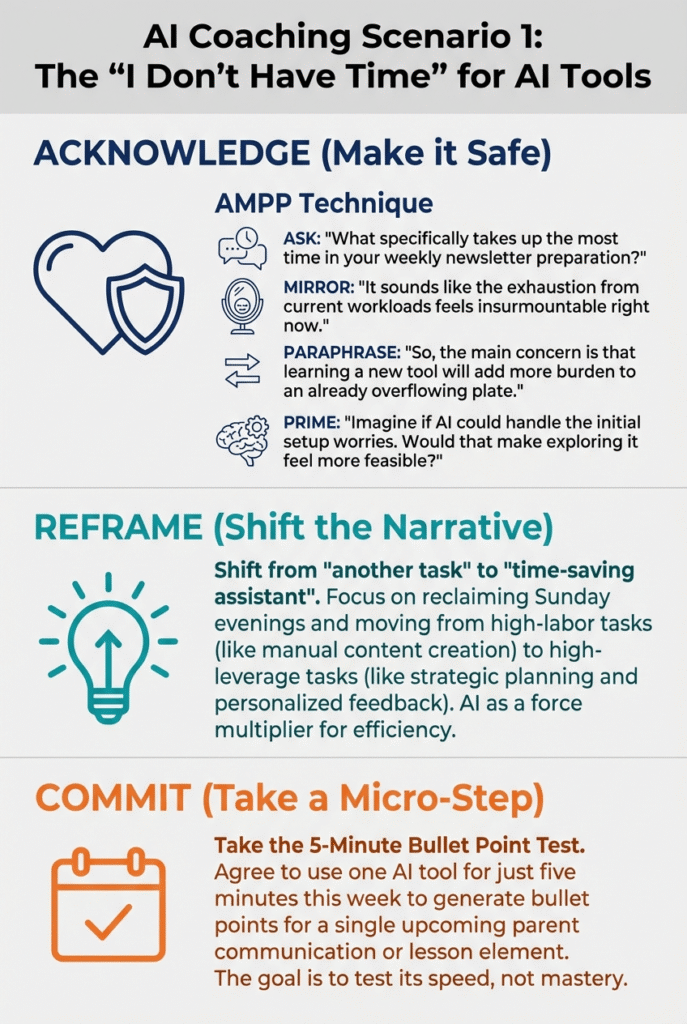
The Situation: A veteran teacher is resistant to using the AI-powered newsletter architecture, claiming they already spend too much time on parent communication.
A – Acknowledge to Make it Safe (using AMPP):
- Ask: “How much time are you spending on parent newsletters right now?”
- Mirror: “I hear the exhaustion in your voice when you talk about the weekend workload.”
- Paraphrase: “It sounds like you feel that adding a new digital tool is just one more burden on an already overflowing plate.”
- Prime: “Is it that you’re worried the setup time won’t actually pay off in the long run?”
R – Reframe the Narrative: “What if we looked at this not as ‘one more thing,’ but as a way to reclaim your Sunday evenings? By using the AI architecture, we shift from ‘writing from scratch’ to ‘editing for impact.’ We are moving from a high-labor task to a high-leverage one, ensuring your hard work is actually seen by parents in a mobile-friendly format.”
C – Commit to a Micro-Step: “Let’s just take your existing bullet points for next week and run them through the ‘Mobile-First’ prompt together for five minutes right now. We won’t even send it—just see if the output actually saves you the drafting time we’re hoping for.”
Scenario 2: The “Performance Anxiety” regarding Video Coaching
The Situation: A teacher is nervous about recording their lesson, fearing it will be used for evaluation rather than growth.
A – Acknowledge to Make it Safe (using AMPP):
- Mirror: “It is completely normal to feel vulnerable when a camera is in the room. Most of us feel like we’re under a microscope when we see ourselves on screen.”
- Ask: “You want to make sure this stays between us and isn’t part of your formal file, right?”
- Paraphrase: “It sounds like your biggest concern is that this might be used against you rather than to help you grow.”
R – Reframe the Narrative: “Let’s shift the camera’s focus. Video coaching has an effect size of 0.99. It’s one of the most powerful tools we have because it provides an ‘objective mirror.’ This isn’t about evaluating you but rather it’s about capturing the students’ reactions to the ‘Heavy Hitter’ strategy we tried. The video is just an extra set of eyes to help us see what we miss while we’re busy teaching.”
C – Commit to a Micro-Step: “Record just a 10-minute segment of your direct instruction tomorrow. You don’t have to show it to me. Just watch it yourself and pick one thing you noticed about student engagement. We can talk about that one observation next time we meet.”
Scenario 3: The “Students Aren’t Ready” for Deep Learning
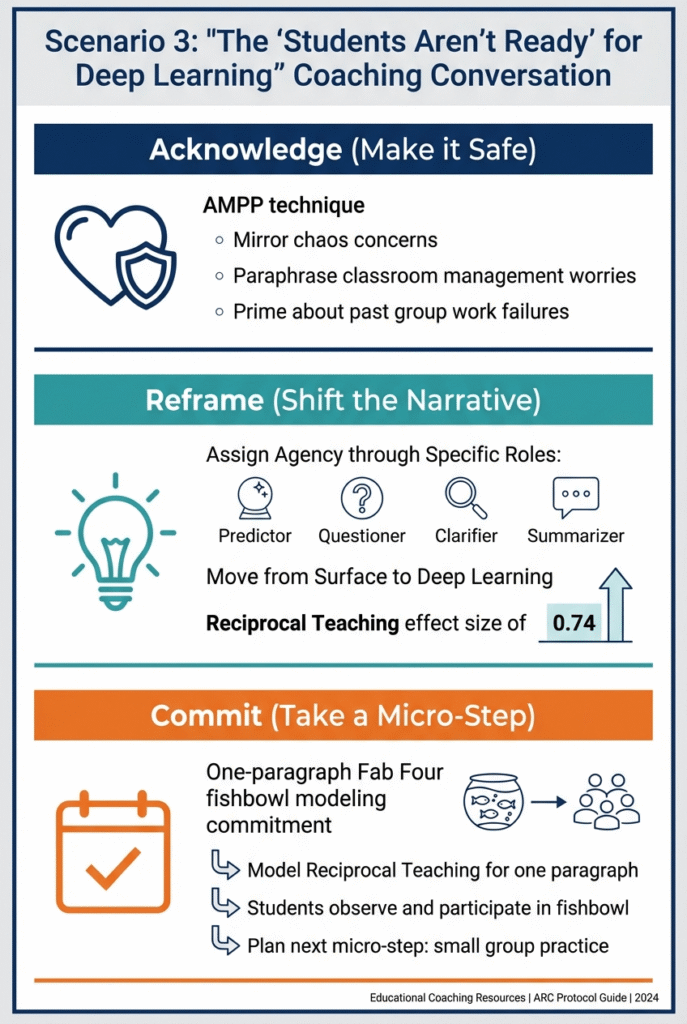
The Situation: A middle school science teacher believes their students lack the discipline for Reciprocal Teaching (d=0.74) and wants to stick to lecture.
A – Acknowledge to Make it Safe (using AMPP):
- Mirror: “Relinquishing control to middle schoolers can feel like inviting chaos, especially with complex content.”
- Paraphrase: “It sounds like you’re worried that if we move away from the lecture, the classroom management will fall apart and the learning will stop.”
- Prime: “Have you tried structured group work before and had it go sideways?”
R – Reframe the Narrative: “Instead of seeing it as ‘giving up control,’ think of it as ‘assigning agency.’ By giving them specific roles (Predictor, Questioner, Clarifier, Summarizer), we are actually providing more structure for their thinking than a standard lecture provides. We are moving from Surface Learning to Deep Learning, which is where the real retention happens. Reciprocal Teaching has an effect size of 0.74. That’s nearly two years of growth in one year.”
C – Commit to a Micro-Step: “Try the ‘Fab Four’ roles with just one paragraph of the text tomorrow. Just one. I’ll even come in and we can do it as a ‘fishbowl’ where you and I model the roles for the students first so they see exactly what the expectations are.”
Scenario 4: The “Colorblind” Approach to Equity & UDL
The Situation: A teacher claims they “treat everyone the same” and doesn’t see the need to adjust lessons for Universal Design for Learning (UDL).
A – Acknowledge to Make it Safe (using AMPP):
- Mirror: “I know your heart is in the right place and that you care deeply about being fair to every student in this room.”
- Paraphrase: “You want to ensure that no one gets ‘special treatment’ that might lower the expectations for the class.”
- Ask: “What does fairness look like to you in your classroom?”
R – Reframe the Narrative: “Fairness doesn’t always mean ‘the same.’ If we look at it through the UDL lens, we’re not changing the goal; we’re just adding multiple paths to get there. It’s about removing the barriers (e.g. heavy reading loads or writing anxiety) that have nothing to do with the actual science content you’re trying to teach. You are removing an unnecessary barrier.”
C – Commit to a Micro-Step: “Let’s look at your next assessment. Can we offer just one alternative, like a verbal explanation or a labeled diagram, for students who struggle with the heavy writing load? We can see if it gives us a more accurate picture of what they actually know about the science.”
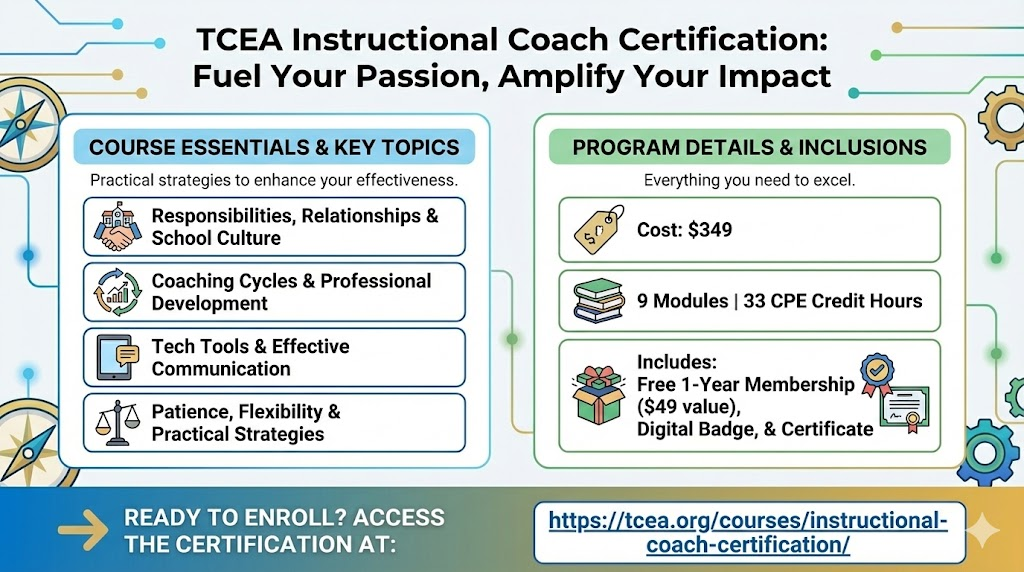
Learn more about TCEA’s Instructional Coaching Certification
Scenario 5: The “Data is Personal” Resistance
The Situation: A teacher becomes defensive when student data shows a low growth rate, blaming the students’ lack of effort.
A – Acknowledge to Make it Safe (using AMPP):
- Mirror: “It is incredibly frustrating when you pour your energy into teaching and the scores don’t reflect that effort.”
- Ask: “It feels like a personal critique of your hard work, doesn’t it?”
- Paraphrase: “You’re saying the students just aren’t putting in the effort they need to succeed.”
R – Reframe the Narrative: “Let’s look at the data as a ‘GPS’ rather than a ‘Grade.’ It’s not saying you didn’t teach it; it’s just telling us that the current strategy hasn’t landed yet. This is our cue to try a ‘Heavy Hitter’ like Spaced Practice (d=0.65) or Retrieval Practice (d=0.49) to see if we can make the learning stick longer. The data isn’t judging you—it’s giving us a roadmap for what to try next.”
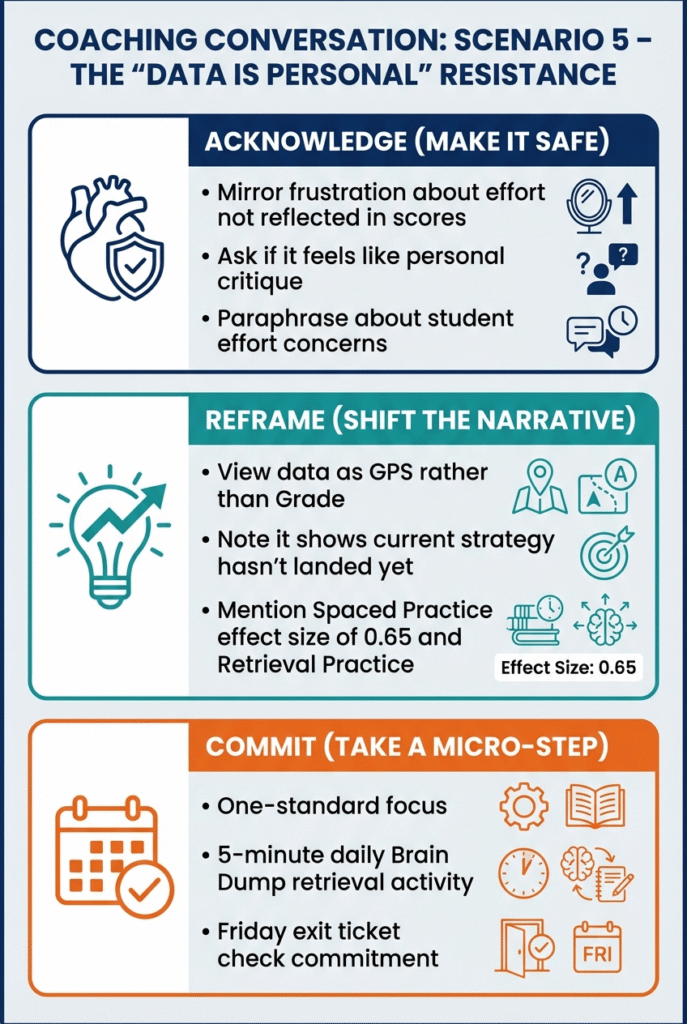
C – Commit to a Micro-Step: “Pick one specific standard where the gap is widest. Let’s try one 5-minute ‘Brain Dump’ or retrieval activity at the start of class every day this week. We’ll check the exit tickets on Friday to see if that small shift moves the needle.”
Wrapping It Up
Each of these scenarios follows the same pattern of emotions before logic. The AMPP technique in the Acknowledge phase ensures that the teacher feels heard before we ever mention effect sizes or instructional strategies. Only when emotions are acknowledged can you focus on reframing, then obtaining a meaningful commitment.
Your Challenge: Which of these five scenarios sounds most like a conversation you’ve been avoiding? Pick one then try writing out your AMPP statements. Practice them out loud. Then go have the conversation. One ARC at a time.
Read the Full Series:
- Part 1: Navigating Resistance with the ARC Protocol
- Part 2: ARC in Action—5 Scenarios for Coaching Reluctant Educators (You are here)
👤 Human-directed (Miguel Guhlin) · 🤖 Gen AI-assisted (Claude, ChatGPT)