
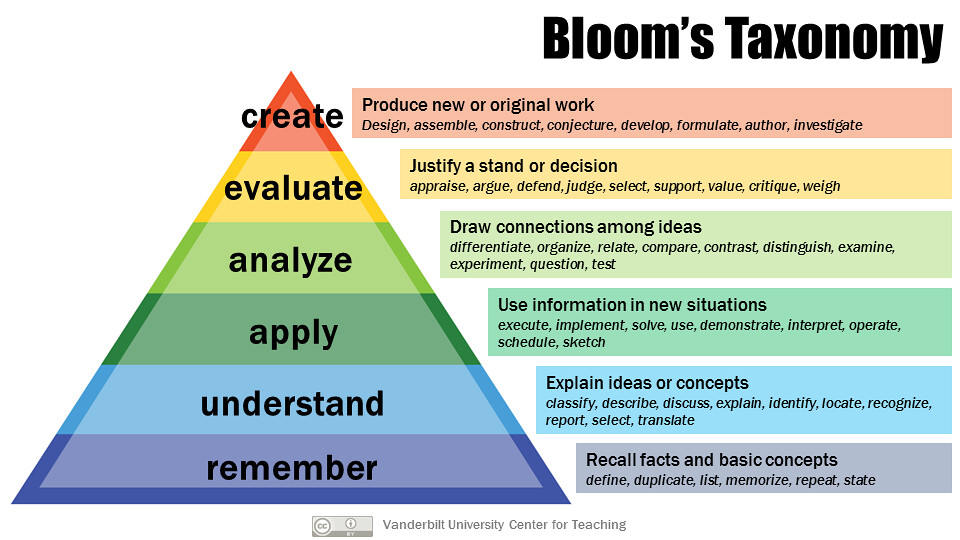
Over my 40-year career in education, I have come to recognize that what I was taught back in college about being an effective teacher is not necessarily true today. It’s not just because times have changed (they have), students have changed (they have), or the world has changed (it has). It’s because, over the past 30 years, more research has been done on what works best in teaching and learning than in all the years before that. And the results of all of that research are startling, to say the least. One of the most astonishing findings has to do with the value of following Bloom’s Taxonomy.
The History of Bloom’s
The taxonomy was created in 1956 by Benjamin Bloom and some of his colleagues as a way to leave behind behaviorist theories of learning that were being used at the time (memorization, rote learning) and embrace higher-order thinking skills. They incorporated aspects of cognitive, affective, and psycho-motor domains into the taxonomy to make it more all-encompassing. It was a radical change in how educators were taught to teach. Then, in 2001, Anderson and Krathwohl offered a revision to Bloom’s, indicating that “in the cognitive domain, creation appears as a higher-order process as compared to evaluation.”
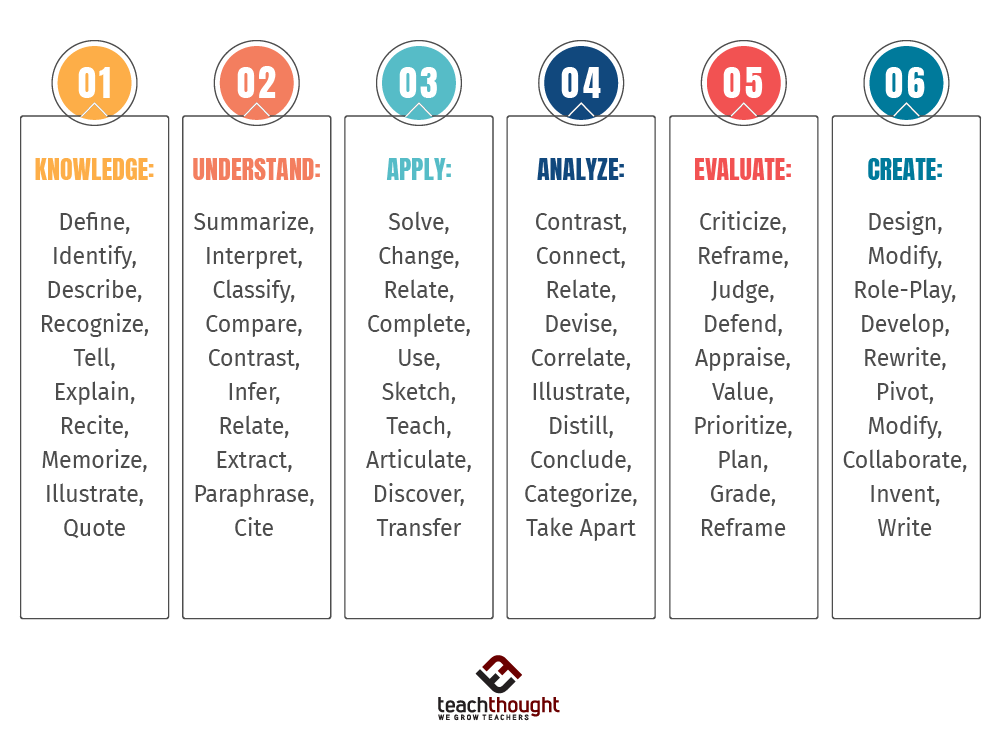
Bloom’s Taxonomy is easy to implement. We are all familiar with the “verb chart” that lets us select the level of thinking we want our students to work at. We pick a content standard, decide what level it is best learned at, find a verb at that level in the chart, create the learning activity, and we’re done. But is this approach still valid today?
Why Bloom’s May Not Be the Best Approach
The first reason to reconsider using Bloom’s Taxonomy in the classroom has to do with how the brain works. Thinking does not operate within hierarchies (as outlined in the taxonomy). All of these “levels” happen simultaneously in a variety of places in the brain.
The second reason to stop relying on Bloom’s is that it was created before rigorous research into its effectiveness was put in place. At more than 60 years old, the taxonomy is simply not supported by any empirical research on learning. The only piece of this hierarchical approach that is validated today is the existence of factual-conceptual knowledge, often called prior knowledge. But there is no clear research on its basic assumption that there are lower- and higher-order thinking skills. The brain doesn’t look at a problem to be solved and decide that it only needs a lower-order process.
The third reason Bloom’s may not be the approach you want to follow in your classroom has to do with new research on the social relation of persons in the creation of knowledge. The taxonomy does not consider the learner and the differences that each learner brings to the table. Motivation, their intellectual values, their past experiences with the content, their differences in cognitive processing: none of these are considered. The approach is based on the belief that all learners are at the same place in their learning, which is inherently false. In short, Bloom’s Taxonomy focuses on abstract cognitive domains and not on the individual learner. It is teacher-centered and not student-centered.
Conclusions to Take Away and Next Steps
I realize that this blog may shock some educators. And for that, I’m sorry. But we want to put our time, effort, and focus into instructional strategies and approaches that we know will work best for our students. And I believe that we must stay current with what the latest (and verified!) research says in order to do so.
So what might your next steps be? Make time to examine what the latest and best research says about effective teaching and learning. TCEA has a series of blogs on instructional strategies that have been proven to work, as well as several online, self-paced courses that will help you dive into how to apply the best approaches in your classroom. Be open to new ideas and new ways to help your students master the content. Question the strategies that are your “favorites” and ensure that they are based on valid, current research. And talk with your colleagues and administrators about getting more professional learning on the most effective teaching methods.
Research and Supporting Articles
- Anderson, L. W., & Krathwohl, D. R. (2001). A taxonomy for learning, teaching, and assessing: A revision of Bloom’s taxonomy of educational objectives. New York: Longman.
- Bandura, A. (2001). Social Cognitive Theory: An Agentic Perspective. Annual Review Of Psychology, 52(1), 1
- Bandura, A. (2006). Toward a Psychology of Human Agency. Perspectives on Psychological Science, (2). 164.
- Barney, Jason (2021). Breaking Down the Bad of Bloom’s: The False Objectivity of Education as a Modern Social Science.
- Berger, Ron (2018). Here’s What’s Wrong with Bloom’s Taxonomy: A Deeper Learning Perspective.
- Bloom, B. S.; Engelhart, M. D.; Furst, E. J.; Hill, W. H.; Krathwohl, D. R. (1956). Taxonomy of educational objectives: The classification of educational goals. Handbook I: Cognitive domain. New York: David McKay Company.
- Briñol, P., & DeMarree, K. G. (2012). Social metacognition. New York, NY: Psychology Press.
- Case, Roland (2013). The Unfortunate Consequences of Bloom’s Taxonomy.
- Deci, E. L., & Ryan, R. M. (2012). Motivation, personality, and development within embedded social contexts: An overview of self-determination theory. In R. M. Ryan (Ed.), Oxford handbook of human motivation (pp. 85-107). Oxford, UK: Oxford University Press.
- Efklides, A. (2006). Metacognition and affect: What can metacognitive experiences tell us about the learning process? Educational Research Review, 13-14.
- Kim, Y. R., Park, M. S., Moore, T. J., & Varma, S. (2013). Multiple levels of metacognition and their elicitation through complex problem-solving tasks. The Journal Of Mathematical Behavior, 32(3), 377-396.
- Schraw, G., & Moshman, D. (1995). Metacognitive Theories. Educational Psychology Review, (4). 351.
- Schraw, G., Crippen, K. J., & Hartley, K. (2006). Promoting Self-Regulation in Science Education: Metacognition as Part of a Broader Perspective on Learning. Research In Science Education, 36(1-2), 111-139.

13 comments
Reading requires using many different skills. Executive functions are some of the skills required in reading, a working memory , planning, organization, time management, etc. Bloom’s taxonomy improves “Executive functions .” “Knowledge ” , identify, label, match, list, improves working memory. “Comprehension “, describe, explain, order, improves organizational skills. Planning is used in “synthesis “, rearrange , predict, reorganize parts into a whole. Time management must be used in “application “, and “evaluate “, construct, demonstrate, illustrate, prioritize, and choose. Let’s question heuristic strategies, and adhere to improving executive functions.
I learned Bloom’s as an undergrad and then again in grad school. In both cases the benefits was in helping educators to write objectives. There were designed to help us articulate what we were hoping to achieve in our instruction. It’s value to me is in helping eductions to think about what their doing and why they are doing it. I don’t feel like that value has faded. The other thing that Bloom and Krathwohl did was decide learning into 3 domains (cognitive, affective, and psychomotor). Once again to help us conceptualize what we are teaching and why are we teaching it that way?
I use Bloom’s verbs as word of the day in my 3rd grade class. They should be familiar with the verbiage of questions that will be asked of them especially on MAP and STAAR tests. I found it to be beneficial.
I think this is a very good use of Bloom’s, Melisa!
I’d add another reason to avoid the Bloom approach: trying to force your course to fit it can be a lot of work. I’ve done multiple educational trainings that have told me to base my course on Bloom’s taxonomy. It never felt like a good fit (I teach philosophy with an emphasis on critical thinking). Yet I trusted the people giving these trainings and wasted time trying to incorporate Bloom’s ideas into my courses. I found your post because I’m doing yet another training that’s going to encourage me to use Bloom. So I did my own search for empirical evidence of the approach’s efficacy and, like you, I’m coming up completely emptyhanded. Nothing, zilch, nada.
Anyway, thanks for this useful post. I’m surprised there aren’t more people making these important arguments.
Just here to point out that Anderson & Krathwohl’s revision occurred in 2001, not 2021. Thanks for the interesting post!
Thanks, Sophie. I’ll make that correction!
There’ still value in using Bloom’s to push students beyond repeating what they’ve read. When I ask for a paraphrase, some students will literally copy and paste a quote from the source. Referencing Bloom’s different types of thinking helps them see how developing your own understanding of a source leads to stronger critical thinking skills.
I always tell them that all types of thinking are important and useful, and we shouldn’t rely on one or two levels.
I struggle with lower-order thinking, but rock higher order thinking. Some students can repeat back precisely what they’ve heard or read but have no idea what it means or how to use it. That’s where Bloom’s comes in: use all of the levels.
I have taken on a very difficult concept to introduce to college students. I interviewed 10 students for a research project. I designed the interview with Blooms Taxonomy woven into each step of this process. Eureka! By the end of the interview each student was able to create their own scenario using the new and complex concept definition. Blooms isn’t a religion, but it certainly works for introducing a heretofore undefined concept!
I’m not convinced that Bloom’s Taxonomy claims to do much of what is stated here. Most strikingly it’s a hierachy to demonstrate levels of understanding, not levels of thinking. Recognising that students are at different stages in their understanding encourages teachers to differentiate their instruction, which in my experience has to be a good thing.
The biggest problem with this article is not that it criticizes Bloom’s Taxonomy. There are legitimate criticisms of Bloom’s, and educators absolutely should reconsider old frameworks when better evidence comes along. The problem is that an article calling for greater rigor and evidence in education should itself demonstrate rigorous thinking. This one repeatedly does not. It makes sweeping claims without adequately supporting them, conflates very different ideas, and criticizes Bloom’s for failing to do things it was never designed to do.
For example, the article’s first argument against Bloom’s is that “thinking does not operate within hierarchies” and that the different kinds of thinking happen simultaneously in different places in the brain. But Bloom’s Taxonomy was not proposed as a neurological model of the brain. It is a classification system for educational objectives. Showing that several cognitive processes can occur simultaneously in the brain therefore does not disprove the usefulness of categorizing different kinds of educational objectives. It is a little like arguing that classifying exercise into strength, endurance, and flexibility must be invalid because the human body does not activate those systems one at a time. The categories may be imperfect, and the proposed hierarchy certainly can be questioned, but that requires evidence about the categories and hierarchy themselves. “The brain doesn’t work like a pyramid” is not enough.
The article then makes an even more sweeping claim: that Bloom’s “is simply not supported by any empirical research on learning” and that “there is no clear research” supporting lower- and higher-order thinking skills. Those are enormous claims, yet the article provides remarkably little evidence for them. There is, in fact, empirical research examining Bloom’s categories, its hierarchy, and whether assessment items can reliably be classified according to the taxonomy. Some of that research raises real problems for Bloom’s and especially for simplistic applications of it. But “research has found problems with Bloom’s” is very different from “there is no empirical research supporting Bloom’s.” If you are going to criticize educators for relying on frameworks without sufficient evidence, you have a particular obligation not to make absolute claims that your own evidence does not establish.
The article also criticizes Bloom’s because it does not account for motivation, intellectual values, prior experience, individual differences, or differences in cognitive processing. Of course it doesn’t. It was never intended to be a comprehensive theory of learning or individual learners. A taxonomy for classifying educational objectives does not become invalid because it fails to explain student motivation any more than a framework for classifying types of assessment becomes invalid because it does not explain memory. These are important considerations in teaching, but they answer different questions. A teacher can use Bloom’s to think about the kind of cognitive work an assignment requires while simultaneously using entirely different research to think about motivation, prior knowledge, metacognition, cognitive load, or individual differences.
The same problem appears when the article calls Bloom’s “teacher-centered and not student-centered.” That conclusion simply does not follow. Nothing about distinguishing between remembering, applying, analyzing, evaluating, and creating requires teacher-centered instruction. Those objectives could be pursued through direct instruction, collaborative learning, inquiry, project-based learning, student-generated questions, or highly individualized work. Whether instruction is teacher-centered or student-centered depends on how teaching is designed, not on whether someone used Bloom’s vocabulary while designing it.
Ironically, the article does stumble onto one of the strongest criticisms of how Bloom’s is commonly used: the famous “verb chart.” A teacher cannot determine the cognitive complexity of a task merely by finding the verb attached to it. Consider the instruction “Analyze the number 7 and determine whether it is odd or even.” It contains the supposedly higher-order verb “analyze,” but the task is trivial for most adults. Meanwhile, a question using the supposedly simpler verb “explain” could ask a student to explain the causes of the 2008 financial crisis and defend which causal factor was most consequential—a vastly more demanding intellectual task. Cognitive demand depends on the content, context, prior knowledge, expertise, and what the learner actually has to do, not simply on the verb printed at the beginning of the question.
That is an important criticism. But notice what it actually establishes: educators should stop treating Bloom’s as a magic verb chart or a scientifically precise measurement of cognitive complexity. It does not establish that Bloom’s is useless as a taxonomy. “Stop using Bloom’s badly” and “dump Bloom’s” are very different conclusions.
There is also a basic category error running through the article. Bloom’s is repeatedly compared with research about “what works best in teaching and learning,” as though Bloom’s itself were an instructional strategy. It isn’t. Retrieval practice, feedback, worked examples, spaced practice, explicit instruction, collaborative learning, and similar approaches concern how we help students learn. Bloom’s primarily concerns how we describe or classify what we want students to be able to do. “What kind of thinking am I asking students to engage in?” and “What instructional method is most effective for helping them learn?” are different questions. An educator can use modern evidence-based instructional practices and still find Bloom’s useful for the much narrower purpose it was designed to serve.
That is ultimately what makes this article so frustrating. There is a genuinely worthwhile article hiding inside it. Bloom’s should not be treated as a scientifically established map of the human mind. Its hierarchy should not be accepted uncritically. Cognitive complexity cannot be determined from verbs alone. Prior knowledge and expertise profoundly affect the difficulty of a task. And educators should absolutely question frameworks that have become conventional wisdom.
But those points require careful distinctions, and this article repeatedly fails to make them. Instead, it attacks an exaggerated version of Bloom’s, moves between neuroscience, learning theory, instructional strategy, student motivation, and educational objectives as though they were interchangeable, and then draws a conclusion much stronger than the argument supports.
For an article whose central message is that educators should demand better evidence and more rigorous thinking, that is a serious problem. If we are going to ask teachers to question familiar ideas—and we should—the standard cannot simply be that the new criticism sounds modern, invokes “the brain,” and cites research. The reasoning connecting the evidence to the conclusion has to hold up too. In this case, much of it does not.
Daniel,
Thanks for the thoughtful pushback. I agree with one important distinction: saying Bloom’s has *no* empirical research behind it goes too far. A better criticism is that educators often treat Bloom’s categories—and especially its familiar pyramid and verb charts—as though they provide a validated measure of cognitive complexity. They do not.
Bloom’s primarily classifies kinds of educational objectives. The **SOLO Taxonomy** asks a different and, for classroom assessment, more useful question: **What does the quality of the student’s understanding actually look like?** It examines observable learning outcomes as understanding moves from isolated ideas, to multiple ideas, to relationships among them, and ultimately to transfer and generalization.
That distinction is also why I increasingly use **ACE: Articulate, Connect, Extend**. ACE is not a replacement taxonomy or an independently validated learning theory. It is a practical routine for making student thinking visible: articulate an understanding, connect ideas and evidence, then extend that understanding to something new. SOLO can then provide a lens for judging the complexity of what students produce.
So, a better takeaway than “dump Bloom’s” is **stop letting Bloom’s verbs stand in for evidence of learning. Focus instead on what students can explain, connect, and transfer.** Focus, not on the verbs, but on observable learning outcomes and measure that as students move from isolated ideas to transfer and application of what they have learned to novel/new problems.
With appreciation,
Miguel Guhlin, TCEA
Thank you for the article. It was a such a worthy read to go through the divergent views on how we can implement Blooms Taxonomy as well as its limitations. Thank you for the new insight on using SOLO Taxonomy and ACE.