
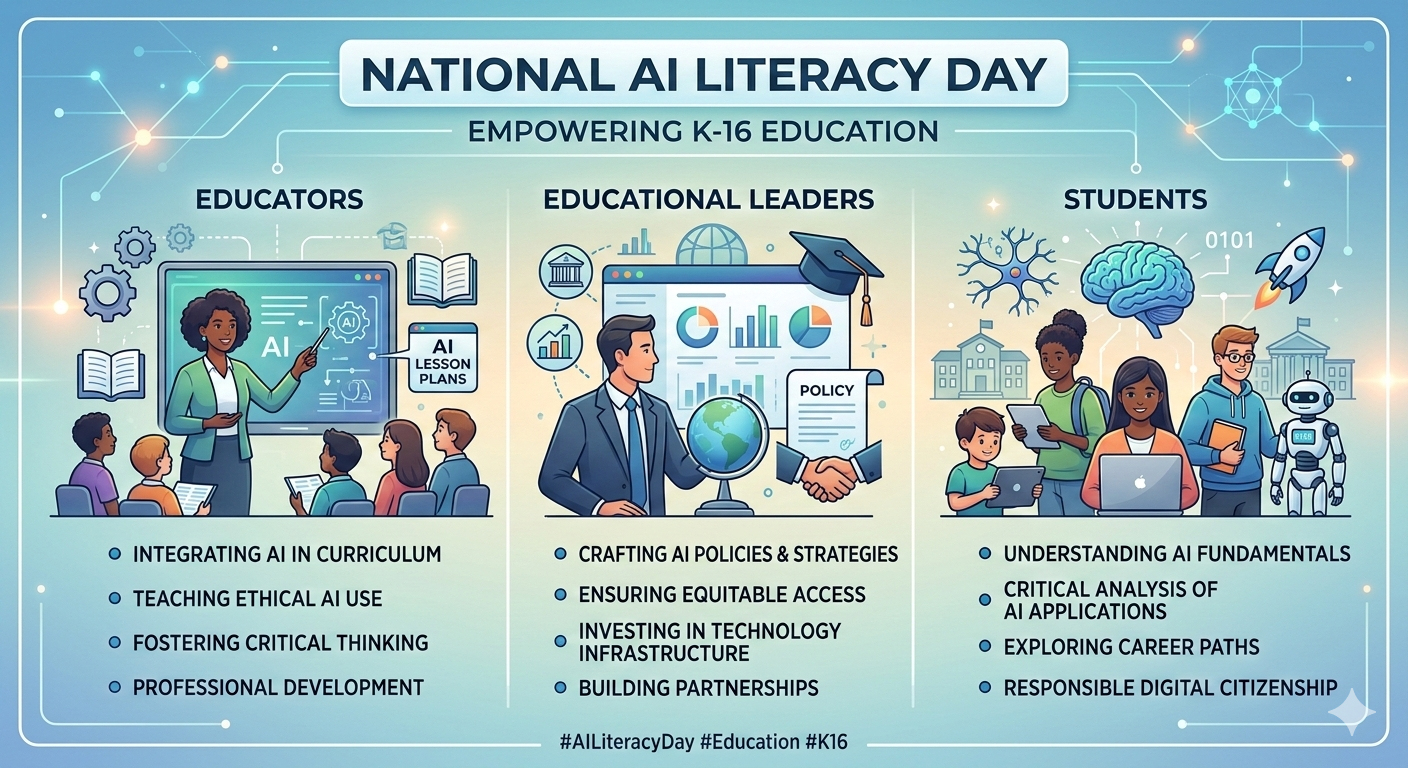
Every spring, a quiet revolution takes place in classrooms, libraries, and community centers across the country. National AI Literacy Day, observed this year on Friday, March 27, 2026, is a nationwide invitation for every learner, educator, and community member to better understand artificial intelligence, how it works, how to use it safely, and how to think critically about its role in our world.
For K–16 educators, this day isn’t just a calendar moment. It’s a mirror.
The Research Is Clear: Educator Readiness Comes First
Brain research consistently tells us that learning is social, contextual, and modeled. Students don’t just absorb information. They watch what their teachers do, trust what their teachers know, and mirror the confidence, curiosity, or anxiety those teachers bring to new topics.
That’s why the most important thing you can do for AI literacy in your school or district isn’t to hand students a chatbot. It’s to become AI literate yourself.
John Hattie’s decades of research on visible learning reinforce this: teacher credibility and subject knowledge are among the highest-leverage factors in student achievement. When it comes to AI, credibility requires fluency. You don’t need to be a data scientist. But you do need to understand what AI is, what it isn’t, and how to use it ethically and effectively.
TCEA’s AI Literacy Framework: A Map for the Journey
Where do you start? TCEA has built a practical, research-aligned starting point: the TCEA AI Literacy Framework.
This framework organizes AI literacy into clear, actionable domains that span foundational understanding, ethical reasoning, practical application, and critical evaluation. Whether you’re a classroom teacher just beginning to explore AI tools or an administrator shaping district policy, the framework gives you a shared language and a progression path.
Think of it as a curriculum map not just for students, but for you.
Key domains include:
- Understanding AI: What it is, how it learns, and what its limitations are
- Using AI Responsibly: Privacy, bias, transparency, and ethical use
- AI in the Classroom: Pedagogically sound integration strategies
- Critical Evaluation: Helping students question, verify, and think deeply about AI outputs
Build Your Own Literacy First: TCEA Courses for Educators
The most meaningful National AI Literacy Day activity you can do this March 27 isn’t a student lesson. It’s investing in your own learning.
TCEA’s AI Learning for Educators provides on-demand, self-paced professional development designed specifically for teachers and administrators. These courses are grounded in sound instructional design and connect directly to the TCEA AI Literacy Framework. Topics include:
- Foundations of AI for educators
- Using AI tools in instructional planning
- AI ethics and responsible use in K–12 settings
- Practical classroom integration strategies
The pedagogical principle here is straightforward: model what you want students to do. When educators engage in genuine inquiry, take risks with new tools, and reflect on what they’re learning, they become the most powerful AI literacy teachers in any building.
Go Deeper: Virtual AI in Education Conference 2026
If National AI Literacy Day sparks something in you, don’t let the momentum stop there.
Join TCEA for the AI for Educators Conference 2026, a virtual conference designed to take your AI literacy to the next level. Connect with forward-thinking educators, researchers, and practitioners who are navigating the same questions you are: How do I use AI without replacing the human heart of teaching? How do I prepare students for a world where AI is everywhere? How do I lead my school or district through this transformation with confidence?
Whether you attend sessions live or on-demand, you’ll leave with practical strategies, a stronger professional network, and a clearer sense of where you fit in the AI in education story.
What You Can Do Right Now
On or before March 27, 2026:
- Explore the TCEA AI Literacy Framework and identify one domain where you feel confident and one where you want to grow.
- Enroll in a TCEA AI course at tcea.org/courses and commit to completing at least one module by the end of March.
- Share what you’re learning with a colleague, a student, or your professional learning community. Articulation deepens understanding.
- Register for the AI for Educators Conference and mark your calendar.
- Facilitate a short AI conversation with your students or staff on March 27. Ask: What do you think AI is? What are you curious about? What worries you? Then listen.
The Bottom Line
AI literacy isn’t a one-day event. But National AI Literacy Day is a powerful reminder that every journey starts with a single, intentional step.
The students in your care are growing up in an AI-shaped world. They deserve educators who understand that world, can navigate it with integrity, and can guide them to do the same.
That educator is you. TCEA is here to help you get there.
Explore TCEA’s AI resources, frameworks, and professional learning at tcea.org and blog.tcea.org.
