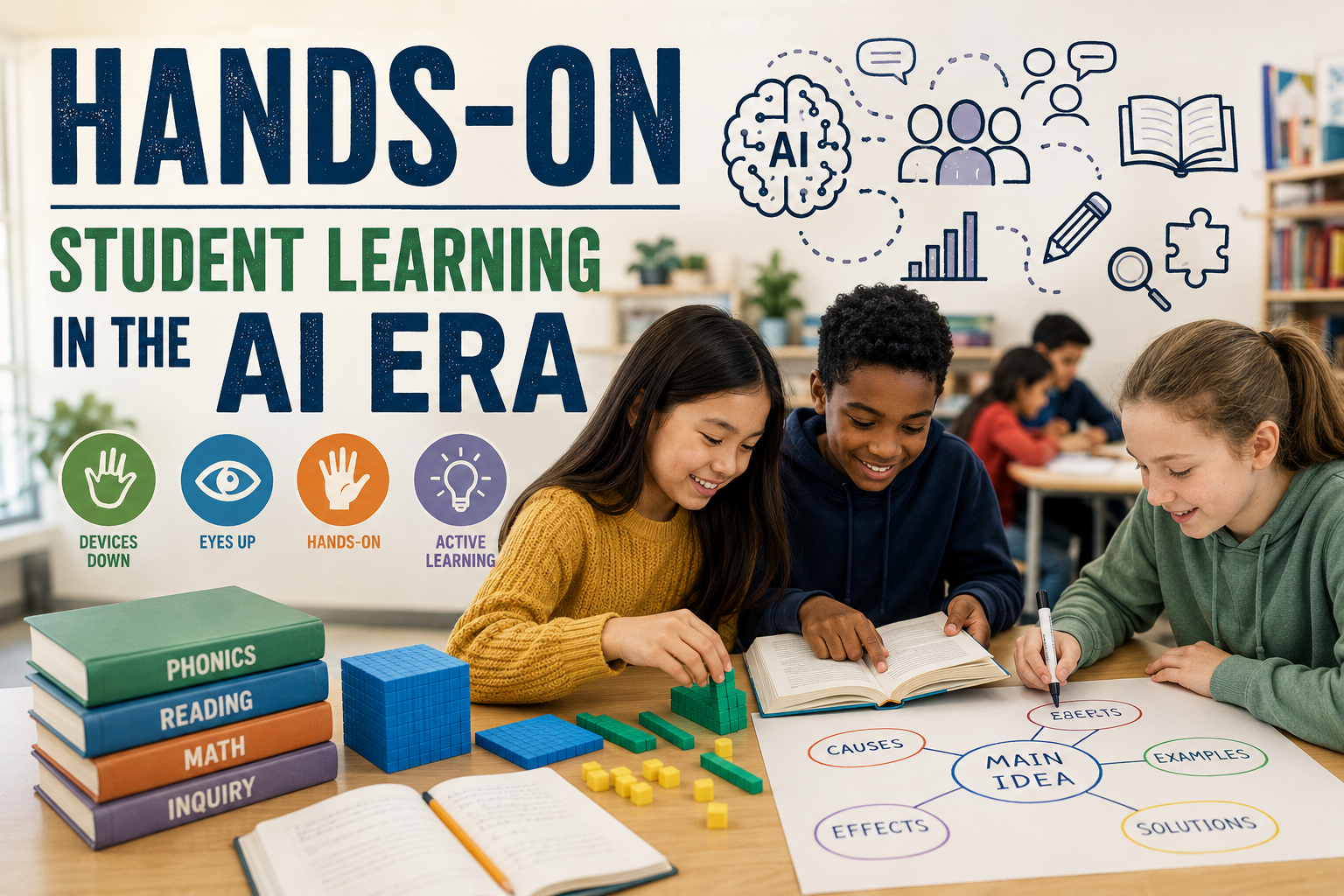
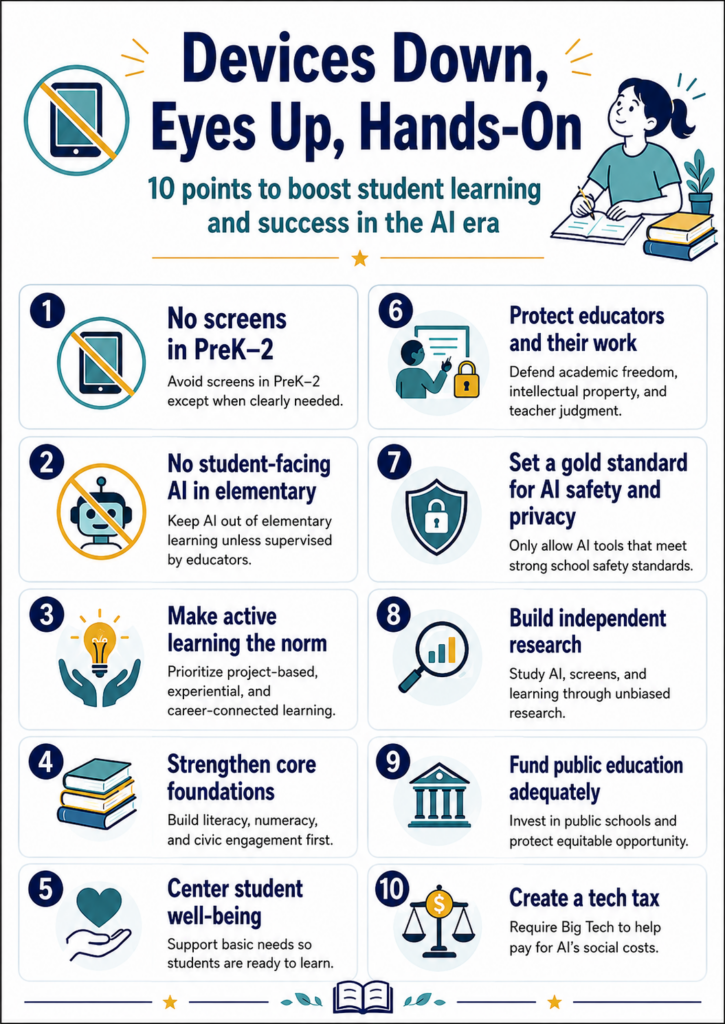
You may have read Randi Weingarten’s retreat from blending educational technology tools into student learning earlier this year. I found the ten points she shared, summarized in the infographic below, quite interesting. I found them interesting because, as school districts bring their retreat from educational technology, I’m left wondering, “Will evidence-based strategies fill the engagement void in classrooms? Or will we default to what feels comfortable in classrooms?”
Let’s explore those ten points with Visible Learning MetaX database of high-effect size instructional strategies in mind.
A second-grade teacher I worked with once kept her assigned laptop cart parked at the back of her room. She only brought it out once a week, if at all, due to a reading program that school required. Once, in confidence (no worries, she’s since left the school district), that the twenty minutes on screens buys her nothing that a book and a partner read would not. Thinking of my favorite high-effect size strategy, Reciprocal Teaching, I found myself unable to disagree. I’ve spent many an hour reading myself, a paperback or hard-backed book in hand.
Become a CyberSmart Educator with a practical, self-paced course designed to help you protect sensitive data, secure accounts and devices, recognize social engineering attacks, respond appropriately to cybersecurity incidents, and build stronger digital safety habits. Or, learn AI Essentials for Educators. Each course is $49 at full price or $34 at the discounted rate. Register online through TCEA Courses.
Devices Down, Eyes Up, Hands-On
In May, the head of the American Federation of Teachers made a version of her argument in front of the National Press Club. Randi Weingarten’s May 27, 2026 speech came with a 10-point plan she titled “Devices down, eyes up, hands-on.” She made several points, such as the importance of a tax on Big Tech earnings, reversing school funding cuts (which get more dire by the day), and an independent research consortium paid for by someone other than the companies whose products are being studied.
These are big points, many of which we might not be able to do much about locally. However, these four points offer some hope.
Four Points That You Can Act On
These four points make sense to anyone who is familiar with K-12 learners and how critical productive struggle is for learning and long-term information retention. Take a moment to review these and what they might look like on your campus:
| Plan point | What it looks like on your campus |
|---|---|
| No screens for prekindergarten through second grade, with exceptions for students who need them | An audit of which K-2 software is required, which is habit, and which is neither |
| No student-facing Gen AI in elementary, with educator supervision everywhere else | A written rule about who may sit a child in front of a chatbot, and when |
| Active learning as the norm at every grade level | Projects, capstones, and career-connected work counted as evidence, not enrichment |
| Educators making classroom-level decisions about technology integration | Teachers on the adoption committee before the contract gets signed |
How would your school rate in regards to this plan?
Evidence-Based Points
As you probably have seen, TCEA TechNotes focuses on John Hattie’s work, especially Corwin Press’ Visible Learning MetaX database, version 1.4, updated February 2026. That means these are the latest effect sizes built on current research. While no research is perfect, the average effect size across multiple studies suggests that unplugged activities that depend on high-effect size instructional strategies can have a huge impact on student learning.
| Grade band | Unplugged activity | Influence and effect size |
|---|---|---|
| Elementary | Sand trays, letter tiles, decodable books read aloud | Phonics instruction, 0.97 |
| Elementary | Small-group text dialogue: summarize, question, clarify, predict | Reciprocal teaching, 0.74 |
| Elementary | Base-ten blocks, fraction tiles, counters | Manipulative materials on math, 0.34 |
| Middle | Expert groups teaching subtopics back to home groups | Jigsaw method, 0.92 |
| Middle | Hand-drawn maps of a unit, a lab, or a novel | Concept mapping, 0.66 |
| High | Socratic seminar, circle of chairs, text in hand | Argumentation and classroom discussion, 0.86 |
| High | Lab work, CTE benches, capstone projects | Problem-based learning, 0.53 |
| High | Printed drafts read aloud in pairs, marked by hand | Feedback, 0.50 |
Manipulatives: Not So Hot
Manipulatives (d=0.34) sit below Hattie’s 0.40 average, and that figure holds across 295 studies. Physical objects do not carry the learning on their own. Someone has to connect the blocks to the abstraction, which is a different instructional move than handing out a bin.
That said, you might still find blending digital math manipulatives in. See these two TCEA TechNotes blog entries on that subject.
Banning Gen AI
As you know, a total ban is easy to announce and hard to implement (think smartphone bans of yesteryear). Does a teacher using Gemini to draft a leveled passage count as student-facing? What about a read-aloud tool with a language model underneath it? Districts that adopt the language without answering those questions will enforce it unevenly, which is worse than a narrower rule enforced well. It’s a tough path to walk and one that must be done in consideration of all the stakeholders. Kudos to those districts that have started to walk down that path.
That aside, I’d rather base student Gen AI use around the SOLO Taxonomy, rather than simply discussing AI Literacy:
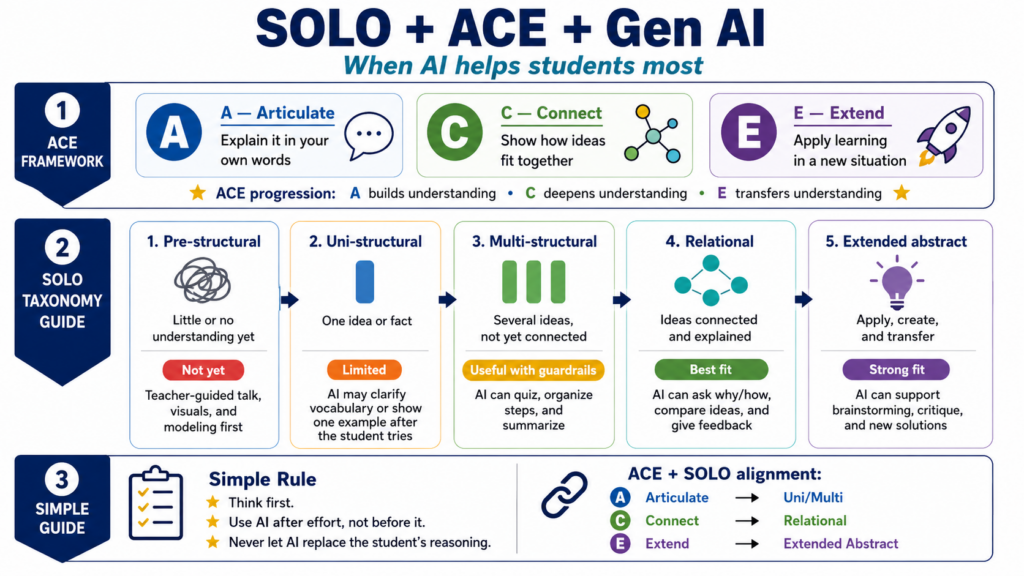
Of course, in the reality of the classroom, a ban is easier than the nuanced approach suggested above. Ask yourself, though, “Who’s actually modeling Gen AI use for students?” If that question leaves you pointing at teachers, then a more nuanced approach with professional learning supporting educators is essential.
Start An Audit
You do not need a federal plan to find out how much screen time your youngest students actually get, or who decided they should get it. Pull the list of tools. Ask what each one replaced. Then ask the second-grade teacher down the hall what she would do with those twenty minutes.
👤 Human-directed (Miguel Guhlin) · 🤖 Gen AI-assisted (Claude, ChatGPT)