
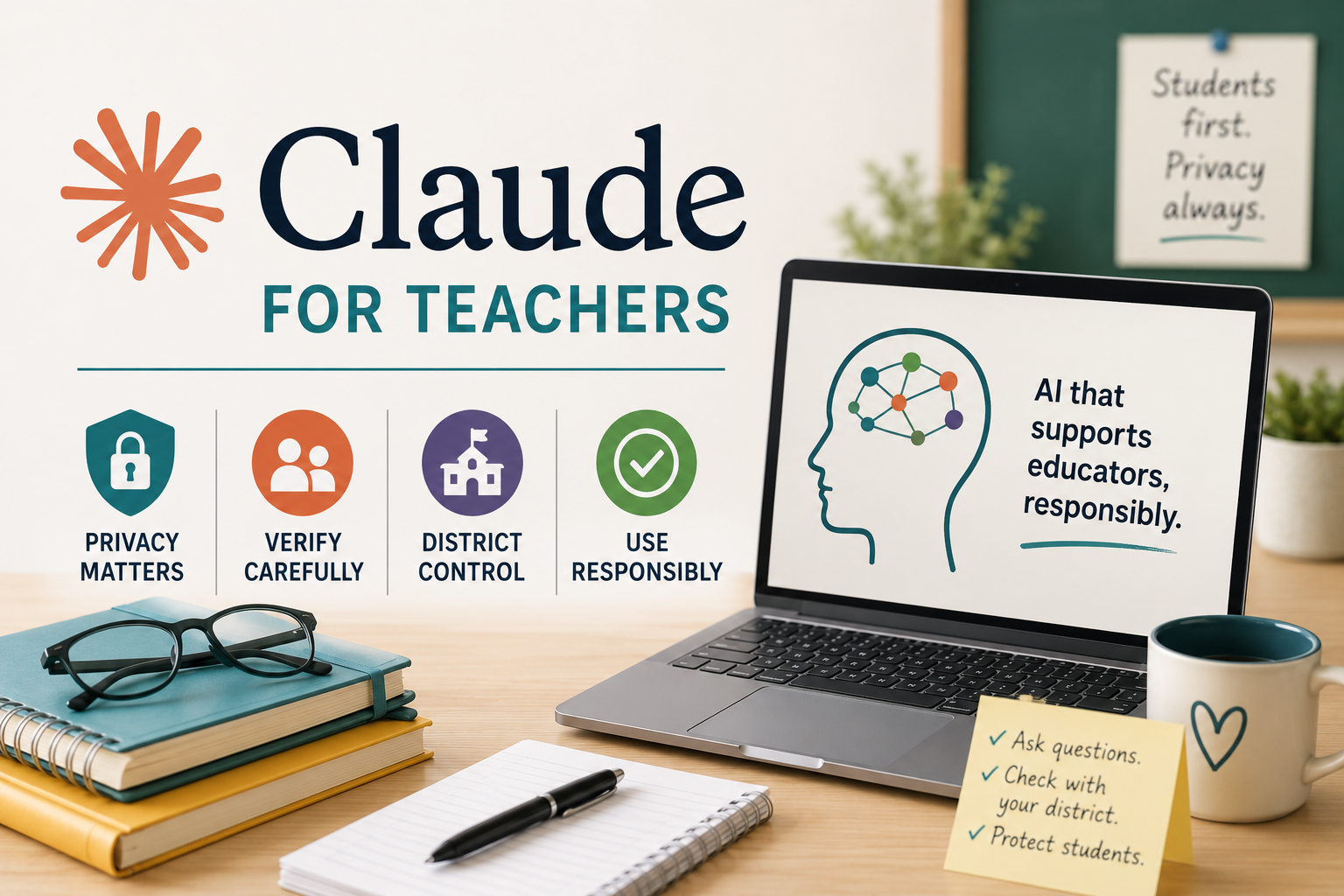
When I first heard about Claude for Teachers, I was excited.
Anthropic is offering verified K–12 educators in the United States free access to Claude’s paid features for one year. Educators must sign up by June 30, 2027.
That sounds like a great deal. But after reading more about the program and talking with my colleague Miguel Guhlin, I have a few concerns. I also read Erin Mote’s LinkedIn post, Calling Balls and Strikes on Claude for Teachers, and worked my way through the comments.
Concern 1: Teachers may be encouraged to upload student information
Anthropic gives an example of a teacher uploading a student roster, diagnostic data, attendance records, and teacher notes into Claude.
That is where I hit pause.
This kind of information may include private student data. Teachers should not upload student names, grades, IEP information, attendance records, behavior notes, or other private details unless their school district has approved the platform and authorized that specific use.
Anthropic says information entered into Claude for Teachers is not used to train its AI models. That is good to know. But districts still need to review the tool and decide whether it meets their privacy and security requirements. A free account does not automatically mean a tool is approved for school use.
Concern 2: Teachers may be asked to share personal documents
I applied for Claude for Teachers myself. As TCEA’s Director of Professional Development, I work with teachers and school leaders across Texas and beyond. I sent in my credentials, but my application was rejected. The message said Claude could not verify that I was a K–12 teacher or connected to a school. I was told to use a school email address and upload a current document showing my full name and school. Examples included a school ID, employment contract, pay stub, or teaching certificate.
I understand why Anthropic needs to verify applicants. Teachers should still think carefully before uploading personal employment documents to an outside company. They should know who receives those documents, how long the documents are stored, and when they are deleted.
Anthropic has clarified that classroom teachers, instructional coaches, specialists, interventionists, librarians, counselors, and other certificated school staff may qualify. However, questions may remain for professional development leaders, regional service center employees, education association staff, consultants, and others who support teachers but are not employed directly by a K–12 school.
Concern 3: School districts may have limited control
Claude for Teachers is currently offered directly to individual educators. Anthropic says a separate version for schools and districts is coming later. The individual educator plan does not provide districts with centralized member management, roles and permissions, single sign-on, or domain control. That may limit a district’s visibility into who has created an account and its ability to manage those accounts.
Education technology leader Erin Mote raised similar concerns in her LinkedIn post. She explained that districts may have little control or visibility over how teachers use the tool.
Some district technology leaders are discussing whether Claude should be blocked until it has been formally reviewed. That may sound extreme, but districts are responsible for protecting student information. If they cannot manage the accounts or determine how the tool is being used, temporarily blocking it may be one response while the platform is reviewed.
Five Things Teachers Should Keep in Mind
1. Claude for Teachers may be a useful tool. I appreciate that Anthropic is offering free access to educators.
2. But teachers should check with their district before signing up or using Claude for schoolwork.
3. Most importantly, do not upload private student information unless your district has approved the platform and authorized that specific use.
4. You can still explore Claude by using fictional student names, blank templates, public information, or synthetic and properly de-identified examples.
5. Free is exciting. District approval is still important.
Thank you to my colleague Miguel Guhlin for helping me think through these concerns. I also used ChatGPT to help fact-check claims and identify areas that needed clarification.

3 comments
When I saw the headline and then the bell rang on the company name I was a little alarmed. I’m very relieved that you brought up privacy concerns especially with the ways facial recognition has been discussed in the news recently.
I am still dismayed that so many teachers may take up the offer and NOT be careful with the information they have access to.
When I was in my twenties and heard about how some people objected to being required to have a state issued photo ID, that it was an invasion of privacy (and not the burden of having an exceptionally unflattering photo for a set number of years) I thought they were being ridiculous. Now not so much.
I did not sign up for Claude, with that being said, what is the difference in using it the way teachers use ChatGPT, Magic School and all these new AI platforms that are being used for lesson planning etc
Thanks for always doing the work that makes things easier for us on the classroom. I currently use a few AI apps but not with any student data. I gave up wanting to sign-up for it to see its capabilities for 18+ years of lesson plans I have for K-5th Physical Education class. I teach PD several times a year and I am always looking for ways to support and mentor new teachers.