
What stops students from delving deep into learning, mining for more glittering mental riches? Or, taking the time to craft a well-written piece? It doesn’t matter now. Generative AI has short-circuited thinking and writing as assessment. In this blog entry, I’ll share an approach to supporting student self-efficacy that caught my eye, “Viva Voce.”
“The cheating is off the charts. It’s the worst I’ve seen in my entire career, “ said Valencia High School English teacher Casey Cuny, a 23-year veteran. “Anything you send home, you have to assume is being AI’ed,” he said.” (Source: Larry Cuban on School Reform and Classroom Practice, 10/6/2025)
Supporting Student Self-Efficacy
In their book, The Opposite of Cheating, Tricia Bertram Gallant and David A. Rettinger offer several reasons why students rely on Gen AI. The authors offered ten principles.
The most important one? The suggestion that knowledge is a learner’s construct. Learning is a process of constructing knowledge, assembling something that connects to a student’s schema.
The real enemies of student constructed learning that they own? Those enemies include stress, limited time, and fear of failure. Students embrace Gen AI tools to quicken their work since they lack self-efficacy. The more I reflected on their arguments, the more they made sense. But students are embracing Gen AI, as much as teachers are. AI makes traditional assessment easy on both sides.
What May Work Instead
If convenient assessment forms have quit the field, then let us think different. But where can beleaguered educators find assessments that work in spite of AI?
Some have suggested a return to blue books, to rhetoric, academic integrity persecution. Peter Paccone offers one practical model. Most of these approaches may work for secondary and university students. What about primary, grades K-6?
From my own experience, I have learned my lesson:
- Handwriting facilitates long-term information retention
- Handwriting makes it easier for me to give voice to ideas recorded, one word at a time
- Handwriting connects new learning to my schema, making it easier to recall and share
We know handwriting notes works, but so does giving voice to ideas.
A Classroom of “Living Voice”
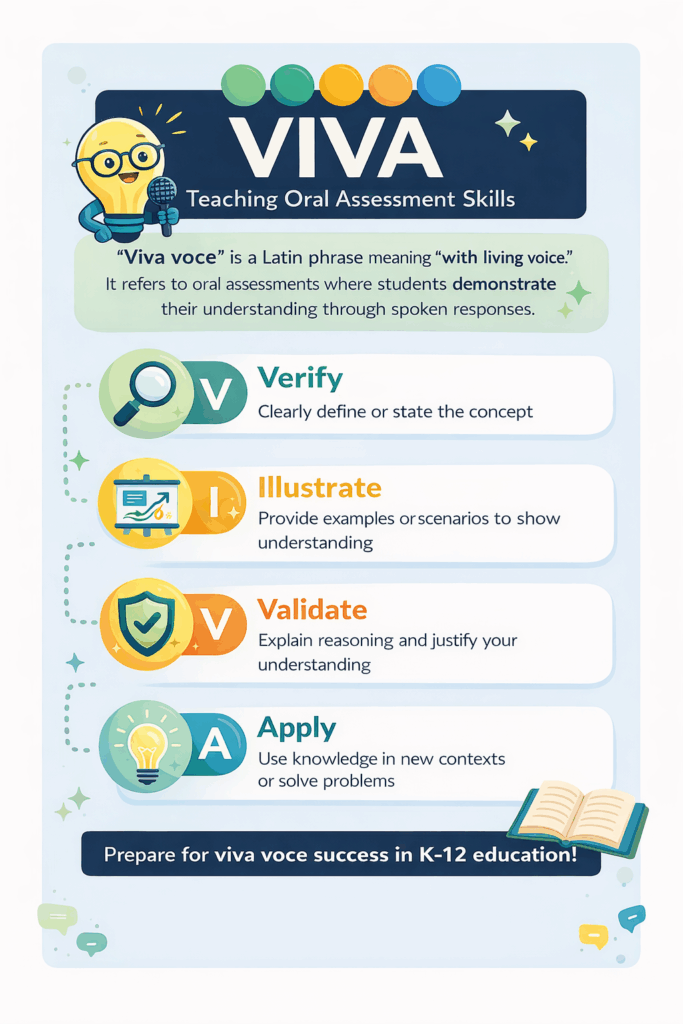
Viva voce comes from Latin. It means, “with living voice.” The term refers to oral examinations where students speak their explanation rather than type it.
Students need oral assessment skills. They need that skill for job interviews, seminars, and professional presentations. It is a skill that I wish I had developed early on rather than tacked on after high school.
How can we teach viva voce in K-12? Let me suggest VIVA, a framework for viva voce in K-12.
A Framework for Viva Voce Success
VIVA offers four steps that work across grade levels and subjects. Let’s take a closer look.
- V – Verify. Students begin with a clear definition or statement of the concept.
- I – Illustrate. Students provide concrete examples, scenarios, or demonstrations. The goal is to connect abstract concepts to real applications. This is about making their ideas, their thinking, visible to all.
- V – Validate. Students share their reasoning, providing justifications for their understanding. This involves presenting evidence, logic, or supporting arguments. The goal is not to memorize, but to comprehend and share from that grasp of content.
- A – Apply. In the final step, student apply their knowledge in new contexts or solve new problems. If you can think with a concept, applying it to a new situation, you show transfer learning has occurred.
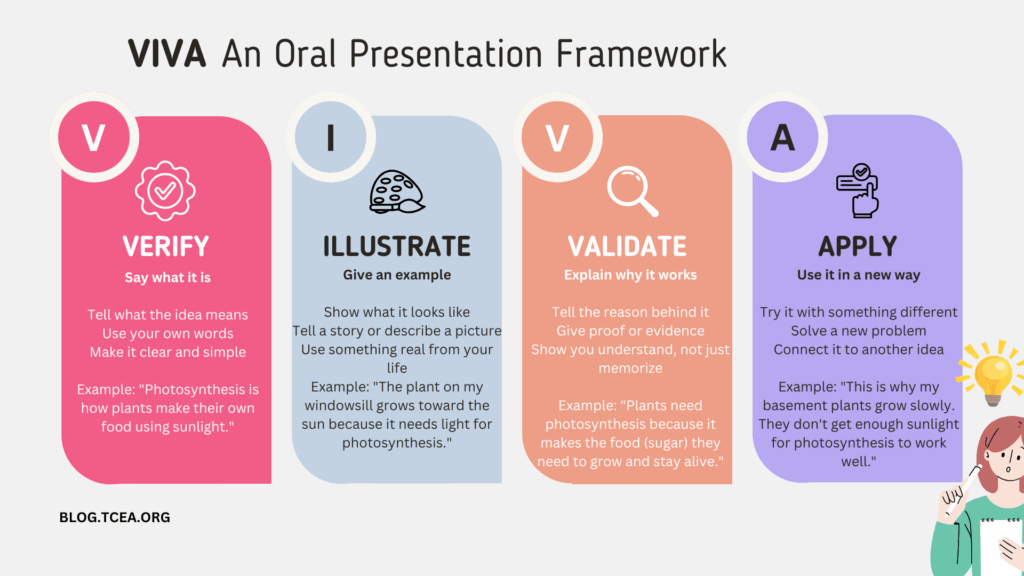
Key concepts in PRISM and the SOLO Taxonomy frameworks are well-represented. What’s more, making an anchor chart of VIVA is easy.
Post the four steps where it can students can see it at all time with language that students understand:
– V: Say what it is
– I: Give an example
– V: Tell why it works
– A: Use it in a new way
How can you prepare students to use VIVA? The anchor chart and modeling are two strategies. Here are some more.
VIVA Preparation Strategies
These strategies make using VIVA easier for students. The strategies include:
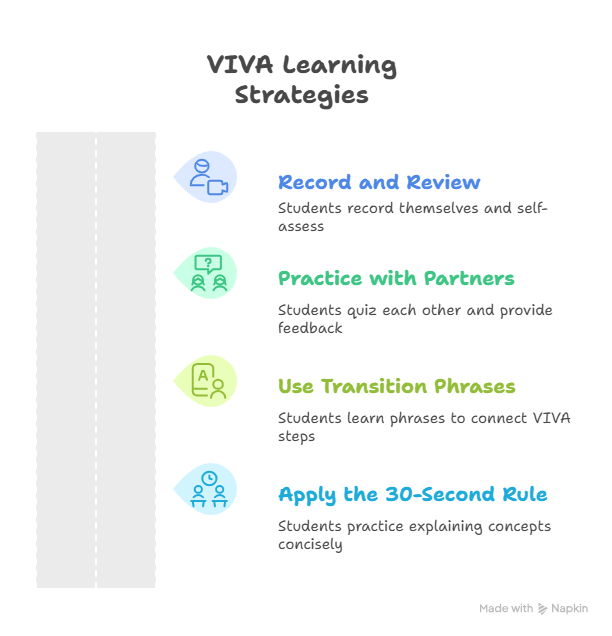
Transition phrases support transitioning to the Illustrate, Validate, and Apply steps of VIVA. This reminds me of an excellent text for teaching writing, They Say/I Say (listen to podcast). Use strategies like this to build comfort and skill with the framework.
Why It Matters
Embracing VIVA has a host of benefits, such as developing communication skills. One of the challenges I face when speaking involves real-time organization of thoughts. In time, verbal confidence grows…you know that you can organize on your feet. Teachers can probe deeper understanding through follow-up questions and spontaneous explanations. Metacognition and alternate ways of demonstrating knowledge are critical, too.
Let’s take a look at an example below.
Transform Show-and-Tell with Structure
Young students already take part in show-and-tell. Use VIVA to prepare students to think on their feet. Here’s a scenario:
Ms. Cruzes’ second grade students bring an object from home. Instead of free-form sharing, they use the VIVA oral framework.
- Verify: “This is my grandmother’s compass.”
- Illustrate: “It has a needle that always points north. See how it moves when I turn?”
- Validate: “Compasses help people find directions because the needle is magnetic.”
- Apply: “If I got lost in the woods, I could use this to walk north toward the road.”
Want more examples? See more primary, subject area, middle school and high school versions. Use VIVA oral framework to close the gap on a lost generation who will, as I did, have to learn VIVA on the job. You can get assessment rubrics, one for primary and another for secondary.
Here is one K-5 example of VIVA. As you read them, ask yourself, how might you do something similar in your classroom?
Make Oral Assessment Work, Prepare Your Students
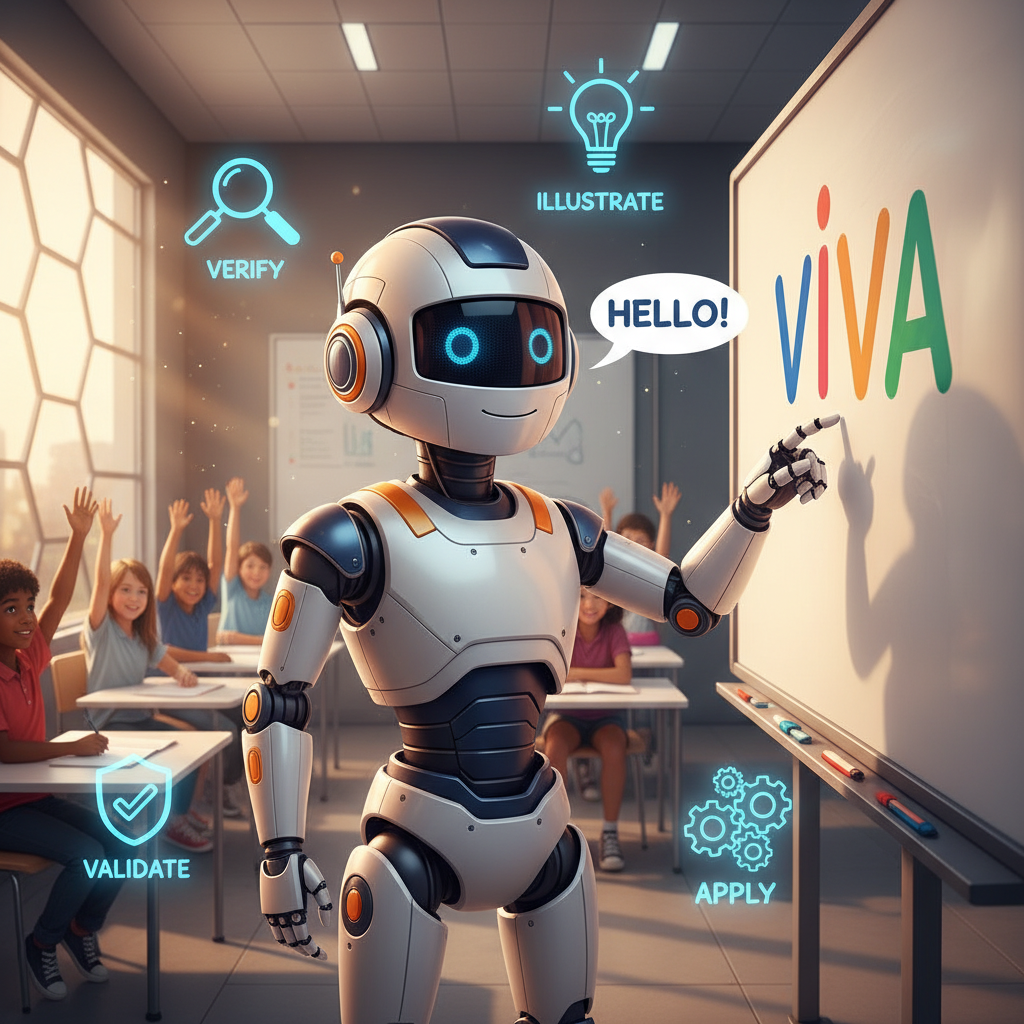
It’s nice to imagine that someday AI Viva may be a reality. Coaching students in VIVA oral framework use pays off. Whether AI takes over K-12 or not. Oh, I almost forgot. Here are two Gen AI assistants you can use to run any topic through to get a VIVA-formatted example.
👤 Human-directed (Miguel Guhlin) · 🤖 Gen AI-assisted (Claude, ChatGPT)