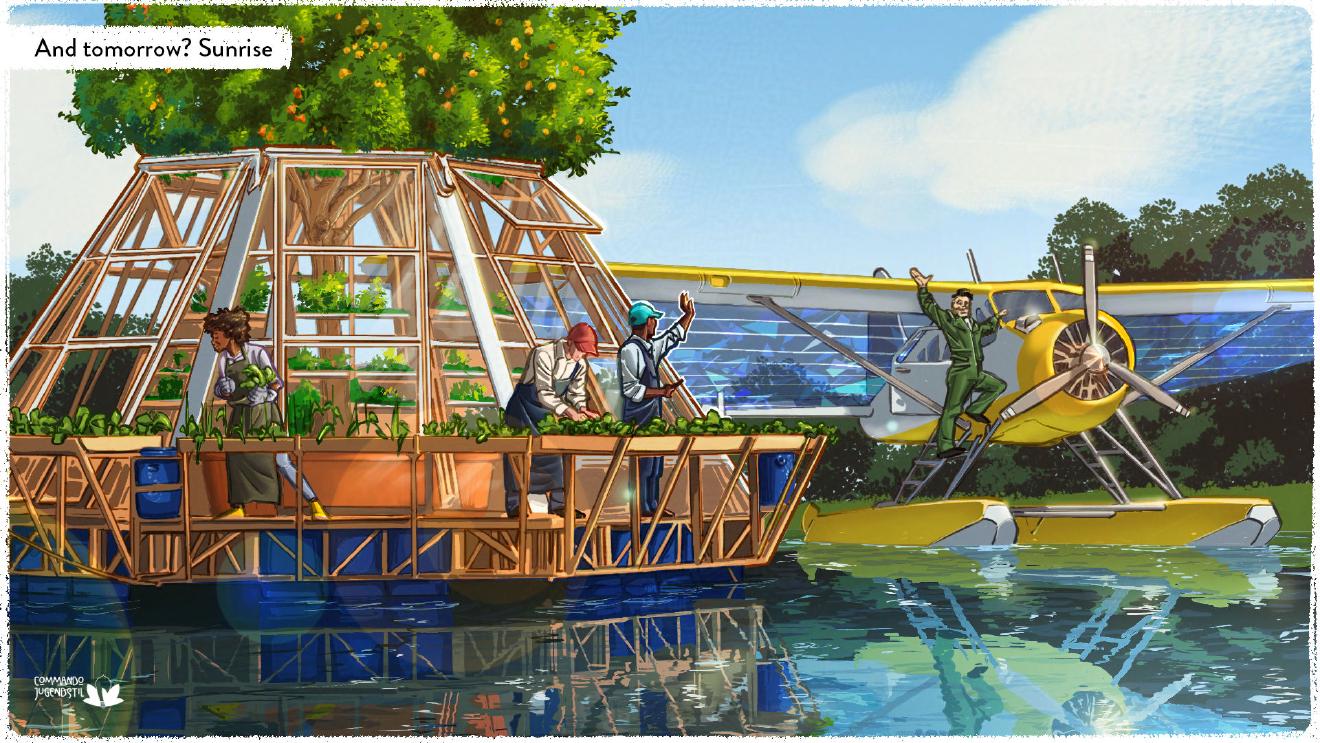
Imagine for a moment that you live in a small farming community in rural California. Your community has a long history of growing the food that people from all over the world eat, and lately there have been more and more advances in renewable agriculture technology that make your work less cumbersome and more rewarding. For you, the farmer, this means that the sensors you use, the seeds from which you grow your crops, the tools and equipment that you maintain, and all technology available to you are all ethically (and equitably) produced and sourced. The development of sustainable technology, like what you use to grow the food that feeds the world, is made possible by advances in carbon-free energy like wind, solar, and fusion. Your job, as a farmer in our Solarpunk world, is to support and enrich both land and people. Throughout this article we will discuss the ways in which we, as cultivators and supporters of student experiences in rural communities, endeavor to bring Solarpunk to rural STEM education.
What is Solarpunk?
Solar Punk is a genre and speculative art movement that builds on themes commonly seen in the Cyberpunk genre. Solarpunk instead “anticipates sustainable and equitable futures striking an ecological balance…the Solarpunk field places a particular emphasis on turning ideas into action and encourages proponents to shape the futures through storytelling” (MacGeorge). Examples of Solarpunk in literature include Ursula K. Le Guin’s experimental Always Coming Home (1985), considered a foundational text for the Solarpunk genre, and A Psalm for the Wild-Built (2021), a fascinating examination into robot consciousness and what it is for anyone to live a fulfilling life. Solarpunk can feature themes like sustainable change, pride in one’s work, environmental resilience, and hope, just to name a few. To quote RoAnna Sylva: “[Solarpunk] is a movement of counter-cultural hope to face the processes of accumulation, inequity, environmental degradation, control of corporations and the state over our life. Hope, then, can nourish the spaces of autonomy” (Silva). While Cyberpunk and Solarpunk stories often take place in city spaces and places of high population density, the appeal to hope and environmental resilience can be particularly relevant for rural communities, for whom resilience can be key to survival.
Why rural education?
The U.S. is a very big place. While it may seem like urban centers stretch and, ultimately, fill the entirety of our country, there is actually more “rural” land than there is urban or suburban. Mara Casey Tieken and Sally Fry Scuggs, in their 2014 book Why Rural Schools Matter, define rurality as “more than just the size of the population or its proximity to a city; it is the meaning embodied in the daily experiences of the residents and relates to identity, perspectives, and understandings of the world” (Tieken and Scuggs). Tieken and Scuggs suggest that, rather than assigning meaning or value to a community based on its proximity to a city or the number of people living there, we should examine the culture, practices, and perspectives of the rural communities. No rural area or community is the same, so no single approach to education or learning will do. Moreover, the approaches used to support urban and suburban communities are not as likely to support the needs of the rural community. Jennifer Seelig, in her chapter of the 2021 book Cultivating Rural Education: A People-Focused Approach for States, reminds us that “not all rural communities share similar experiences. Rural communities are not homogenous, but differ in many important ways, including the composition of local industry, ethnic diversity, and wealth distribution” (Howley, Caitlin, and Redding). It is worth noting, though, that government services require a way to “measure” or estimate what resources can be provided to communities–including rural ones, meaning that the ability of the federal and state governments to provide financial resources to rural communities often relies on the need for a numerical representation of rurality (Brown & Schafft). So, in some ways, “rural” is defined by remoteness and low population density, and in others it continues to be defined and redefined by the people who make up rural communities.
Rural education, then, is education aimed at students learning within rural communities. The needs, and often, interests, of students in rural communities can be starkly different from the needs and interests of students in urban communities. While many communities may struggle with funding and supporting their students, rural communities struggle for different reasons. For example, much of the federal or state funding aimed at supporting students requires enrollment numbers to be above a threshold that rural schools just cannot, and will not, meet. Additionally, grants and funding from private organizations often require heavy lifting in the form of bureaucratic paperwork, tracking, and regular communication. This is not something that many rural schools have the capacity for, as their very small team is already stretched thin managing the day-to-day operations of the institutions they serve. These are very good reasons to support rural education in general, but to understand what rural education has to do with Solarpunk requires a bit more understanding of the lives and experiences of those living in rural communities.
So, why discuss a literary genre in relation to rural education?
Much of Solarpunk’s advances happen in the energy and agriculture sectors, and these advances bring technological growth and industry to parts of the country that are most likely to suffer from destructive practices. Rural parts of America have often been centers of sourcing materials needed for technological advances, such as plutonium mines in Utah, or coal mines in West Virginia. As such, rural communities grapple with the tensions between the positive economic benefits of such industries and the negative ecological destruction that can lead to increased health risks for community members. Today, rural communities are also witness to, or a part of, the building of huge solar and wind farms and data centers from companies investing in “Artificial Intelligence” (AI). While solar and wind farms have the potential to provide energy to the local communities as well as being sent hundreds of miles to cities, AI data centers consume water at rates that can take away from the need for water for communities to maintain their health and grow food.
A report put out bi-annually by the National Rural Education Association (NREA) provides wonderfully specific statistics and information on rural areas across the U.S., as well as state-specific data on the education of students in rural areas. The authors of the report point out that “more students in the United States attend rural schools than attend the 100 largest U.S. school districts combined” (Showalter et al., emphasis added). The report also states that more than 7.3 million public school students are enrolled in rural school districts, and that over half of US school districts are rural. Moreover, more than one million staff were employed in rural school districts in Fall 2019. These are staggering numbers, particularly considering the increased difficulty of accessing increasingly necessary technology like reliable broadband internet access for rural communities, something that has been improving in recent years but has traditionally been a roadblock for training students in computer sciences, which we discuss a bit later.
Because the communities are small, and some are getting smaller, rapidly, many experience economic hardship. Where there are inadequate financial resources and allocations of funding due to small population numbers, it is likely that teachers serving these communities struggle against dire time and financial constraints to provide access to educational practices that are both modern and equitable for their students. The fields of science and technology change rapidly, and in order to keep up, so too must the methods of science and technology education. Perhaps some of the themes and practices found in Solarpunk can help us better prioritize, and advocate for, our rural communities.
To further argue in support of embracing literary genre and tools of the humanities, I quote Toni Morrison from her collection of essays and other works published in 2019, The Source of Self Regard. She discusses the role of the writer to draw the reader into the disquiet, and thus the vulnerability, of what is happening in the world around them. Morrison writes, “Certain kinds of trauma visited on peoples are so deep, so cruel, that unlike money, unlike vengeance, even unlike justice, or rights, or the goodwill of others, only writers can translate such trauma and turn sorrow into meaning, sharpening the moral imagination,” (Morrrison). So, perhaps it can be helpful for our efforts to support rural learners and educators to examine their experiences, and what challenges they face, through the lens of a literary genre that seeks to understand and overcome what are increasingly the same, or similar, challenges.
What does the work to improve rural STEM and computing education look like?
In today’s middle and high schools, Science, Technology, Engineering, Mathematics, and Computing (STEM+C) education in urban and suburban areas is typically broken into multiple different classes that reference one another. These areas also typically have several different teachers who each specialize in particular topics related to STEM and computing. However, in rural communities, one or two teachers are often slated to become credentialed in multiple STEM+C topics and teach these very different classes themselves. In these low-population areas, it is often impossible to provide all the separate topics in single classes. For example, engineering and computer science is often taught by the same teacher, often in the same class, as science. The way in which science is practiced with today’s modern technology and new science standards (see the National Research Council’s “A framework for K-12 science education: Practices, crosscutting concepts, and core ideas”), makes it possible to meet many different educational standards in all STEM+C topics within a single course per grade level in middle and high schools. This is great for our teachers in rural communities, but it comes with its challenges.
One example topic that spans multiple STEM+C specifically is computational thinking. Computational thinking is a concept and a skill that can be defined in a few different ways, but for our purposes is having the skills necessary to solve problems in creative and effective ways, using processes or calculations that can be computed (hence, “computational”). It enables a young person to think critically and gather the information that they need to make an informed decision about something, an important skill for students who will ideally go on to become actively engaged citizens of their state and country. These skills are going to be crucial for young people as they exit high school, college, or trade school, and enter jobs that will continue to demand experience and efficiency in them. Many of these young people, if given the proper exposure to and time to develop computational thinking skills, will be ready to innovate and develop creative and lasting solutions to the challenges (environmental or financial) that will continue to impact rural communities.
These strengths will enable today’s students to bring the world that we see in Solarpunk art and fiction to the center stage of their work. Generations of learners who are empowered and supported by tools like computational thinking as they let their curiosity guide them through technological discovery and innovation will have what they need to make Solarpunk a reality, and all of humanity will benefit from it.
Solarpunk and Rural Education
Computational thinking is about modeling systems, and Solarpunk provides for us an emphasis on finding ways to make these systems more efficient and sustainable, making each iteration better for the sake of our shared future and the future of our communities. Funded by the U.S. Department of Education, STEM And Computing Education Success (STEMACES) puts an easy-to-learn hardware system into the hands of 8th grade science students in rural communities who may not otherwise have reliable access to it. We develop and implement teacher training specifically for the science teachers who endeavor to support their students to the best of their ability while also struggling with complex scientific concepts themselves. We create hands-on educational material that is fun, engaging, and capable of being done differently for each student. This way, students can come up with their own creative answers and methods of meeting criteria–strengthened and empowered by computational thinking skills they will continue to develop over the course of the rest of their lives. It may sound simple, but playing with code that turns LEDs on and off again is a powerful tool that we believe to be capable of bridging a chasm between engagement and disillusionment. Included in this process is a journey into learning about circuits and the importance of resistors, gaining skills in modeling systems, and the confidence that one can answer any question with the right tools and a bit of patience.
STEMACES aims to increase students’ science learning outcomes by ensuring the use of hands-on STEM+C activities within a science classroom, providing for teachers the training needed to incorporate these activities into the classroom while meeting local and state STEM+C standards, along with additional teacher-requested support throughout the year. This is an important goal, which has the potential to build capacity in rural communities to continue to build their own technological solutions, while engaging in those that provide electricity and resources to urban and suburban areas. The vision that these three elements of the STEMACES theory of action (student activities, teacher training, and teacher support) is rooted in the philosophies of the Solar Punk movement. No community should be asked to bear the weight of the needs of other communities without first meeting the needs of its own community. The Solar Punk visions together with the STEMACES goal and activities provide a way to add to what rural communities are already building for themselves. We look forward to watching these communities continue to face, and overcome, their challenges and build a bright and robust future for their youth.
Sources Cited
Brown, David L., and Kai A. Schafft. Rural People and Communities in the 21st Century: Resilience and Transformation. Polity Press, 2019.
MacGeorge, Richard B. “Illustrating tomorrow: The role of comics in engaging research participants in Disruptive Futures Research.” World Futures Review, vol. 16, no. 1–2, Mar. 2024, pp. 26–41, https://doi.org/10.1177/19467567241249710.
Morrison, Toni. The Source of Self-Regard. Random House US, 2020.
National Research Council. 2012. A Framework for K-12 Science Education: Practices, Crosscutting Concepts, and Core Ideas. Washington, DC: The National Academies Press. https://doi.org/10.17226/13165
Showalter, D., Hartman, S.L., Eppley, K., Johnson, J., & Klein, R. (2023). Why rural matters 2023: Centering equity and opportunity. National Rural Education Association.
Silva, RoAnna. “Solarpunk: We Are Golden, and Our Future IS BRIGHT.” SciFi Ideas, www.scifiideas.com/posts/solarpunk-we-are-golden-and-our-future-is-bright/. Accessed 9 Oct. 2025.
Tieken, Mara Casey, and Sally Fry Scruggs. Why Rural Schools Matter. The University of North Carolina Press, 2014.
Vint, Sherryl. Science Fiction. The MIT Press, 2021.
Cover photo by Commando Jugendstil, found at https://storyseedlibrary.org/art/commando-jugendstil-panel-and-tomorrow-sunrise/.