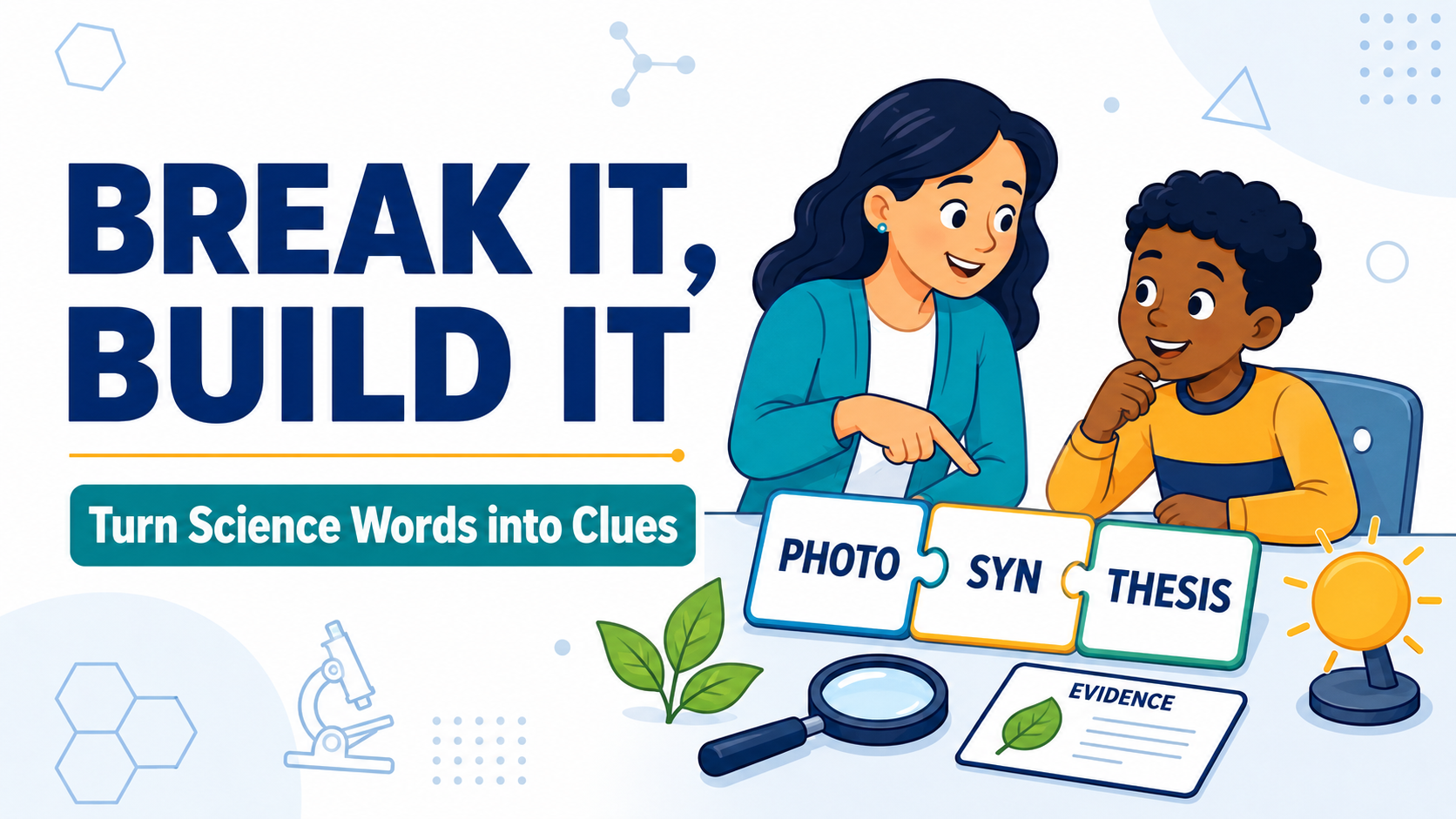
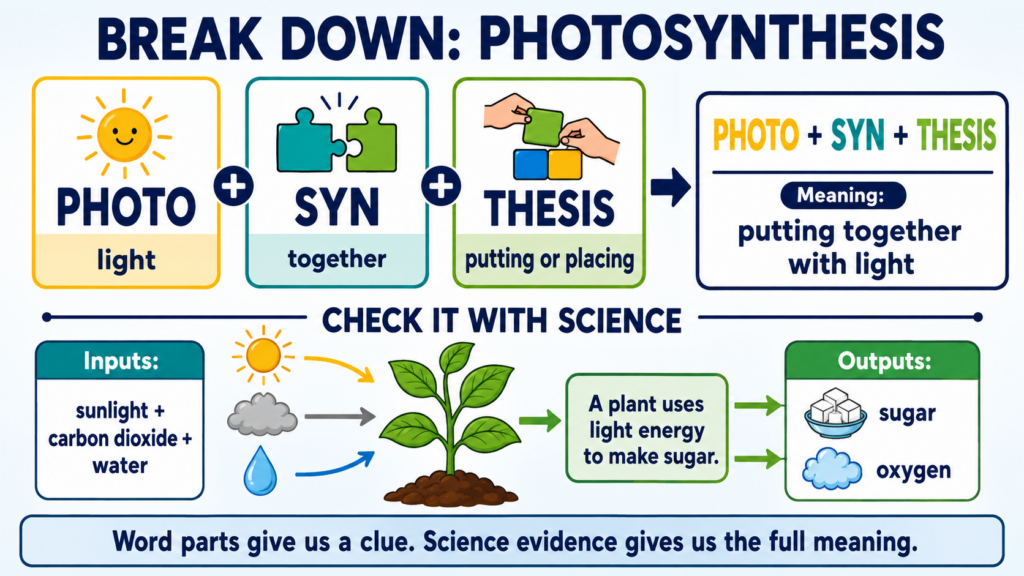
Long words, tough concepts often mean a child will give up and ask you, the giver of all-knowledge, a question. Think of a student reading a science text and encountering photosynthesis in a passage. That word’s length, and difficulty in pronouncing it, may stop a student. The word is long, unfamiliar, and sounds funny when they try to say it. You can provide the definition, but the next difficult word will create the same problem. You are setting yourself up as an answer-giver when it’s more useful to the student to figure it out from word parts.
That is why I spent much of my time reading dictionaries, and why students need to learn how science words are built.
Start with the Parts
Break It, Build It: Science Word Parts gives students a repeatable routine for decoding unfamiliar vocabulary:
- Spot It
- Break It
- Predict It
- Check It
- Use It
Students might recognize hydro as water or therm as heat. They combine those clues to predict a word’s meaning, then check that prediction against a diagram, passage, or set of data.
A thermometer measures temperature, not heat. A microwave is not simply a tiny wave. Word parts offer a way into the science, but evidence determines whether the first interpretation holds up.

Great teaching grows one strategy at a time. Join TCEA for Pedagogy Showcase: Igniting Excellence on November 7 for two and a half hours of practical, classroom-ready professional learning. Explore strategies for strengthening instruction, engaging students, making thinking visible, meeting diverse learning needs, and using digital tools and Gen AI with purpose. Leave with ideas, templates, and resources you can put to work right away.
Move Beyond Memorization
The current grades three through five collection includes 30 word parts, 35 science terms, and 12 printable activities. Students work with terms connected to Matter and Energy, Force, Motion, and Energy, Earth and Space, and Organisms and Environments.
You can filter activities by science area, SST checkpoint, ACE move, or activity type. Color and black-and-white versions are available, along with separate teacher keys. The black-and-white sheets use shapes and border patterns, so meaning does not disappear somewhere between your computer and a tired campus copier.
Build the Thinking Across the Year
The activities connect vocabulary work to the ACE Framework.
| Checkpoint | ACE move | Student thinking |
|---|---|---|
| BOY | Articulate | Identify a word part and explain its clue |
| MOY | Connect | Combine word structure with science evidence |
| EOY | Extend | Decode a new term and justify the interpretation |
This BOY, MOY, and EOY progression is a local approach to SST readiness, not a TEA requirement or official SST practice. Its value is instructional: the thinking grows more demanding instead of giving students the same worksheet three times with a different label.
Make Revision the Win
When students change an initial prediction after examining evidence, do not treat that as failure. That revision shows scientific thinking. They formed an idea, tested it, and adjusted it.
Start with one word during your next science lesson. Ask students to break it apart, make a prediction, and prove or revise their thinking with evidence.
Explore the free Break It, Build It activities and choose one printable to try this week.
👤 Human-directed (Miguel Guhlin) · 🤖 Gen AI-assisted (Claude, ChatGPT)