
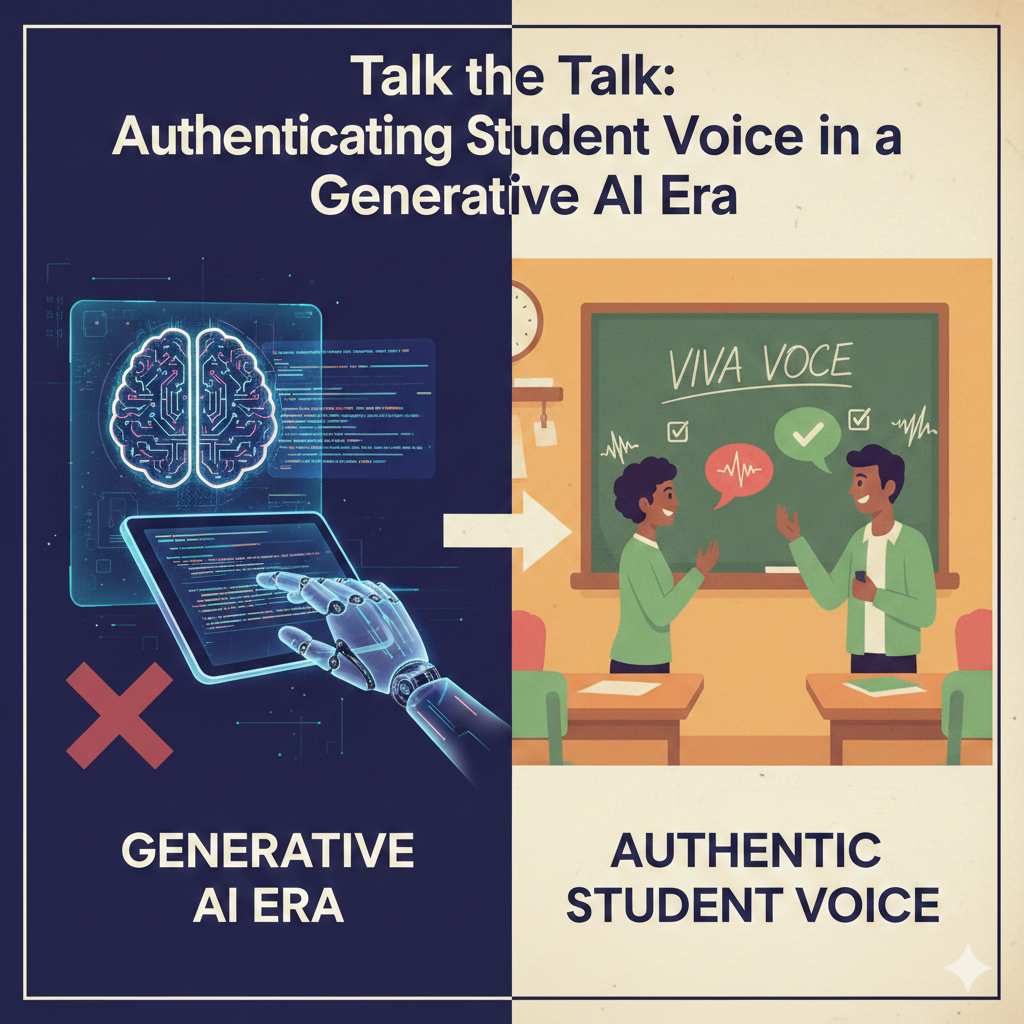
In an era where generative AI can craft a convincing essay on the French Revolution or a lab report on osmosis in seconds, educators are facing an “authenticity crisis.” We’ve all felt it: that nagging doubt when a student’s written voice doesn’t quite match their classroom persona.
While we shouldn’t abandon writing, the traditional “take-home” essay is losing its status as the gold standard of evidence. The solution, however, isn’t necessarily more high-tech surveillance. It’s actually quite “low-tech:” we need to start talking to our students more.
Welcome to the revival of the Viva Voce, Latin for “with the living voice.” Traditionally reserved for PhD defenses, a simplified VIVA Framework is the perfect tool for middle and high school teachers to verify understanding quickly and authentically.
What Is the VIVA Framework?
The VIVA Framework is a structured, two-minute “micro-assessment” designed to confirm that the student who submitted the work is the same student who understands the work.
Recent research (Auckland, 2025) suggests that “Interactive Oral Assessments” (IOAs) are among the most effective ways to see what students truly know. Unlike a test, a VIVA is a dialogue. It’s hard to “prompt-engineer” your way through a live conversation.
The Two-Minute VIVA Framework
To make this sustainable for a class of 30, the goal isn’t a long interview. It’s a surgical “check-in” using four specific pillars:
- V – Validate: Confirm the student knows the basic “what” of their work.
- I – Interpret: Ask them to explain the “how” or “why” behind a specific choice.
- V – Vault: Have them apply the concept to a new, hypothetical scenario (the “Vault” of knowledge).
- A – Authenticate: Discuss the process—what was the hardest part? What did they change?
You don’t need a complex rubric. Keep these four questions on a sticky note or your clipboard during “Work Time” or “Student-Teacher Conferences.”
| Phase | Question Prompt | What You’re Looking For |
| Validate | “In your own words, what is the ‘big idea’ or central thesis of this piece?” | Can they summarize without reading their screen? |
| Interpret | “You chose [specific detail/source/method] here. Why did you pick that over another option?” | Understanding of intent and selection. |
| Vault | “If the circumstances changed to [new variable], how would your conclusion change?” | Transfer of knowledge to a new context. |
| Authenticate | “What was one ‘dead end’ you hit while working on this, and how did you pivot?” | Insight into the human learning process. |
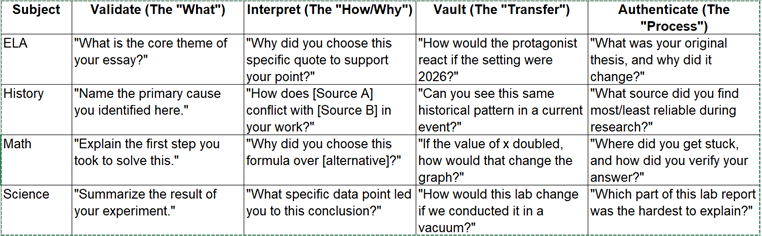
Or check out these subject-specific questions below:
What the Research Says
You might worry that oral assessments take too much time, but the data tells a different story:
- Integrity without Policing: A 2025 study from the University of South Australia found that replacing some written exams with structured orals reduced academic integrity breaches to nearly zero in targeted subjects.
- Better Grade Accuracy: Research published in Frontiers in Education (2025) indicates that students often perceive oral check-ins as more “fair” and accurate reflections of their knowledge than high-stakes tests.
- Employability: Beyond “catching AI,” oral exams develop “work-ready” skills: the ability to defend a position, communicate clearly, and think on your feet (University of Auckland, 2025).
Implementation Tip: The “Sampled” VIVA
You don’t have to VIVA every student for every assignment. Try sampled moderation. Tell the class you will randomly select five students to do a two-minute “VIVA check-in” after they submit their digital work. The mere possibility of a conversation encourages students to engage more deeply with the material themselves rather than outsourcing it to a bot.
Pro Tip: Tech-Smarter, Not Harder
A common hurdle for oral assessments is the “Where do I put the grade?” factor. Luckily, you don’t need a heavy gradebook entry for a two-minute chat. Use this streamlined workflow to keep your data organized without the paperwork:
- The “VIVA Tracker” Form: Create a simple Google Form or Microsoft Form with three fields: Student Name, Phase (Validate, Interpret, Vault, Authenticate), and a Checkmark for “Demonstrated Mastery.”
- Voice-to-Text Feedback: Instead of typing notes while the student talks, use the dictation (microphone) feature in a Google Sheet cell. Briefly summarize their “Vault” answer. This creates a time-stamped record of their verbal mastery that you can refer back to during parent conferences or IEP meetings.
- The “Randomizer” Spreadsheet: Use a simple =RANDBETWEEN formula in a spreadsheet to select your “VIVA 5” for the day. Projecting this on the board adds a layer of gamified transparency: students know the “Living Voice” check-in is a standard, fair part of the classroom routine.
Ready to try your first VIVA? Pick one assignment this week and choose three students for a two-minute “desk-side chat” using the template above. You might be surprised at how much more you learn about their thinking than a “Turnitin” score could ever tell you.

1 comment
Learn more about VIVA Framework – https://blog.tcea.org/teaching-oral-assessment-with-viva/