
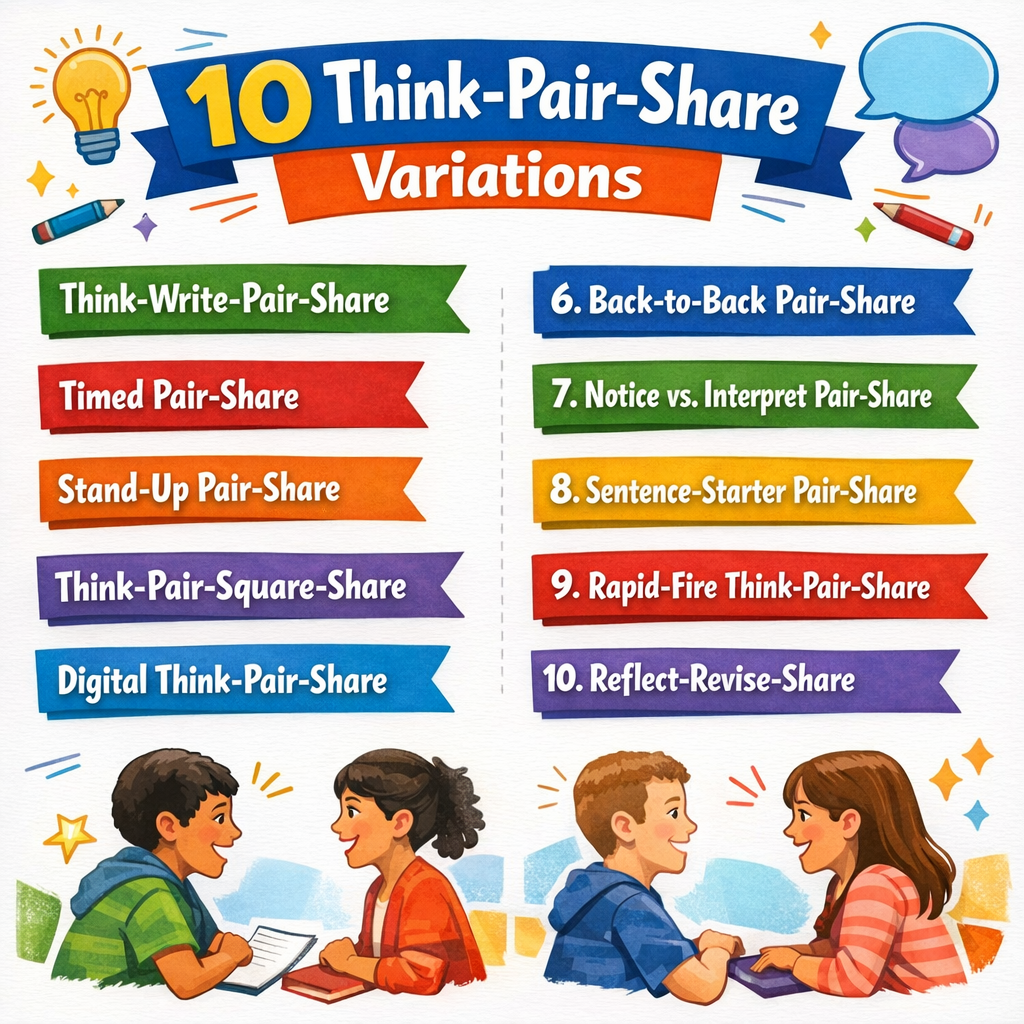
Think-Pair-Share is one of those classic instructional strategies that most teachers have probably used in their classroom hundreds of times. Not only does it increase student participation, it also gives students processing time. However, Think-Pair-Share can become routine. We ask a question. Students turn and talk. A few share out. Then we move on. With just a few small adjustments, we can vary the strategy so students don’t become bored with it.
Here are ten fresh ways to rethink this classic strategy.
1. Think-Write-Pair-Share
One simple upgrade is adding a writing step before students talk. Instead of thinking and immediately turning to a partner, students first write their response for one to three minutes. Writing clarifies thinking and increases accountability. When students move into the pair discussion, they are not scrambling for ideas. They have already organized their thoughts. After partners talk, you might even have them underline one strong sentence from each other’s response before sharing with the class. This small adjustment dramatically improves the quality of conversation.

2. Timed Pair-Share
Sometimes one partner dominates while the other quietly listens. Adding structure solves this quickly. In a timed pair-share, Partner A speaks for sixty seconds while Partner B listens without interrupting. Then they switch. Displaying a timer keeps the pace moving. This format not only guarantees equal participation, but it also strengthens listening skills and encourages students to be concise and intentional with their thinking.
3. Stand-Up Pair-Share
If energy in the room feels low, adding movement can make a noticeable difference. In this version, students stand up and find a partner across the room to discuss the prompt. After sharing, they find a new partner for the next question. This variation works especially well after direct instruction or before independent work. A simple change in movement often resets focus and increases engagement.
4. Think-Pair-Square-Share
For more complex questions, consider adding an extra layer. Students first think independently, then pair up to discuss. Afterward, two pairs join to form a group of four before sharing highlights with the whole class. This scaffolded approach allows students to rehearse and refine their ideas multiple times before speaking. By the time someone shares with the class, the idea has already been strengthened through discussion.
5. Digital Think-Pair-Share
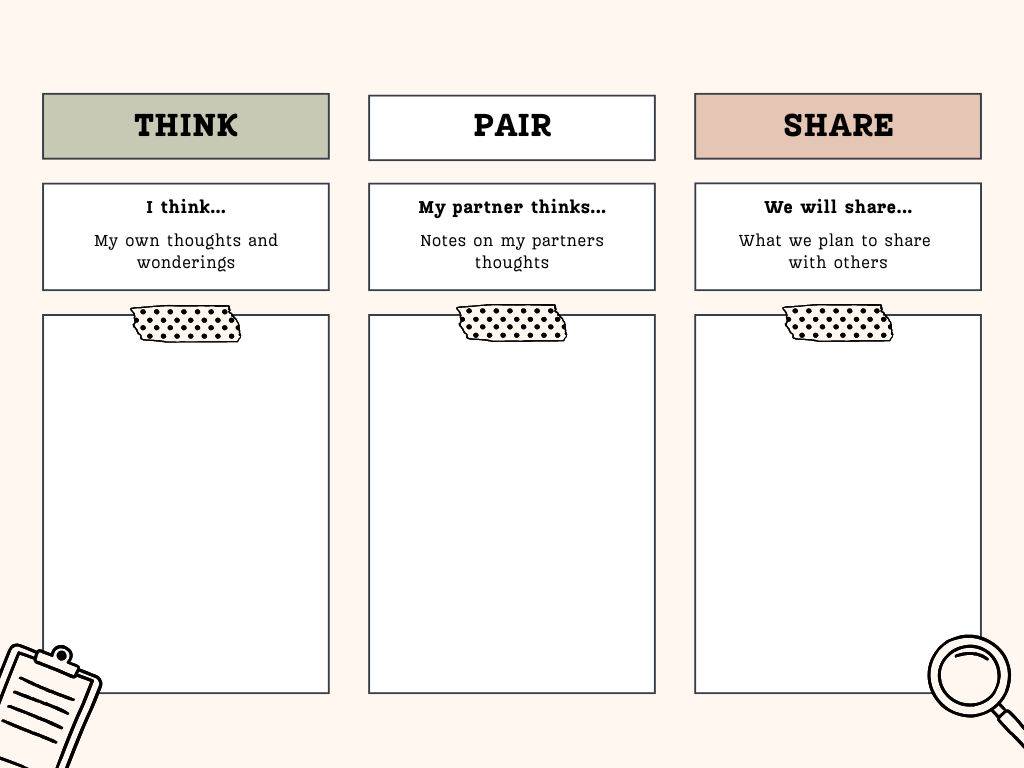
Technology can enhance this strategy by making student thinking visible. Students might first type their responses in a shared document, then discuss with a partner, and finally post a refined response to a shared board. Tools like Canva for Education, Google Docs, or Padlet work beautifully for this. Check out this Canva template.
6. Back-to-Back Pair-Share
If you want to strengthen listening skills, try having students sit back-to-back with a partner. They think silently, then discuss the prompt without visual distractions. Afterward, they turn around and summarize what their partner said. This structure forces students to truly listen rather than simply waiting for their turn to speak. It shifts the focus from responding to understanding.
7. Notice vs. Interpret Pair-Share
When analyzing images, videos, data, or text, separating observation from interpretation can deepen thinking. In this variation, one partner shares only what they notice. For example, they might share facts and observable details. The other partner will share interpretations and inferences. By clearly distinguishing between what is seen and what is inferred, students develop stronger analytical skills and more precise academic language.
8. Sentence-Starter Pair-Share
Providing sentence stems can significantly strengthen academic discussion, especially for English Language Learners or students who need support organizing their thoughts. Prompts like “One important idea is…,” “I agree with you because…,” or “Another perspective might be…” give students a starting point without limiting their thinking. Structure, in this case, builds confidence and increases the quality of conversation.
9. Rapid-Fire Think-Pair-Share
For review or retrieval practice, quick cycles can keep momentum high. Pose a short question, give thirty seconds to think, and sixty seconds to share. Then move on to the next prompt. This fast-paced version works well as a warm-up, a mid-lesson check, or an end-of-class review. It maintains energy while reinforcing key ideas.
10. Reflect-Revise-Share
One of the most powerful variations adds a metacognitive layer. After students’ pair and discuss, ask them to revise their original response. Then have them reflect on how their thinking changed. What did their partner say that influenced them? This version makes learning visible and highlights growth rather than just answers.
Try a Variation
Think-Pair-Share doesn’t need to be complicated to be powerful. With a few intentional shifts, it can move from a simple turn-and-talk routine to a meaningful structure that increases equity, strengthens student voice, and deepens thinking. The next time you plan a lesson, try one of these variations.