
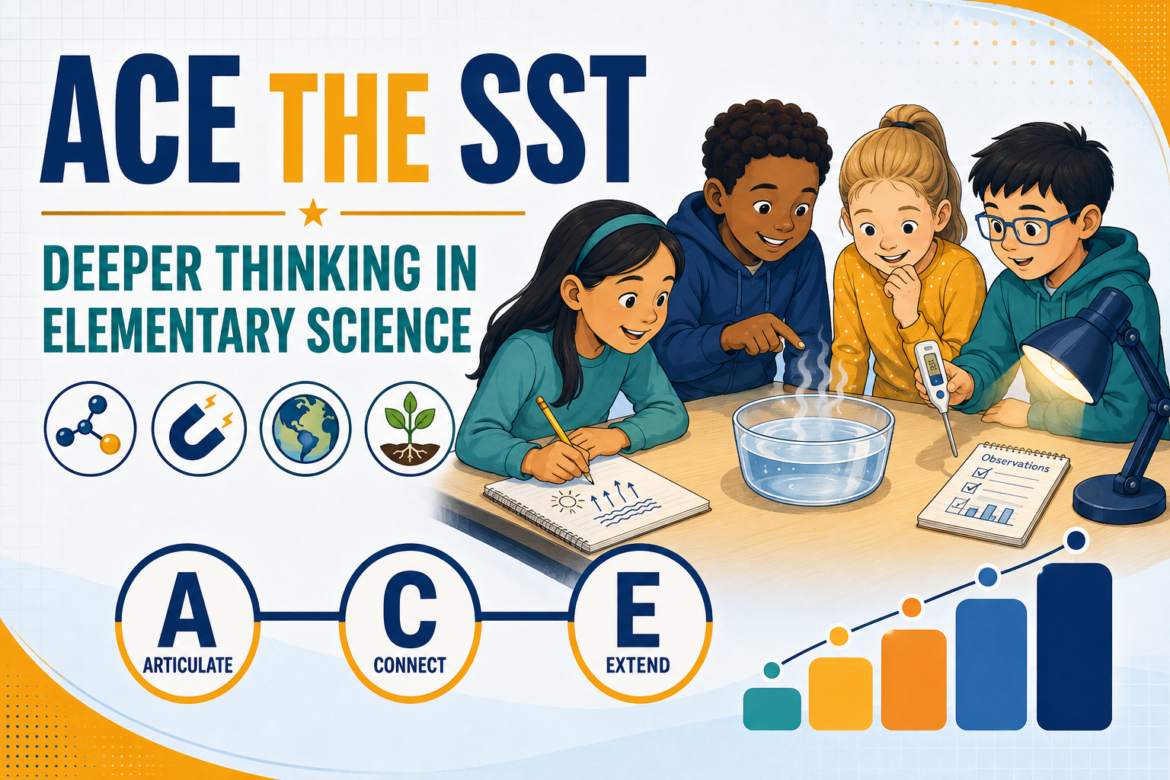
“What happens next?” I smiled at one of my fifth grade student groups. They were staring intently at a diagram that I had adjusted in front of them. They weren’t sure. Then, one of them started making the connection as she spoke aloud. This experience came to mind recently. A fifth-grade student can identify evaporation in a diagram. Then when there is a change to a single condition, students are unsure as to what happens next. Suddenly, the memorized definition, what they thought they knew, is not enough. The student has to do something that makes thinking real. That is, find a way to connect evidence, explain a relationship between changing variables, and/or apply the idea. In this blog entry, you will find a variety of resources and the promise of more to come.
Preparing for the Student Success Tool (SST)
That kind of thinking needs to be modeled as Texas prepares for the Student Success Tool. Beginning in 2027–2028, SST will replace STAAR and include beginning-, middle-, and end-of-year assessments. TEA’s draft elementary science blueprints organize questions around four strands: Matter and Energy; Force, Motion, and Energy; Earth and Space; and Organisms and Environments. Question formats include multiple choice, multiselect, multipart, and inline choice. (TEA SST resources)
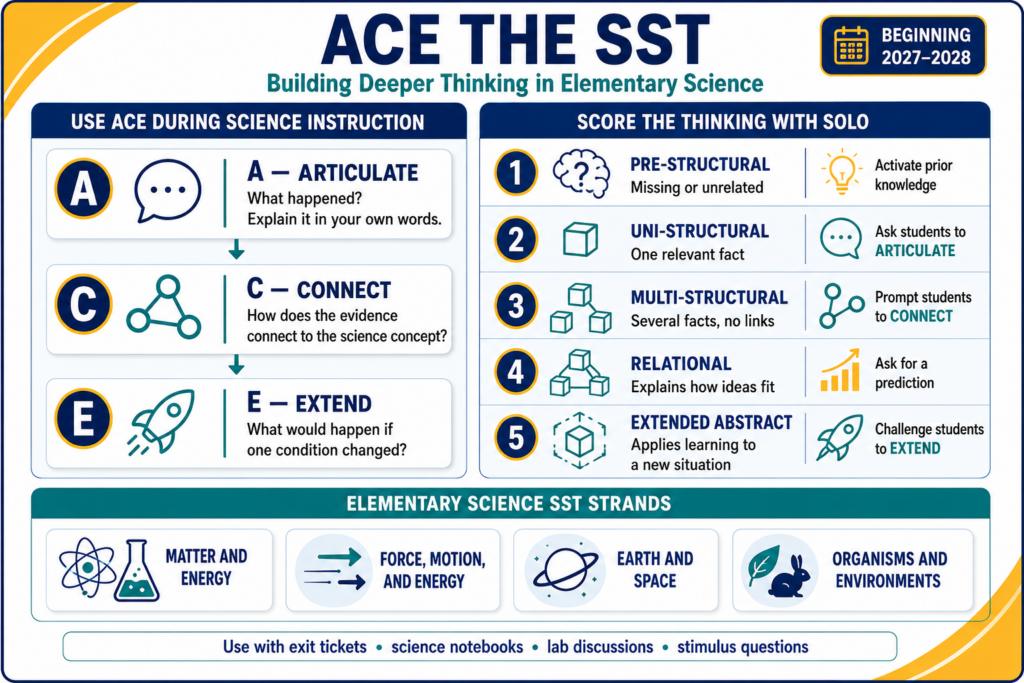
Use ACE During Science Instruction
The ACE Framework gives you three questions that fit almost any science investigation:
- Articulate: What happened? Explain it in your own words
- Connect: How does the evidence connect to the science concept?
- Extend: What would happen if one condition changed?
I like ACE because it takes less than a minute to explain, but it quickly reveals whether students understand a concept, or simply recognize familiar vocabulary.
Score the Thinking with SOLO
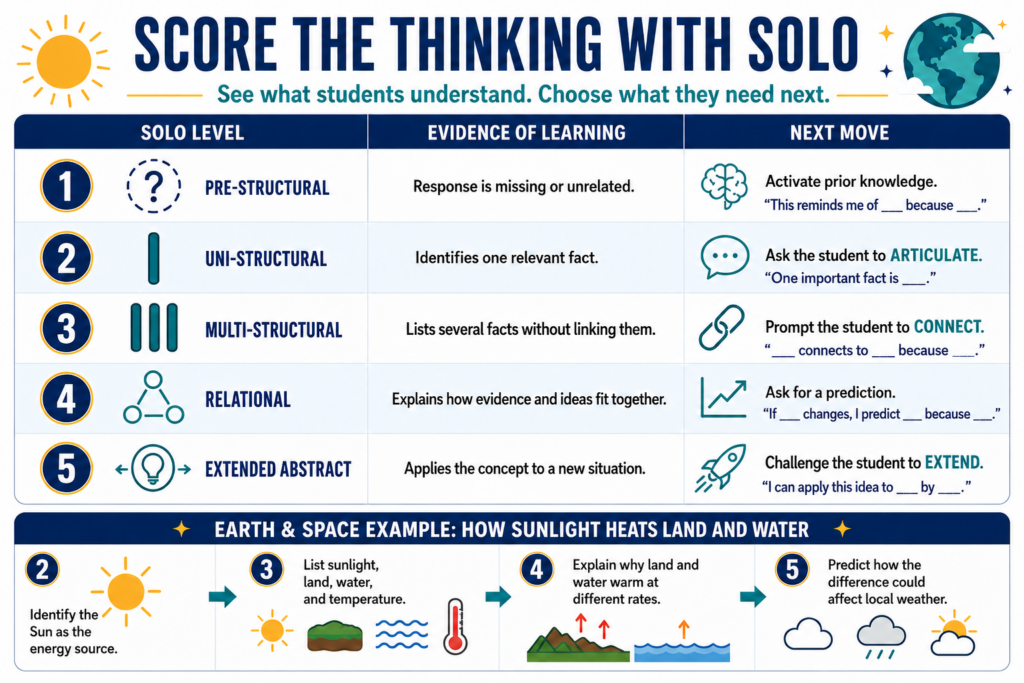
A simple SOLO Taxonomy scoring guide can help you decide what students need next.
| Score | Evidence of learning | Next move |
|---|---|---|
| 1: Pre-structural | Response is missing or unrelated | Activate prior knowledge |
| 2: Uni-structural | Identifies one relevant fact | Ask the student to Articulate |
| 3: Multi-structural | Lists several facts without linking them | Prompt the student to Connect |
| 4: Relational | Explains how evidence and ideas fit together | Ask for a prediction |
| 5: Extended abstract | Applies the concept to a new situation | Challenge the student to Extend |
Consider an Earth and Space question about how sunlight heats land and water (see below for example). A student at level two might identify the Sun as the energy source. At level three, the student lists sunlight, land, water, and temperature. A level-four response explains why land and water warm at different rates. At level five, the student predicts how that difference could affect local weather.
ACE Entry/Exit Tickets for SST Success
See how to build deeper thinking in elementary science, leveraging the ACE framework for SST success. Get grade 3-5 entry/exit tickets, too. What’s more, these are available in seven languages (e.g. English, Spanish, Arabic, Chinese, Hindi, Urdu, Vietnamese) for multilingual classroom situations.
Access the ACE the SST Entry/Exit Tickets
SST preparation should not become a fresh stack of test-prep packets. Use ACE exit tickets, science notebooks, lab discussions, and short stimulus questions throughout the year. Score the thinking with SOLO, then teach from the level students actually show you.
Try one ACE science exit ticket this week and use the SOLO score to plan tomorrow’s instruction.
Looking Forward
As Texas moves forward, TCEA is committed to providing additional resources. Be sure to explore the SST Activities resource site for more info.
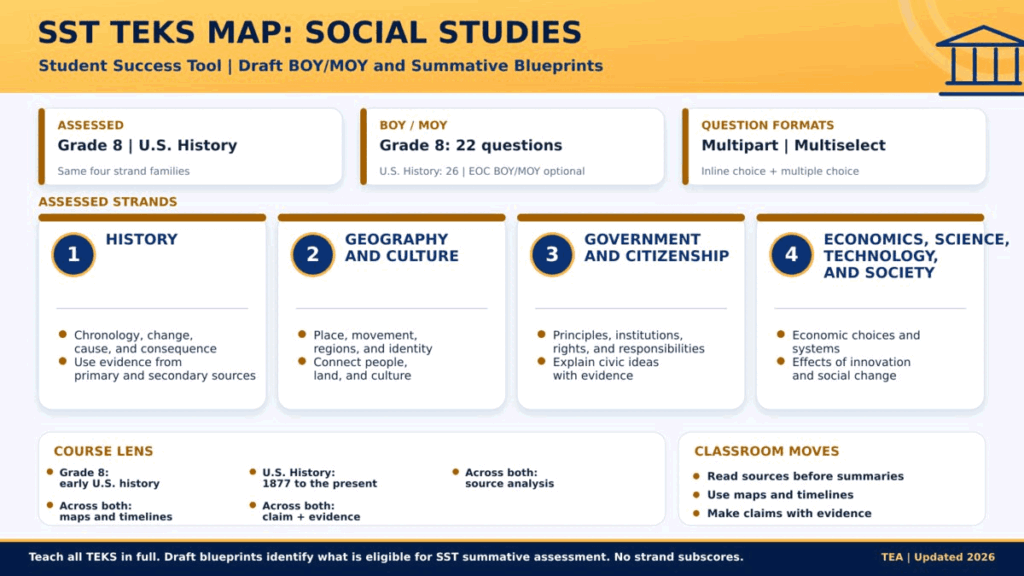
You can find a roadmap for SST TEKS for each of the content areas. One page per subject, drawn from the draft BOY/MOY and summative blueprints: what is assessed, how many questions, the strand families, and the classroom moves each one rewards. Open an image to see it full size. Here’s a quick preview:
Get the timeline straight
- STAAR remains in place through the 2026–2027 school year.
- Under House Bill 8, SST begins in 2027–2028 with beginning-, middle-, and end-of-year assessments. Grades 3–8 use all three checkpoints.
- BOY and MOY are optional for the Algebra I, Biology, English I, and U.S. History end-of-course assessments.
- BOY and MOY are adaptive. EOY is static, so its questions can be released.
- RLA writing has a separate April window, with other EOY testing in May.
- TEA says results must reach school systems within two business days after the testing window closes.
- The English II EOC is eliminated beginning in 2027–2028, though the graduating classes of 2026 and 2027 still have it as a graduation requirement.
Turn three checkpoints into one teaching loop
| Checkpoint | Teacher move | Practical question |
|---|---|---|
| BOY | Identify unfinished learning and establish a baseline | What support does each student need first? |
| MOY | Regroup, reteach, and adjust scaffolds | What changed, and what is still getting in the way? |
| EOY | Review mastery, growth, and remaining gaps | What should the next teacher know? |
What are you doing to prepare for Student Success Tool (SST) in your school or district? Let us know in the comments what would be most helpful for you.
👤 Human-directed (Miguel Guhlin) · 🤖 Gen AI-assisted (Claude, ChatGPT)