
What if your students did more of the thinking, questioning, and talking while you did more of the listening? Socratic Seminars are a classroom activity that can help make that happen. With a little preparation and the right questions, you can turn everyday classroom discussions into opportunities for deeper learning.
Who Is Doing Most of the Talking?
Picture this. You’ve just finished teaching an important concept. You ask, “Does everyone understand?” Several students nod, a few avoid eye contact, and others look like they’re ready to move on. Then you ask a question, and the same three students raise their hands.
Sound familiar?
You may have heard the same saying that I’ve heard: “Whoever is doing the most talking is the only one learning.”
Now, that may be a bit of an exaggeration, but there’s an important truth behind it. When we deprive our students of opportunities to think out loud, process their ideas, and learn from one another, we diminish their opportunities to develop critical thinking, communication, and reasoning skills.
One way we can change that is through Socratic Seminars.
A Socratic Seminar is a structured, student-led discussion where students explore a question or topic together. Instead of looking to the teacher for the correct answer, they examine evidence, consider different perspectives, ask questions, and build on one another’s thinking.
And here’s something I especially like about this strategy. The teacher doesn’t have to be the person doing all the talking.
Our role shifts from providing answers to helping students develop their own understanding. That doesn’t mean we stop teaching. It means we’re intentional about when we talk and when we give students opportunities to do the thinking.

What Does Research Tell Us About Classroom Discussions?
There is research supporting the value of giving students opportunities to talk about what they’re learning.
The Education Endowment Foundation’s research on oral language interventions reports that structured speaking and listening approaches can support student achievement, with an average impact equivalent to six additional months of progress. It’s important to recognize that this research examines a variety of oral language strategies, not just Socratic Seminars. However, it reinforces the value of purposeful academic conversations connected to what students are learning.
A 2017 classroom case study published in The American Biology Teacher also explored how Socratic Seminars could help high school science students interpret complex scientific data. The researchers described how student conversations helped reveal misconceptions and provided opportunities for students to reason through evidence together.
For our classrooms, I see three important benefits:
- Develop critical thinking. Encourage students to examine evidence, explain their reasoning, and consider other possibilities.
- Strengthen communication. Give students opportunities to listen carefully, ask questions, and respond respectfully to different perspectives.
- Make student thinking visible. Listen to how students explain concepts so you can identify misunderstandings and determine where additional instruction may be needed.
I also think there’s a benefit we sometimes overlook. Students begin to recognize that their classmates have valuable ideas, even when those ideas are different from their own.
How Do You Prepare Students for a Socratic Seminar?
If you’ve never facilitated a Socratic Seminar, don’t feel that you need to start with something elaborate. In fact, I’d encourage you to start small.
Choose Something Worth Discussing
Begin with a reading, question, image, data set, or situation that encourages students to think beyond a single correct answer. For example, students might examine a character’s decision in a story, analyze scientific evidence, or consider an ethical dilemma. For your first seminar, keep the material manageable. A short reading or single graph may be all you need.
Ask Questions That Encourage Thinking
The questions you ask can make a big difference. Rather than asking students to recall information, give them something they need to think through, explain, or defend with evidence.
Here are a few examples you might adapt for your content area.
| Content Area | Possible Seminar Question |
|---|---|
| English Language Arts | Was the character’s decision justified? |
| Mathematics | Can two different methods both be the most efficient? |
| Science | What evidence best explains the results of this experiment? |
| Social Studies | When should individual rights take priority over community needs? |
| Elementary Reading | What makes someone a good friend? |
| Career and Technical Education | How should professionals balance cost, safety, and quality? |
I recommend preparing one opening question and three follow-up questions. You don’t need to script the entire conversation. In fact, some of the best questions may come from your students.
Establish Expectations Before You Begin
Students need to understand that a Socratic Seminar isn’t about winning an argument. It’s about exploring ideas and learning from one another. Before your first seminar, work with students to establish a few discussion expectations.
- Listen to understand what others are saying.
- Support your ideas with evidence.
- Invite classmates to share their thinking.
- Disagree respectfully with ideas rather than criticizing people.
- Allow time for others to think before responding.
- Build on what classmates have already shared.
Don’t assume students automatically know how to do these things. Model what respectful disagreement and evidence-based discussion sound like. You might even have students practice with a partner before participating in a larger group.

Get Your Free Socratic Seminar Planning Guide
Want a little help planning your first Socratic Seminar? I’ve put together a free Socratic Seminars in Action educator guide with practical examples for elementary, middle school, high school, and college classrooms.
You’ll also find tips for facilitating discussions, sample questions, assessment ideas, a planning template, and additional resources to help you get started. Feel free to make a copy and adapt it for your students.
Try Your First Socratic Seminar in 45 Minutes
You don’t have to dedicate an entire week to this strategy. You can introduce a Socratic Seminar during a regular class period. Here’s one way to organize a 45-minute lesson.
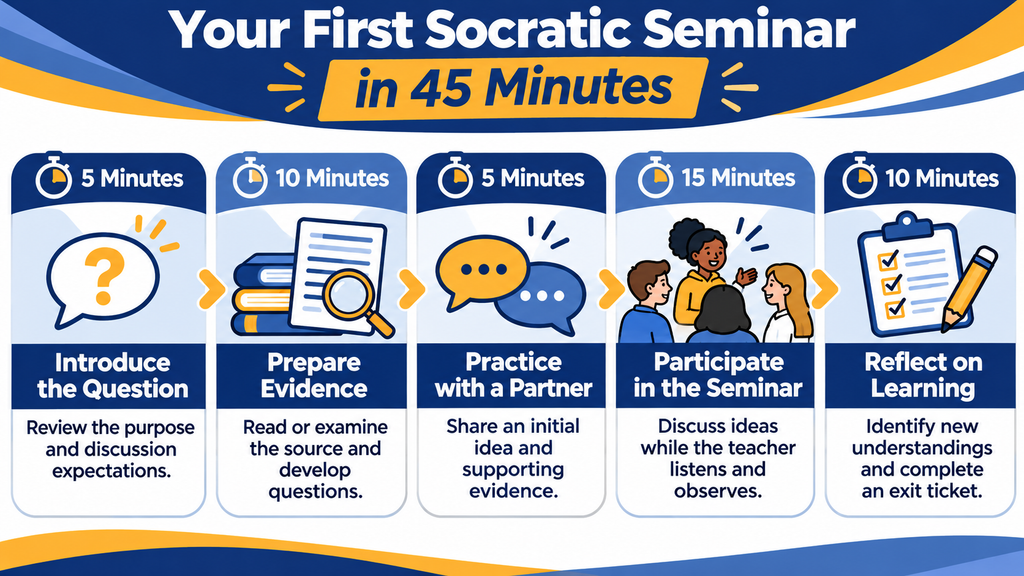
During the seminar, resist the temptation to respond to every student comment. I know that can be difficult, especially when you hear something that needs clarification. Instead of immediately correcting or confirming an answer, try asking, “What do the rest of you think?” or “What evidence supports that idea?” And don’t be afraid of silence. We sometimes rush to fill quiet moments when students may simply need a little more time to think. Your first seminar may feel awkward. That’s okay. Students are learning a new skill, and like most skills, it takes practice.
How Can You Make Sure Everyone Participates?
One concern teachers often have is that the same students who dominate regular classroom discussions will also dominate a Socratic Seminar. That’s a legitimate concern, but there are ways to make participation more accessible without requiring every student to speak the same number of times.
One option is the fishbowl format. Divide students into two groups. The first group participates in the discussion while the second group observes and records examples of effective discussion strategies. Then have the groups switch roles. The infographic below shares how making a few adjustments can make the activity more inclusive.
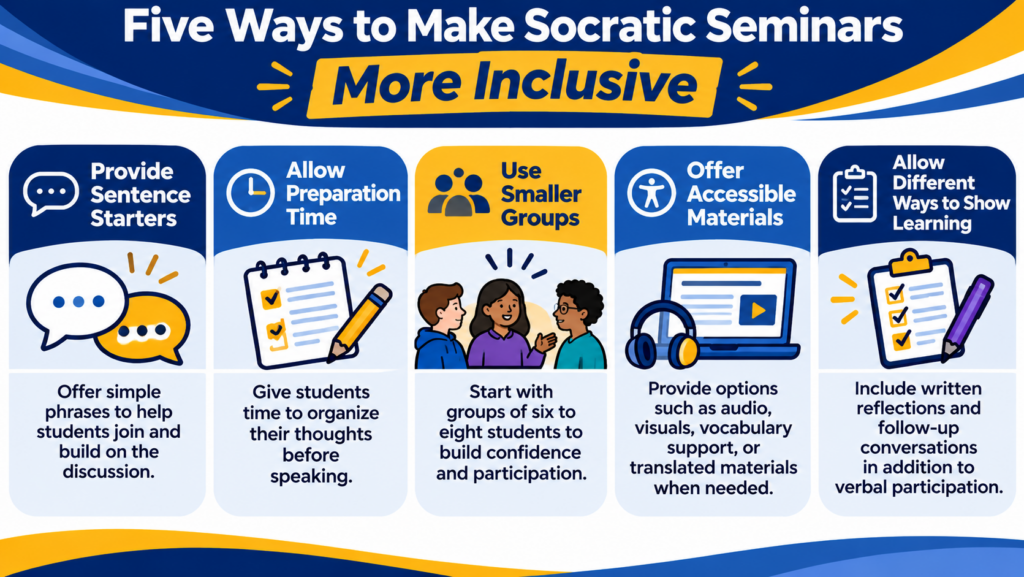
For multilingual learners, having time to practice with a partner can be especially helpful. For students with disabilities, consider their individual communication needs and accommodations.
Remember, the goal isn’t necessarily equal speaking time. The goal is to make sure students have meaningful opportunities to participate, process information, and demonstrate their understanding.
Use Technology When It Makes Sense
You certainly don’t need technology to conduct a Socratic Seminar. In fact, I would encourage students to put their devices away during the actual discussion whenever possible.
However, technology can make preparation and reflection a little easier.
| Tool | How You Might Use It |
|---|---|
| Google Docs | Share readings and collect student questions. |
| Google Forms | Collect exit tickets and student reflections. |
| Canva for Education | Create visual discussion expectations and sentence starters. |
| Padlet | Let students submit questions before the seminar. |
One idea is to create a shared Google Doc with three headings: Questions, Evidence, and New Understandings. Have students contribute their initial questions and evidence before the seminar. Afterward, ask them to add something they learned or a perspective they hadn’t previously considered. This gives you a simple way to see how their thinking changes.
You could also use AI to help generate possible discussion questions. Just make sure students evaluate and improve those questions rather than accepting them without thinking. After all, the purpose of the activity is to develop student reasoning, not outsource it.
How Do You Assess a Socratic Seminar?
Here’s a question worth considering. How do you grade a classroom discussion fairly? I would caution against using the number of times a student speaks as the primary measure of success. A student who makes one thoughtful contribution supported by evidence may demonstrate a stronger understanding than someone who talks frequently without adding much to the conversation.
Instead, consider a simple rubric that focuses on four areas.
| Criteria | What to Look For |
|---|---|
| Preparation | Understands the source and brings relevant questions. |
| Reasoning | Supports ideas with evidence and explains connections. |
| Listening | Responds thoughtfully and builds on others’ ideas. |
| Reflection | Recognizes new perspectives and identifies remaining questions. |
You could use a three-level scale: Developing, Meeting, and Extending.
Share the criteria with students before the seminar so they understand what you’re looking for. Discuss each criteria and give any clarification before the seminar starts so they better understand what the criteria may sound/look like.
Afterward, ask students to respond to these three prompts:
- One idea I contributed or considered was…
- Something a classmate said that changed my thinking was…
- One question I still have is…
These responses can tell you quite a bit about what students understood, what they’re still questioning, and where you may need to provide additional support.
What If Your Seminar Doesn’t Go as Planned?
Not every Socratic Seminar will go smoothly, especially at first. Remember that you are supporting critical thinking which is more complex than students just recalling vocabulary. Think of using Socratic Seminars as your class is “in it for the long haul.” Here are a few challenges you may encounter and some adjustments you can try.
- Nobody wants to talk. Give students one minute to write their thoughts, followed by a quick conversation with a partner. Then open the discussion to the group.
- One student dominates. Introduce a “step up, step back” expectation. Encourage students who frequently speak to make room for others.
- Students get off topic. Bring them back to the original question and ask how their comments connect to the evidence.
- Students start arguing. Remind them that understanding another perspective doesn’t mean they have to agree with it.
- The discussion stays at the surface level. Ask follow-up questions such as “Why do you think that?” or “What might someone with a different perspective say?”
And when something doesn’t work, ask students for feedback. What helped the conversation? What made it difficult? What should you do differently next time? Their answers may surprise you.
Find Resources to Help You Get Started
If you’d like to learn more about Socratic Seminars, here are a few resources worth exploring.
- Facing History & Ourselves: Socratic Seminar provides classroom guidance, discussion strategies, and reflection questions.
- Socratic Seminar with Data shares a science classroom example of using student discussion to interpret data.
- How I Designed an Inclusive Socratic Seminar (and You Can Too!) features John Spencer discussing seminar structures and inclusive participation.
- A Demonstration of How Students Carry Out a Socratic Seminar shows middle school students participating in the process.
If you’re leading professional development, consider having teachers participate in a short Socratic Seminar themselves. Experiencing the strategy as learners can help them better understand how to use it with their students.
Give Students More Opportunities to Think
You don’t need to have the perfect lesson or a classroom full of students who are already comfortable speaking in front of others. Start with one good question, a short reading or other source, and 15 minutes of discussion. Pay attention to what students do well. Notice where they struggle. Make one or two adjustments, and try it again.
As students become more comfortable with the process, you may begin to notice them asking better questions, listening more carefully, and supporting their ideas with stronger evidence. And perhaps most importantly, they’ll begin looking to one another for ideas rather than always looking to you for the answer.
Remember that saying about whoever is doing the most talking being the only one learning? Maybe it’s time we gave our students more opportunities to do the talking.
Your Turn! What Will You Try?
Have you used Socratic Seminars with your students? If so, what worked well, and what would you do differently? If you haven’t tried one yet, what’s a topic you’re teaching that might make a good starting point?
Share your experiences or ideas in the comments. I’d love to hear how you’re helping students do more of the thinking, questioning, and talking in your classroom.