
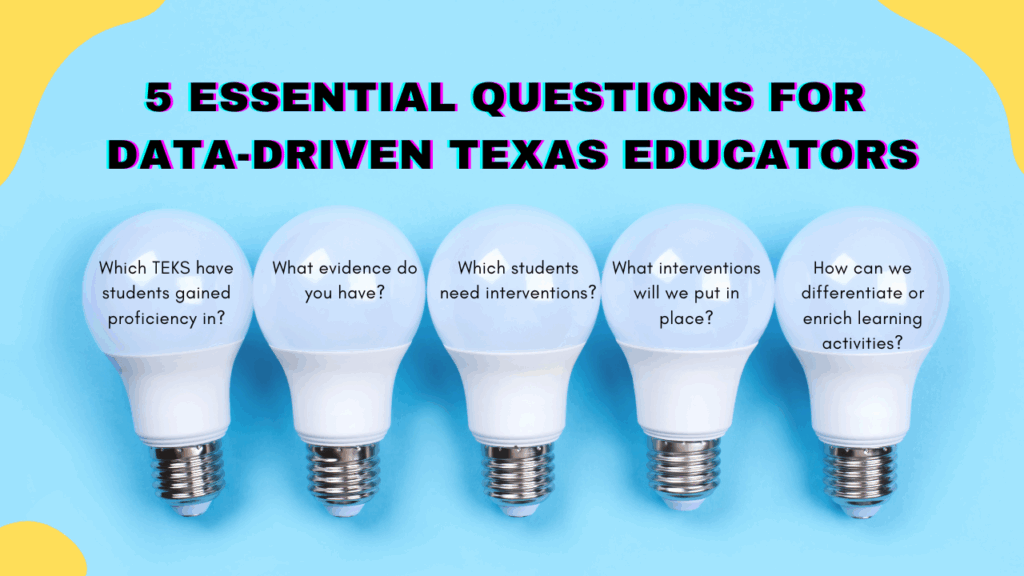
While working in a small, suburban school district as a technology director, I found myself dragged into several Professional Learning Committee (PLC) meetings, but only a few seemed to prove real results. I couldn’t help but wonder, “What questions should we really be asking about our data? How could these critical questions change how a PLC approaches student learning?” That’s why I’ve developed these five critical questions for Texas educators to consider.
Focusing on What Matters: The TEKS Mastery Conversation
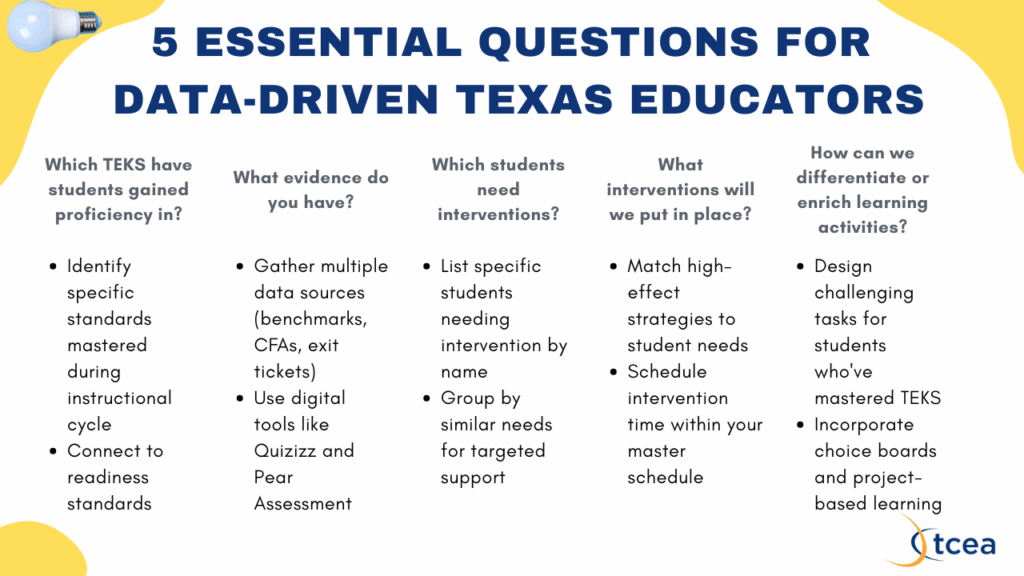
These five questions can easily become a framework that lends some structure to PLC meetings. Use these questions to focus conversations on ensuring students achieve essential learning standards. Let’s take a look at each of the questions below.
Question 1: Which TEKS have students gained proficiency in?
This first question cuts straight to the heart of our work as educators: “Which TEKS and/or state/local standards have we ensured students gain proficiency in during this instructional cycle?”
What’s powerful about this question is that it focuses on what student have actually learned —on specific TEKS that students have gained proficiency in. The benefit is that it shifts the conversation from curriculum coverage to student outcomes. As you might imagine, this question aligns perfectly with the the SOLO Taxonomy’s relational level, where students connect ideas within the content area.
Want to learn more about The SOLO Taxonomy? Sign up for the Mastery Learning Series: Visible Learning with Ed Tech.
Think of this in the context of an example for fourth grade math. A fourth grade team meets and identifies that 85% of students had mastered TEKS 4.4A (add and subtract whole numbers and decimals). They discover that only 62% had mastered 4.4H (solve with fluency one- and two-step problems involving multiplication and division). If you are familiar with the PRISM Framework, you may think of this as a way of recognizing patterns in the data.
Question 2: What evidence do you have?
This question focuses on teachers showing evidence of student learning. It requires proof of the assertion that students showed proficiency, “What evidence (interim assessments, district benchmarks, CBAs, or formative data) demonstrates student mastery of these essential TEKS?”
It’s essential to proportion claims to the evidence available. This evidence could include:
- District benchmark results
- Common formative assessments
- Student work samples
- Exit ticket data
- Digital tool analytics (Quizizz, Pear Assessment, etc.)
Using the PRISM framework, this question helps us move from simply recognizing patterns in data to reasoning about what those patterns mean for instruction.
Question 3: Which students need interventions?
The third question personalizes our data: “Which specific students interventions within our MTSS framework to master grade-level TEKS and readiness standards?”
This question transforms abstract percentages into actual students with names and faces. The goal is to identify students by name, and ensuring you are able to identify growth opportunities for them. One approach you can take advantage of is the Amazing Lesson Design Outline (ALDO). It recommends conducting pre-assessments to discover what phase of learning students are in. MTSS covers both academic and behavioral supports in a holistic, coordinated system for all students
Question 4: What interventions will we put in place?
This question is intended to shift us towards action. It requires us to consider interventions and supports we can implement as a team. It asks: “What targeted interventions and supports will our team implement within the MTSS framework to ensure these students achieve mastery of essential TEKS?”
As you may know, MTSS merges RTI and PBIS. It provides a unified framework that addresses academic, behavioral, and social-emotional supports. At the same time, it encourages collaboration between educators and stakeholders.
Using evidence-based strategies, we determine exactly how we’ll provide additional time and support. This might include:
- Small group instruction during designated RTI time
- Digital tools like Padlet’s AI features for collaborative learning
- Reciprocal teaching strategies for reading comprehension
- Flexible grouping based on specific skill deficits
This is where having access to TCEA’s Strategy Partner could be helpful. Gain access to it via the Mastery Learning Series: Visible Learning with Ed Tech.
Question 5: How can we differentiate or enrich learning activities?
The final question ensures we’re meeting all students’ needs: “What GT differentiation or enrichment activities will we provide for students who have demonstrated mastery of grade-level TEKS and readiness standards?”
Too often, we focus exclusively on struggling students. This can mean that high achieving students are left bored, isolated on their own plateau of learning. Our purpose in answering this question is to ensure we are planning for extension activities. That is, activities that push students to the extended abstract level of the SOLO Taxonomy.
Making It Work in Your School
To get this done, you need to leverage your entire team. Five steps to get you started appear below:
- Schedule regular data meetings. Set aside dedicated time (bi-weekly works well) for teams to analyze evidence and plan interventions.
- Create evidence templates. Develop simple forms for teams to document their evidence and intervention plans.
- Use digital tools wisely. Leverage technology like Poll Everywhere or Mentimeter for quick formative assessments that provide real-time data.
- Build intervention time into your master schedule. Without dedicated time, interventions rarely happen consistently.
- Celebrate growth. Recognize both student progress and teacher effectiveness in moving students toward mastery.
The goal is to create a culture of collective responsibility and ensure a focus on students gaining proficiency in essential standards.