
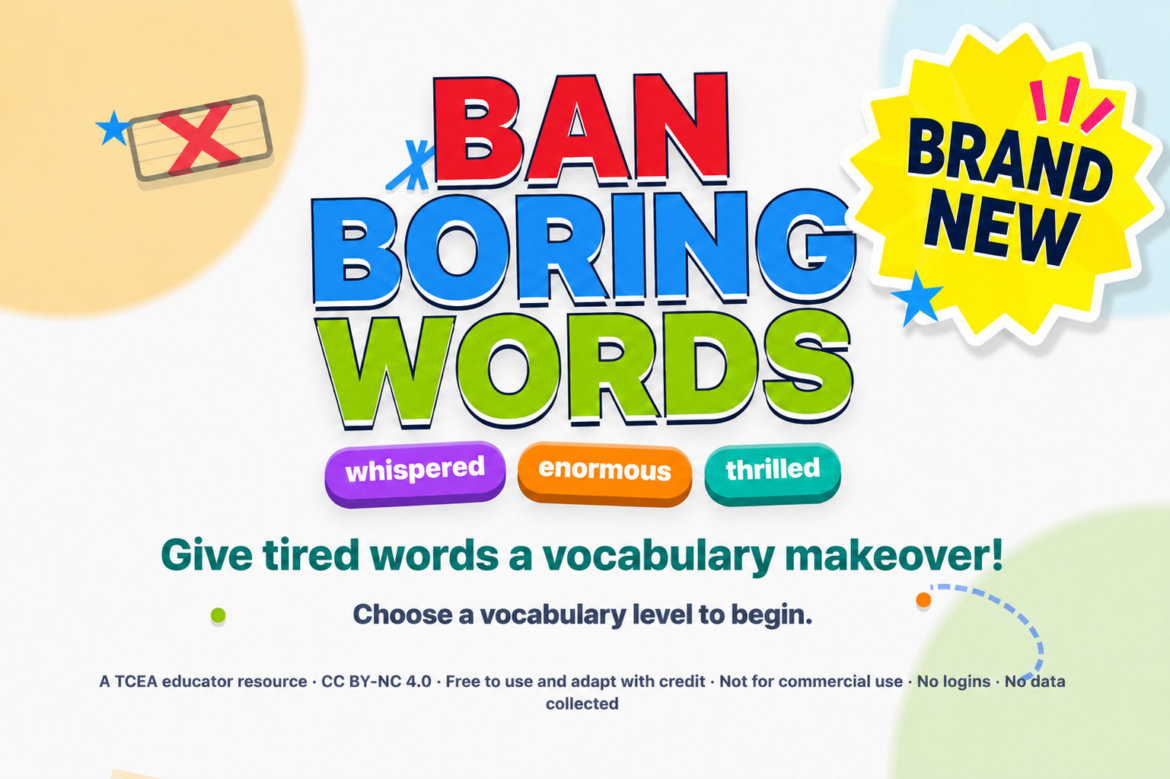
Good. Nice. Big. Said. Happy.
There is nothing wrong with these words, but sometimes they could use a little help.
Ban Boring Words Interactive
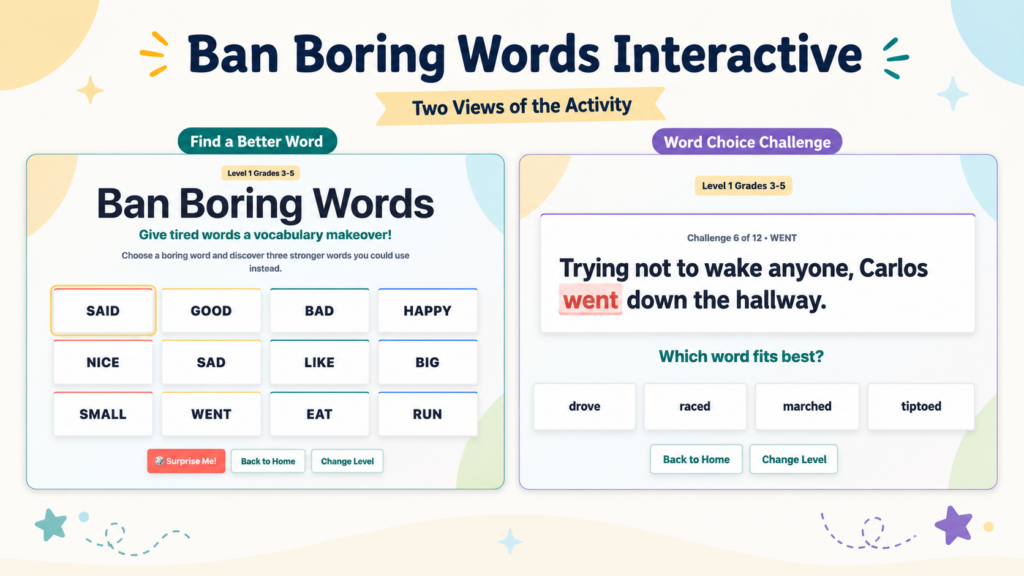
That is where Ban Boring Words Interactive comes in. I vibe-coded this tool to help students give tired words a vocabulary makeover. Students choose Level 1 for grades 3–5 or Level 2 for grades 6–8, then pick one of two activities.
With Find a Better Word, students choose an overused word and explore stronger alternatives. Feeling indecisive? Hit Surprise Me and let the interactive choose.
In the Word Choice Challenge, students read a sentence and decide which word fits best. After each choice, they see an improved version of the sentence, giving them another example of stronger word choice in action.
And a few teacher-friendly details: no student logins, no timers, no scores, no ads, and no data collection. Just pick a level and start playing.
More ELA Activities
Ban Boring Words got me thinking about some of the other English language arts activities I have created over the years. So I went digging and pulled together a few more that give students a chance to play with words, build vocabulary, and strengthen language skills.
Mystery Locker
Students examine the clues inside 20 different lockers, make inferences, and decide when there simply is not enough information to answer.
A Fruit Salad of Idioms
Students use clues to identify 15 fruit-themed idioms while practicing figurative language and context clues.
A Fruit Salad Sentence Pick Activity
Students read a fruit idiom and choose which of two sentences uses it correctly, with a little fruit-filled celebration for correct answers.
Vanishing Vowels
Students decode words with the vowels removed, giving them a quick workout in spelling, vocabulary, and word recognition.
Frayer Model + Emoji Kitchen
Students use the Frayer Model to explore a vocabulary word, then create an Emoji Kitchen mashup to represent the word visually and make the meaning stick.
Peggy’s Connections
Students sort 16 words into four related groups, using vocabulary, word relationships, and inference skills to figure out what belongs together.
Syllacrostic Puzzles
Students combine syllables to solve words using clues about meaning, word length, and syllable count, giving vocabulary and spelling skills a fun workout.
Make K-5 and Middle School ELAR TEKS Easier to Plan and Teach
Use these editable spreadsheets to make ELAR planning easier and keep grade-level standards organized. Each resource includes the ELAR TEKS along with coordinating “I Can” statements, helping teachers plan instruction, track skills, and make learning goals more student-friendly.
Link: The K-5 ELAR TEKS and Free, Editable Spreadsheets
Link: The Middle School ELAR TEKS and Free, Editable Spreadsheets
Sometimes ELA practice works best when students are too busy solving, sorting, guessing, and choosing to notice how much language work they are doing. And if a few boring words get retired along the way, even better. And as always, if you need answers or additional information, email Peggy at preimers@tcea.org